
A Return to a Full Life After Complex Surgery for Anal Cancer
In January of 2025, Jonathan Cherins, then 53 and chief executive officer of a New York software and online training company, went to see his primary care doctor with what he thought were symptoms of a hemorrhoid. Much to his surprise, his doctor told him he urgently needed to see a rectal surgeon. In February, he was diagnosed with anal squamous cell carcinoma, an aggressive type of lower gastrointestinal cancer that is rare in someone without known risk factors. He was assured it was usually treatable without the need for surgery.
Jonathan went to see an oncologist and radiation oncologist at his local health system in New Jersey, then received a second opinion from the oncology team at Mount Sinai West. The treatment plans offered were similar: six weeks of radiation and chemotherapy pills with an 80 percent cure rate. As the treatment involved daily visits at 7 am, he opted to be treated at his local hospital.
Jonathan started treatment in March 2025. Although there were some difficult side effects from the radiotherapy, he was able to keep working on a reduced schedule, and initially the tumor appeared to be responding reasonably well. However, after the first course of treatment, he continued to experience serious pain. “I just knew something was still wrong,” Jonathan says. “In July, I was given a PET scan and a CAT scan, and it was confirmed that the cancer had not responded the way they wanted.”
It was becoming increasingly likely that Jonathan would need surgery to treat the cancer, and in September, the oncology team at Jonathan’s local hospital referred him to Patricia Sylla, MD, Chief of Colon and Rectal Surgery for the Mount Sinai Health System. When surgery is necessary, the procedure involves the removal of the anus, rectum, and part of the colon; patients require a permanent colostomy bag after the procedure. Jonathan was still hoping there would be a nonsurgical option for him. The prospect of undergoing this type of extensive surgery provoked profound anxiety for him. “I had all these fears about what life would be like after that surgery, that I wouldn’t be able to run, play golf, be intimate, and have a normal life.”
Surgery needed after chemotherapy
Dr. Sylla and a multidisciplinary tumor board reviewed his case, and the consensus was reached that he could undergo a three-month trial of chemotherapy and immunotherapy back at his local hospital. “We told him there’s no harm in trying something off the standard path,” Dr. Sylla says, “but if it doesn’t work, we cannot delay surgery.”
The chemotherapy was particularly harsh this time around. “I went through this pretty rigorous chemotherapy that really crushed me,” Jonathan says. “I lost my hair, I was sick, and I was a ghost—I lost 20 pounds.”
By December 2025, tests revealed that the treatment had still not worked. Dr. Sylla would have to proceed with surgery in order to save his life.
“When he came back to us, he accepted it. Unfortunately, his disease had progressed to the point where the tumor was starting to grow back even more than it had before,” Dr. Sylla says. “We were on a timeline, and we moved very quickly to plan for the surgery.”
The next month, Jonathan and his wife met with Dr. Sylla and her colleague Marco Harmaty, MD, a plastic and reconstructive surgeon at The Mount Sinai Hospital.
“When we saw Dr. Sylla and Dr. Harmaty, my wife and I were overwhelmed by their competence,” Jonathan says. “I can’t describe enough the feeling that we were safe. Dr. Sylla was so impressive in the way she talked to us and the way she coordinated with Dr. Harmaty. It was effortless.”
The surgery was carried out on January 27, 2026, and took ten hours. The procedure to remove the areas affected by the cancer was carried out by Dr. Sylla in conjunction with one of her colleagues, Sue J. Hahn, MD, a colon and rectal surgeon at The Mount Sinai Hospital. Dr. Harmaty oversaw the last, reconstructive step of the surgery. Jonathan remained in the hospital for the next six days.
“I can’t say enough about the quality of the teams under Dr. Sylla and Dr. Harmaty, how attentive and understanding they were, not only to me but to the people who came to visit—my family, my wife,” Jonathan says. “And Dr. Sylla herself is a force of nature. She walks into a room, and you are awed by her competency. And I think Dr. Harmaty’s work is equally as important. I now have a totally different perspective on what plastic surgeons do.”
“I have no limitations on my life”
After he returned home, there was a recovery time of at least six weeks to allow the body to heal and regain energy. However, he was surprised at how quickly he was able to return to a normal life.
“As soon as I got home and started eating and sleeping, I began to get better very quickly. I was on a lot of pain meds for the first two weeks, but with physical therapy I was moving around really well, and within a month I was swimming, doing a little golf, and exercising on my own,” Jonathan says. “I went back to work at the end of March with a limited schedule, but by May I was on a full schedule, 8 am to 6 pm, and traveling every week for work.”
Jonathan hopes that by sharing his experience, he will help others in his situation make the right decision and understand that a full life can be lived after this type of surgery.
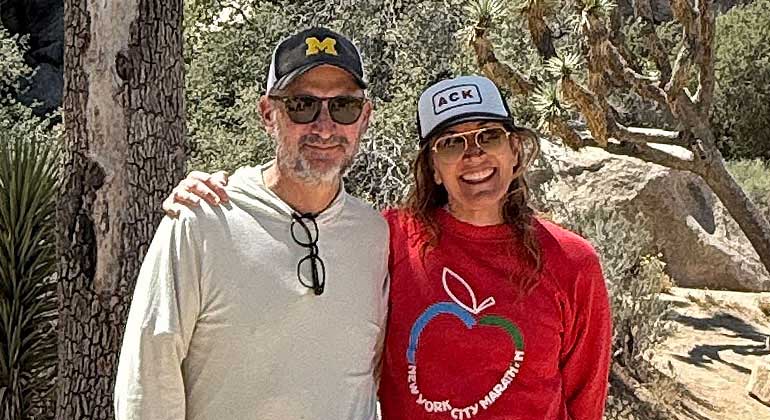
“I want to help people who are in the same place as I was when I first heard about the surgery and let them know I couldn't have been more wrong. I don't want to underplay what I'm going through—it's a lot—but it's not unmanageable. And I have no limitations on my life, I can do everything that I did before, and I'm not dead. I'm in every way alive and thriving and being a parent again, and a husband, and we're traveling, and hiking, and running. I'm just so grateful and thankful.”