
After Years of Arthritic Knee Pain, Patient Gets Relief from Genicular Artery Embolization at Mount Sinai West
Tammy Lake began to experience osteoarthritic pain in her knee in 2022. Knee osteoarthritis is a degenerative disease caused by wear and tear of the protective cartilage. Over time, the condition can lead to severe pain and limit daily activities.
An active person who enjoyed roller skating, Tammy felt pain severe enough that she fell when she tried to skate. Even walking down steps or walking a few blocks became a struggle. She was determined to find a solution, but did not want to have knee replacement surgery.
“To me, I still had a good knee, and if I could get rid of the pain, then I could keep my own knee,” Tammy says.
However, when physical therapy and pain management did not help, Tammy was running out of options. She found a possible solution after learning about genicular artery embolization (GAE) as a treatment for knee pain. GAE is a minimally invasive procedure that blocks the blood flow to inflamed areas of the knee joint. With the use of a small IV catheter, small particles are injected into the blood vessels in the knee, to decrease blood flow to the inflamed areas and to reduce pain.
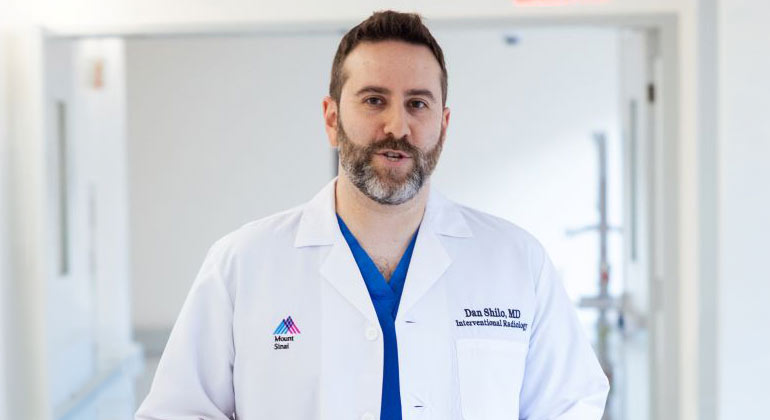
In March 2025, on the recommendation of a good friend, she went to see Dan Shilo, MD, Director of the Division of Vascular and Interventional Radiology at Mount Sinai West.
“When Tammy came to see us in March, she told us she had 10 out of 10 knee pain whenever she was walking, even worse when going up and down stairs,” says Dr. Shilo. After sending her for an X-ray and magnetic resonance imaging, Dr. Shilo felt that she was a good candidate for genicular artery embolization.
“The mainstays of therapy for osteoarthritis are physical therapy, anti-inflammatory medications and, if applicable, weight loss. And if you have severe disease, you will be referred to an orthopedic surgeon for a knee replacement. But there are a lot of people in the middle who aren’t responding well to pain management or don’t want major surgery,” Dr. Shilo says. “With genicular artery embolization, there are no major incisions, and nearly all patients go home the same day after a one- to two-hour recovery. There’s essentially no recovery time—patients walk out of the hospital after their procedure.”
Tammy’s procedure, in April 2025, took about an hour. She was able to walk out of the hospital the same day and was no longer experiencing knee pain.
“After I came out of the surgery, I felt really good,” Tammy says. “Dr. Shilo literally saved the day, because from the day I had the surgery my pain went from a 10 all the way down to a two. After that day, it was a beautiful life again.”