
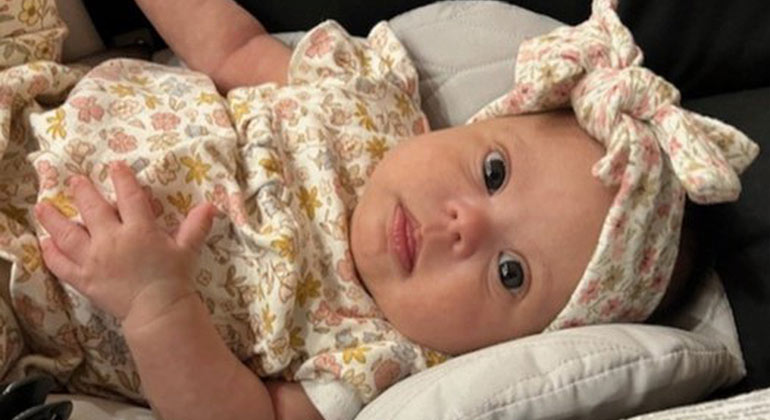
Newborn is Smiling and Thriving After Urgent, Minimally Invasive Surgery
When newborn Aylee needed urgent surgical treatment, the pediatric surgery team at Mount Sinai Kravis Children’s Hospital was able to offer both the expertise and minimally invasive techniques that can make all the difference for the tiniest patients.
Aylee has a congenital heart condition, so her parents knew she would eventually need heart surgery, but they didn’t anticipate that another condition would require attention first. Soon after her arrival, Aylee was diagnosed with a duodenal web—a rare obstruction in the duodenum, located in the intestine, that partly or completely blocks the passage of food. This condition affects only 1 in 5,000-10,000 live births.
Bethany Slater, MD, MBA, Division Chief of Pediatric Surgery and Professor of Pediatric Surgery, Icahn School of Medicine at Mount Sinai, met with Aylee’s parents to explain the diagnosis and walk them through the surgical plan. She shared that the repair could be performed laparoscopically, with surgeons operating through tiny 3-4 mm incisions. This advanced approach reduces pain, supports earlier feeding, minimizes complications, and leaves only small scars—all important considerations for newborns. This minimally invasive option brought immense relief to Aylee’s family.
The operation went smoothly. Within 48 hours, Aylee reached a major milestone: she began feeding. She quickly advanced to full feeds, tolerating them well and signaling a strong recovery.
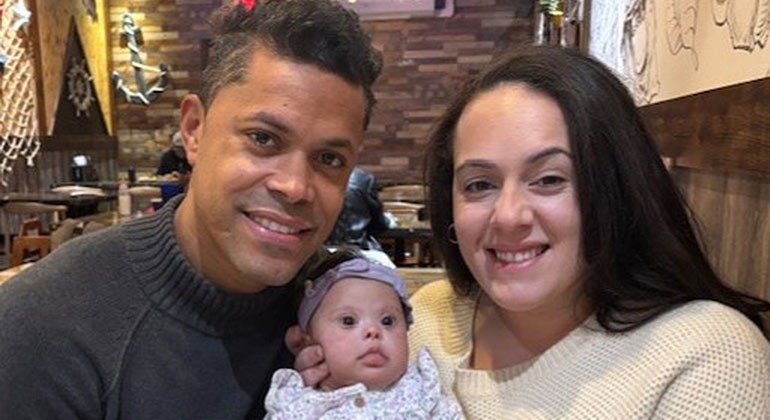
Throughout their stay, the team not only supported Aylee, but her entire family. The Child Life and Creative Arts Therapy team played an important role in easing the emotional strain of hospitalization. “Even though I wasn’t the patient, Child Life Specialist Sofia came to Aylee’s room almost daily to say hi with Summer, the facility dog,” Diana, Aylee’s mother, says. “She always asked how I was doing and if I needed anything. Those conversations helped me feel seen during such an emotional time.”
Aylee soon became a favorite in the Pediatric Cardiac Intensive Care Unit, winning over nurses with her calm and sweet demeanor.
In winter 2025, at three months old, Aylee was thriving—eating well, gaining weight, and smiling often.
Reflecting on their experience, Diana says: “The doctors and surgeons are some of the best. You can feel at ease knowing your child is in good hands.”