

“Girl With a Pearl Earring” Beats Epilepsy With Targeted Brain Procedure
For four years after her epilepsy diagnosis, Lucy Foote was given one medication after another. Nothing helped. “My seizures were getting worse, and so was my mental health,” Lucy says. She had delusions, obsessive-compulsive thoughts, and extreme anxiety as a result of both the seizures and the anti-seizure medications. It felt as if none of her doctors were listening to her.
In April 2025, then-28-year-old Lucy made an appointment with Lara V. Marcuse, MD, a neurologist and co-director of the Mount Sinai Epilepsy Center. “I could tell right away that Dr. Marcuse wanted to help me. I finally found a doctor who was on my side and allowed me to be heard. It was a turning point in my epilepsy journey to find a doctor I could trust.”
By April 2026, after getting a more precise diagnosis and a successful brain surgery, Lucy was celebrating a year of being seizure free.
Medicine Wasn’t Enough
Dr. Marcuse realized that Lucy had small seizures nearly every day. She tried some of the most advanced medicines. Then she determined that Lucy had refractory epilepsy. That means it can’t be controlled by medicine. “About 30 percent of people with epilepsy are drug resistant,” Dr. Marcuse says.
Lucy needed surgery to deactivate the spot where the seizures began. Fortunately, her seizures started in an area of the brain that is highly treatable. Dr. Marcuse sent Lucy to Fedor E. Panov, MD, a neurosurgeon specializing in epilepsy and movement disorders. He is the Director of the Adult Epilepsy Surgery Program at the Mount Sinai Health System and is an Associate Professor of Neurosurgery at the Icahn School of Medicine at Mount Sinai.
Surgery is most effective when it targets the exact point where the seizures begin. To identify that spot, Dr. Panov performed a diagnostic procedure called a stereotactic electroencephalogram (sEEG). He made nine tiny incisions into Lucy’s head. Then he threaded fine electrical leads, the width of graphite in a pencil, through the incisions and into the surface of Lucy’s brain areas that were possible culprits in her epilepsy. Each lead had 12-16 small sensors. Each sensor was attached to equipment that recorded the brain’s activity. Then they wrapped Lucy’s head in a precise headdress to secure the wires.
Lucy needed to remain in the Epilepsy Monitoring Unit until she had a major seizure that the team could study. “I drank triple shots of espresso for breakfast, avoided hydration—anything I could think of to trigger a tonic clonic seizure,” she says. It took five days. “They let my mom stay in the empty bed next to mine, it was the greatest gift of that hard time,” Lucy says. “She gave me the power to make it through the week, and cared for me just like all of the amazing nurses in the Epilepsy Monitoring Unit.”
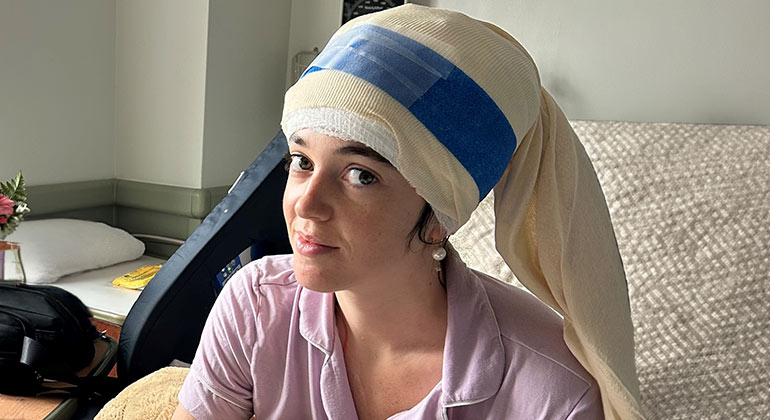
“When my mother saw me in that headdress, she says, ‘I have to go home to get a pearl earring, because you look just like the Vermeer painting “Girl with a Pearl Earring,” Lucy says. Her mom, Dana, took a photo of her with the earring and headdress and posted it online. “This was the most challenging thing I’ve ever done to my body. But in moments of challenge, you have to find a sense of humor,” Lucy says.
Surgical Choices
The sEEG found that Lucy’s seizures started in an area near her right ear called the right temporal lobe. Magnetic resonance imaging also showed an enlarged area of the brain on that side just in front of the hippocampus, called the amygdala. These parts of the brain help memory, decision making, and emotions. The fact that her seizures were starting so close to the part of the brain that deals with emotions may have contributed to Lucy’s anxiety, Dr. Marcuse says. Lucy had two surgical choices: the traditional “open” surgery or a laser procedure. After long conversations with Dr. Panov, Lucy opted for an ablation of the hippocampo-amygdalar area. This minimally invasive approach uses the energy from a small laser fiber to deactivate the origin point of the seizures.
A month after the sEEG, Dr. Panov performed the ablation—a procedure that precisely targets and deactivates problematic tissues—with live neuronavigation and temperature guidance. “We threaded a little laser probe to the spot in Lucy’s brain pinpointed by the sEEG.” The key is to maintain the correct temperature for the right amount of time. “This is a highly effective, safe way to carefully ablate just enough of the tissue that causes the seizures without affecting any area of the brain that is critical to Lucy's function,” Dr. Panov says. “It lets you be accurate and precise.”
The surgery was a success, and Lucy hasn’t had a seizure since. “It was absolutely life changing for me to have these doctors that I fully felt I could trust,” Lucy says. “With trust, and an incredible support unit, I stopped resisting my epilepsy diagnosis and began to ride the wave of surrender to accept my condition.”
Looking to the Future
Lucy has an excellent prognosis. “We're lowering her medication just a tiny bit,” Dr. Marcuse says. “But I'm going to go slow, because it doesn't matter so much to me if she's on medicine. I just want her to have a wonderful, full, seizure-free life.”
The surgery and medication are only part of Lucy’s success. “Even before we did the laser ablation, Lucy began to develop resilience and a deeper level of intuition and insight into herself,” says Dr. Marcuse. “She was looking at different ways to take care of her body and was really growing as a person.” Lucy maintains her seizure-free existence with daily meditation, yoga, and journaling. She is also much more careful about what she puts into her body. She watches her diet and has stopped drinking coffee and alcohol. “I am building a lifestyle that fully supports my brain,” Lucy says. She is launching Brainwave Retreats to bring awareness of somatic healing she has found in her yoga and mindfulness practices.
“My hope for anyone with epilepsy is that they find doctors they can trust,” she says. “And when they tell you that you may have to do something really hard, you must trust that they see the strength in you that you cannot yet see in yourself. And learn to trust them too.”