
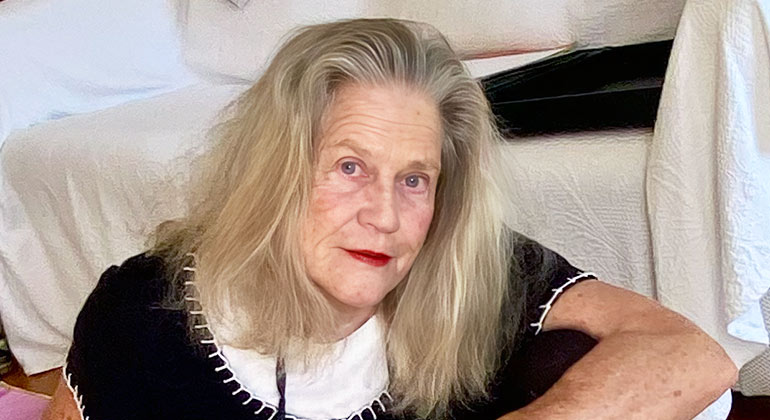
New York Artist Celebrates 80th Birthday, Five-Years Cancer Free
Star Black, a New York-based poet and photographer, turned 80 on September 11. Born in 1946, she has authored seven collections of poetry and taught in the MFA program at Stony Brook Southampton and at The New School. In 1997, The East Hampton Star said Ms. Black was “one of the few contemporary artists with parallel visual and verbal avocations.”
Ms. Black has lived a long and creative life. And thanks to a timely CT scan, she began a successful health journey with leading lung specialists at Mount Sinai. She reached a crucial milestone in fall 2026—five years free of lung cancer.
Ms. Black was a smoker for 50 years, and it was her primary care doctor, Lolita Chatterjee, MD, who first suggested she may be eligible for a low-dose CT scan. Ms. Black wanted the more familiar chest X-ray she had gotten in the past. But Dr. Chatterjee insisted, explaining that the CT scan was more effective.
“She called me up and told me the scan revealed I had lesions in my lung with dark areas that could be cancer,” Ms. Black says. “Dr. Chatterjee told me, ‘They’re not that large, but the cancer is there,’ and sent me for a biopsy.”
Low-dose CT scan for early detection
Ms. Black wound up getting a biopsy on Christmas Eve 2021 with David Yankelevitz, MD, Professor of Radiology at the Icahn School of Medicine and Co-Principal Investigator of the International Early Lung Cancer Action Program (I-ELCAP), a world-renowned champion of early lung cancer detection.
“Thank God, I got him,” she says.
Dr. Yankelevitz, has been a pivotal figure in making low-dose CT scans globally accessible and standard for lung cancer screening, along with his longtime collaborator Claudia Henschke, PhD, MD, Co-Principal Investigator of I-ELCAP.
“The critical point about finding screen-detected cancers is that they are highly curable,” Dr. Yankelevitz says. “Overall, about 81 percent, and up to 95 percent. This is dramatically different than outside the screening context, where it is only around 20 percent that can be cured.”
In the United States, low-dose CT scans have been covered under Medicare only since 2015. That year, the government-backed health insurance program started covering annual scans for high-risk beneficiaries aged 55 to 77 with a 30 pack-year smoking history.
A pack year is a standard clinical unit used to measure a person's total lifetime exposure to cigarette smoke. Doctors determine pack-years by multiplying the number of cigarette packs smoked per day by the total number of years the person has smoked. Ms. Black was eligible for screening due to her age and smoking history. Further screening found two nodules on her right lung. “Mount Sinai gave me ready access to the doctors, information and appointments,” she says. “They got me appointments very quickly and were always available.”
Lung-sparing surgery
Dr. Yankelevitz referred Ms. Black to Raja Flores, MD, Chair of Thoracic Surgery at Mount Sinai Health System. “I was so nervous, and then I remember Dr. Flores coming into the room to tell me: ‘You’re going to live to be 100!’” Ms. Black says. “It was the first time I received any news that things were going to be okay.”
They discussed the different treatment options, such as targeted chemotherapy versus surgery. “We decided on a Thursday to do the operation, and I went in for surgery to remove the cancer the very next Tuesday,” she says.
“We were able to remove two separate lung cancers, one from the upper lobe and one from the lower lobe, using minimally invasive surgery five years ago,” Dr. Flores says. “But what made this case particularly meaningful was the research we conducted here at Mount Sinai, which helped us understand that we could safely perform lung-sparing surgery and not remove the entire lung.”
“The goal of lung cancer surgery is not simply to remove the cancer. It is to strike the delicate balance between removing enough lung tissue to achieve a cure while preserving as much healthy lung as possible so patients can continue to live full, active lives,” Dr. Flores says. “Knowing how to achieve that balance is something that only experience can teach you.”
Life after cancer
Five years later, Star Black is still here, she’s still performing her poetry, still exhibiting her visual art. She splits her time between Murray Hill in New York City and Sag Harbor on Long Island. She still sees Dr. Flores every six months and soon will only need to see him once a year.
Before her surgery, she had several conversations with Dr. Flores about smoking. She admitted to him that she felt guilty and embarrassed for not being able to quit. She still remembers that her cravings were so strong that even when after she learned she had lung cancer, she still couldn’t stop. After frantically trying to cut down, Black had her last cigarette the day before her surgery.
Dr. Flores told her that she should not be too hard on herself. He reminded her that tobacco companies spend billions of dollars each year on marketing and promotional expenses to target smokers. For example, the top U.S. cigarette manufacturers spent $8 billion on advertising and promotion in 2022 (close to $22 million per day), according to the American Lung Association.
“I often hear this from my patients who have a long history of smoking. They talk about this guilt,” Dr. Flores says. “I tell them that they’re not alone. We can provide patients with access to all kinds of cessation programs, but the truth is that quitting smoking is very hard.”
Dr. Flores encourages all eligible adults with a smoking history to talk to their doctor about the benefits of a low-dose CT scan.