
A Birthday Celebration in New York City Ends With Life-Saving Heart Treatment
In September 2025, Jim Small, a 71-year-old father of three and grandfather of seven was in New York to celebrate his daughter’s 40th birthday. That night, after dinner, he collapsed on the sidewalk on Park Avenue. “It was sort of a slow decline,” Jim says. “Think of the Wicked Witch of the West getting melted. It was a little scary.”
His son-in-law, who completed medical school at the Icahn School of Medicine at Mount Sinai, recommended that they go to the emergency room at The Mount Sinai Hospital. Doctors ran tests and determined that Jim’s heart rate was dangerously slow. An EKG revealed complete heart block, where there is a breakdown in the electrical system of the heart causing it to stop beating. The condition is very serious and potentially fatal.
Jim was immediately transferred into the care of Joshua Lampert, MD, cardiac electrophysiologist, Assistant Professor of Medicine, and Artificial Intelligence and Human Health, Medical Director of Machine Learning for Mount Sinai Fuster Heart Hospital, and Director of Cardiovascular Artificial Intelligence for the Windreich Department of Artificial Intelligence and Human Health.
“The top chambers of Jim’s heart were electrically beating, but that wasn’t being communicated to tell the bottom chambers of his heart to beat,” Dr. Lampert explains. “Without that signal, the heart’s pumping action can stop altogether.”
A pacemaker, as soon as possible
Dr. Lampert recommended that Jim undergo a pacemaker implantation as soon as possible. “The pacemaker’s job is to assess whether or not the heart is beating on its own, and if it’s not, to pace the heart to make it beat,” he explains. “It compensates for the electrical problem and ensures the heart continues to beat.”
When Dr. Lampert explained that Jim would need a pacemaker, it came as a surprise, but it was also a relief. “At least we knew what was going on,” Jim says. “He walked me through every step with calm clarity, and his bedside manner was fantastic.”
Jim received a newer, less invasive type of device: a fully leadless pacemaker. Unlike traditional systems, which require wires and a battery pack to be implanted under the skin, this technology uses two small devices placed directly in the heart. “One sits in the top chamber and one in the bottom chamber, and they wirelessly communicate,” Dr. Lampert explains.
The procedure to insert this type of pacemaker is minimally invasive: a vein in the groin is accessed, and the device is then brought up into the heart. Jim underwent the procedure and was discharged the next day.
The recovery time for this procedure is typically fast. “Patients are advised to avoid strenuous activity for two to four weeks after the procedure, primarily to allow the access site to heal, but otherwise they can go back to their lives,” Dr. Lampert says.
Jim is in admiration of the level of care and expertise he found at Mount Sinai. “I was so fortunate to walk off the street and into the ER at Mount Sinai,” Jim says. “I have nothing but nice things to say about all the people in that emergency room. I had lots of incredible caregivers watching out for me and letting me know what was coming next.”
Going back to his life
He emphasizes the high level of expertise shown by Dr. Lampert and his team. “I was struck by Dr. Lampert’s expertise and equanimity. I appreciate all the work needed to train and prepare for when somebody like me shows up. I’m reminded of my father’s career as chief of surgery at a hospital in Massachusetts. Like he did, Dr. Lampert and everyone at Mount Sinai are performing miracles every day. They should all be so proud.”
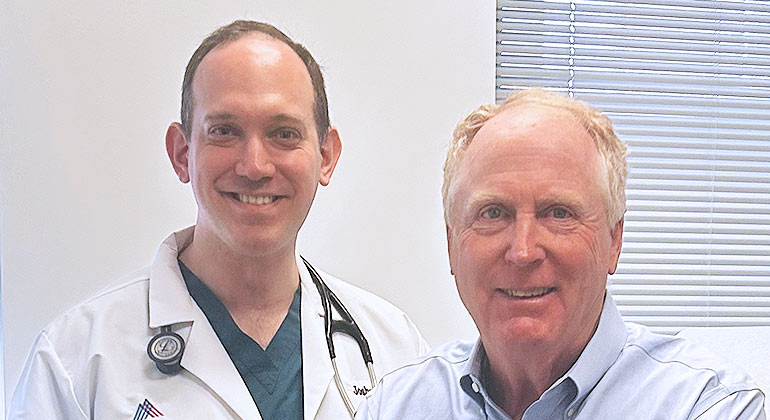
Jim recently returned to see Dr. Lampert for a checkup. “He’s doing great—his is a reassuring example where seeking help caught a treatable, life-threatening condition, allowing this kind gentleman to return to his wife, daughters, and his grandchildren,” Dr. Lampert says. “It is heart-warming to see him doing so well when he visits me in the office.”
Dr. Lampert stresses the importance of visiting a doctor if you experience unexplained fainting or have frequent fluttering or palpitations in your chest, which can also be associated with atrial fibrillation, another abnormality in the heart rhythm that often warrants treatment. “I don’t want people to avoid seeking care because they are afraid of what might happen. It’s better to ask for help from experts,” Dr. Lampert says. “While not an issue in Jim’s case, it is also important not to rely on commercial artificial intelligence models to self-diagnose or triage potentially dangerous symptoms.”
Looking back, Jim says there were signs. “I had decided to ignore a couple of dizzy spells that I had in the prior couple of days, which is typical of me” he admits. “But it’s always better to just find out what’s going on, especially as you get older.”