
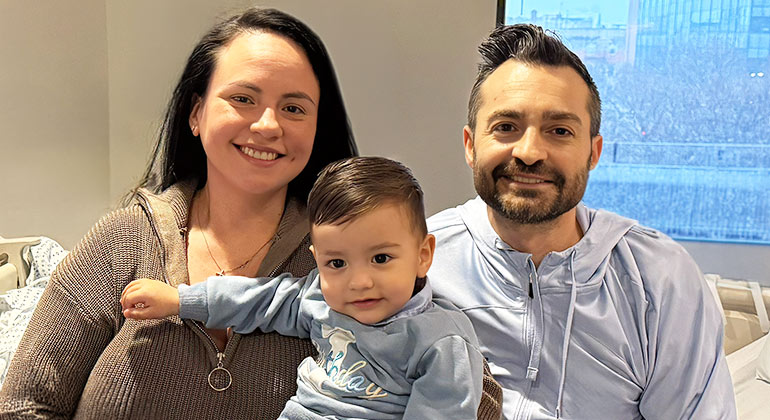
Heart Transplant Saves the Life of 41-Year-Old New Jersey Firefighter
Nico Ratto was a healthy 41-year-old New Jersey firefighter, a runner who loved soccer and playing with his infant son. In January 2026, he was battling a fire and was struck with stomach pain so severe he almost fainted. He finished out his shift, then headed straight to the emergency room.
At the ER, Nico learned that his stomach was fine. The problem was his heart. He had heart failure and a seriously irregular heartbeat, a life-threatening combination. The ER staff got him stabilized, then sent him to The Mount Sinai Hospital for more specialized care. About two months later, a heart transplant saved Nico’s life.
At The Mount Sinai Hospital, Nico came under the care of heart transplant and heart failure cardiologist Maya Barghash, MD. She confirmed that Nico had a dangerously irregular heartbeat, called ventricular tachycardia (or VT), and heart failure. Heart failure means that his heart wasn’t pumping enough blood and oxygen to the rest of his body. Having both conditions meant Nico needed immediate care.
“We treated Nico to stabilize his heart while we waited for blood test results, which included genetic testing, to find out what was causing his heart failure,” Dr. Barghash says. “We also did an imaging test called an MRI, which showed scarring in his heart.” Treatment included medication and implanting a defibrillator in Nico’s chest to help treat the VT if necessary.
On the heart transplant list
Nico’s family is very close. He and his wife were expecting their second child, and they didn’t let his hospitalization get in the way of celebrating. They held the gender-reveal party (hint: think pink) in the intensive care unit, with family in attendance. Dr. Barghash stabilized Nico’s condition, and on January 16, he went home.
Nico was very tired, short of breath, and had some yellowing around his eyes. In addition, he had a few experiences of heart racing, which meant the defibrillator delivered electrical shocks to control the heartbeat. “Every time that happened, it felt like a horse kicked me in the chest,” Nico says. It was especially disconcerting in the middle of the night when he was sound asleep. Once that started happening, Dr. Barghash put Nico on the heart transplant waiting list. This list is national and ranks people by how severe their illness is. Then it’s a matter of waiting for an appropriate match to become available.
Family support in the hospital
By February 8, Nico’ s heart, liver, kidneys, and lungs were struggling enough that he was back in the ICU at Mount Sinai. They put him on additional medications to stabilize his heart. But they also needed to increase his blood circulation, to help his liver and lungs. To do this, they attached Nico to two pumps, one on each side of his heart, to circulate blood from the heart to the body. Thanks to the increased blood flow, Nico’s organ began functioning normally. But being attached to these two pumps meant he had to stay in the hospital until the transplant.
Nico ended up spending 45 days in the hospital, but he had plenty of support from family and friends. “I didn’t spend a single night by myself. There was always someone with me: my mom, my wife, my uncle, my aunt, my sisters, and my brothers.” Nico and Maria made themselves at home in the hospital room. They brought in a mini fridge, a TV, and an air mattress for Maria. They even celebrated his son’s first birthday in the ICU. “They let us decorate the room, we had cake, we sang him happy birthday,” Nico says.
Nico was still worried. “When I heard the phrase ‘heart transplant,’ I thought it was a death sentence. I was scared they would put me under for the procedure and I would never wake up,” Nico remembered. He talked to his surgeon, Anelechi Anyanwu, MD, Vice Chair of the Department of Cardiovascular Surgery and a specialist in heart transplantation. “He told me he had a 98 percent success rate, which made me feel much better,” he says.
A heart became available on March 17. It was a mixed blessing for Nico. “I wanted a heart, but I knew that meant a tragedy had to happen to someone else.”
Dr. Anyanwu performed the procedure, and Nico did very well. “It usually takes 12 hours, but they completed the transplant in six hours because everything went so smoothly,” Nico recalls. He went home a week after the surgery.
Recovering, and grateful
Nico was found to have giant cell myocarditis, a rare condition that tends to affect younger adults like Nico, Dr. Barghash says. In this condition, the heart muscle becomes inflamed by the body’s immune system. It also tends to progress very quickly, as it did with Nico.
Nico’s doctors are keeping a close eye on him to make sure his body doesn’t reject the new heart. At first, Nico saw Dr. Barghash every week or two. By fall 2026, he had progressed to having blood work every two to four weeks and coming into The Mount Sinai Hospital once a month to see Dr. Barghash and the heart transplant team.
Nico also began physical therapy and was back to taking long walks. “I hope to start running again soon,” he says. “But the best part is that now I can roughhouse with my little boy. I am truly grateful to my doctors, nurses—everyone at Mount Sinai.”
Nico is now father of a beautiful baby girl and has returned to the Hoboken Fire Department, easing his way back into work.