
Scientists Identify Dysregulation of RNA Editing as Contributor to Altered Fetal Brain Development in Down Syndrome
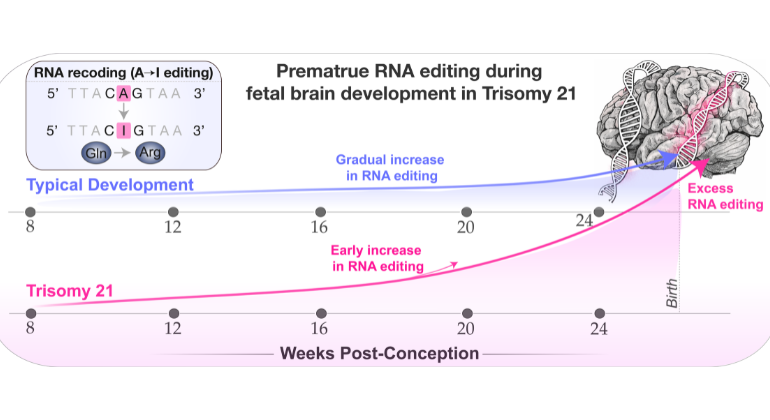
RNA editing increases gradually during fetal brain development. In Down syndrome (Trisomy 21), this process happens earlier and more intensely, leading to high levels of RNA editing before birth. Credit: Michael Breen, PhD
A collaborative research study co-led by scientists at the Icahn School of Medicine at Mount Sinai and the Liber Institute for Brain Development has for the first time identified a biological process that may help explain how the brain develops differently in people with Down syndrome. The study was a collaboration among scientists from the Icahn School of Medicine at Mount Sinai, the Lieber Institute for Brain Development, the Medical University of Sofia in Bulgaria, and the University of Arizona.
The findings, published March 31 in Nature Communications [https://doi.org/10.1038/s41467-026-70217-5], revolve around a gene that produces an enzyme called ADARB1 (also known as ADAR2), a molecule that helps edit genetic messages inside cells. Too much of this enzyme causes RNA messages to be altered too early and too extensively in developing brain cells of individuals with Down syndrome, thereby affecting how brain cells communicate and how brain circuits form.
Down syndrome, also known as trisomy 21, occurs when an individual has an extra copy of chromosome 21, where the ADARB1 gene is located. While the extra chromosome has long been known to influence development, how it changes early brain formation has remained unclear.
“These findings help us understand how an extra copy of chromosome 21 reshapes the brain from the earliest stages of development,” said author Michael S. Breen, PhD, Associate Professor of Genetics and Genomic Sciences, and Psychiatry, at Mount Sinai. “This is exciting because we are starting to uncover how this genetic imbalance leads to changes in the brain, linking the extra chromosome to increased levels of a key RNA editing enzyme, and subsequent accelerated RNA editing in important neuronal genes. RNA editing is a natural process that is highly active in early development and fine-tunes how proteins function in neurons. We found that RNA editing occurs earlier and more extensively in trisomy 21 and this early shift may influence how brain circuits are formed from the very beginning.”
Studying the Developing Brain
The research team analyzed brain tissue collected between 13 and 22 weeks after conception, an important time for early brain development. These samples, obtained through collaboration with colleagues at the Lieber Institute for Brain Development and the Medical University of Sofia in Bulgaria, included tissues from 20 individuals with trisomy 21 and 27 individuals without the condition. The study focused on two brain regions important for learning and memory: the prefrontal cortex and the hippocampus.
Using advanced RNA sequencing, the team examined gene activity and RNA editing across the entire set of RNA messages in each brain sample. They found widespread disruption of gene expression during mid-gestation in trisomy 21. One of the most consistently over-expressed genes was ADARB1. The resulting increased levels of the ADARB1 enzyme were associated with higher levels of RNA editing throughout the brain.
The team also observed excessive editing in GRIA2, GRIA3, GRIK2, and GABRA3, key glutamate and GABA-receptor genes that help regulate how neurons send and receive signals. This editing leads to RNA recoding, a process in which a single nucleotide change alters the amino acid sequence of the resulting protein, directly modifying its function. These premature molecular changes are predicted to alter the balance between excitatory and inhibitory signaling at a time when neural circuits are actively being established.
Confirming the Findings
To strengthen their findings, the researchers performed a combined analysis of nine independent human trisomy 21 datasets. The combined analysis showed the same pattern: higher ADARB1 enzyme levels and increased RNA editing linked to an extra copy of chromosome 21 across multiple independent human datasets.
A New Way to Understand Brain Development in Down Syndrome
The study identifies ADARB1-driven RNA editing dysregulation as a fundamental molecular consequence of chromosome 21 triplication in Down syndrome.
Their finding that excess ADARB1 enzyme drives premature and excessive RNA recoding during critical windows of fetal brain development directly links gene dosage imbalance to altered neuronal signaling.
“These findings redefine Down syndrome neuropathology to include disrupted post-transcription regulation and establish RNA editing as a measurable biomarker of early brain circuit development and a promising avenue for therapeutic intervention,” said author Joseph D. Buxbaum, PhD, Professor of Psychiatry, Neuroscience, and Genetics and Genomic Sciences, at Mount Sinai. “This study was only possible because of a truly collaborative effort across multiple institutions all focused on understanding how an extra copy of chromosome 21 affects the developing brain.”
Researchers say the findings open the door to new ways of measuring early brain development and may eventually help guide precision treatments aimed at improving neurological and behavioral outcomes in Down syndrome.
About the Lieber Institute for Brain Development
The mission of the Lieber Institute for Brain Development and the Maltz Research Laboratories is to translate the understanding of basic genetic and molecular mechanisms of schizophrenia and related developmental brain disorders into clinical advances that change the lives of affected individuals. LIBD is an independent, not-for-profit 501(c)(3) organization and a Maryland tax-exempt medical research institute affiliated with the Johns Hopkins University School of Medicine. The Lieber Institute’s brain repository of nearly 5,000 human brains is the largest collection of postmortem brains for the study of neuropsychiatric disorders worldwide.
About the Mount Sinai Health System
Mount Sinai Health System is one of the nation’s leading integrated academic health systems and one of the largest in the New York metropolitan area. Its comprehensive system includes seven hospitals, more than 400 outpatient practices, over 600 research and clinical laboratories, the Icahn School of Medicine at Mount Sinai, the Graduate School of Biomedical Sciences, and the Mount Sinai Phillips School of Nursing. Together, the Health System comprises approximately 48,000 employees, more than 9,000 physicians, and 8,600 nurses.
As a leading learning health system, Mount Sinai combines clinical expertise with scientific discovery to improve patient care while training the next generation of health care and biomedical leaders. The Health System provides care across every stage of life, from prenatal care through geriatrics, while advancing personalized medicine through artificial intelligence, data science, and biomedical research.
Mount Sinai is consistently recognized among the nation’s leading academic health systems for patient care, research, and education. The Mount Sinai Hospital is ranked No. 1 in New York by Newsweek® and No. 7 in the U.S. on the magazine’s World’s Best Hospitals 2026 list. The Icahn School of Medicine at Mount Sinai ranks No. 9 among U.S. medical schools and No. 1 among freestanding medical schools for National Institutes of Health grant funding, reflecting the strength of its scientific enterprise and leadership in biomedical research.


New Research Reveals Autism Risk Genes Are Shared Across Ancestries
Mar 30, 2026 View All Press Releases