
Women's Health Reimagined
Women's health is often associated with pregnancy and reproductive care—but that’s only part of the story.
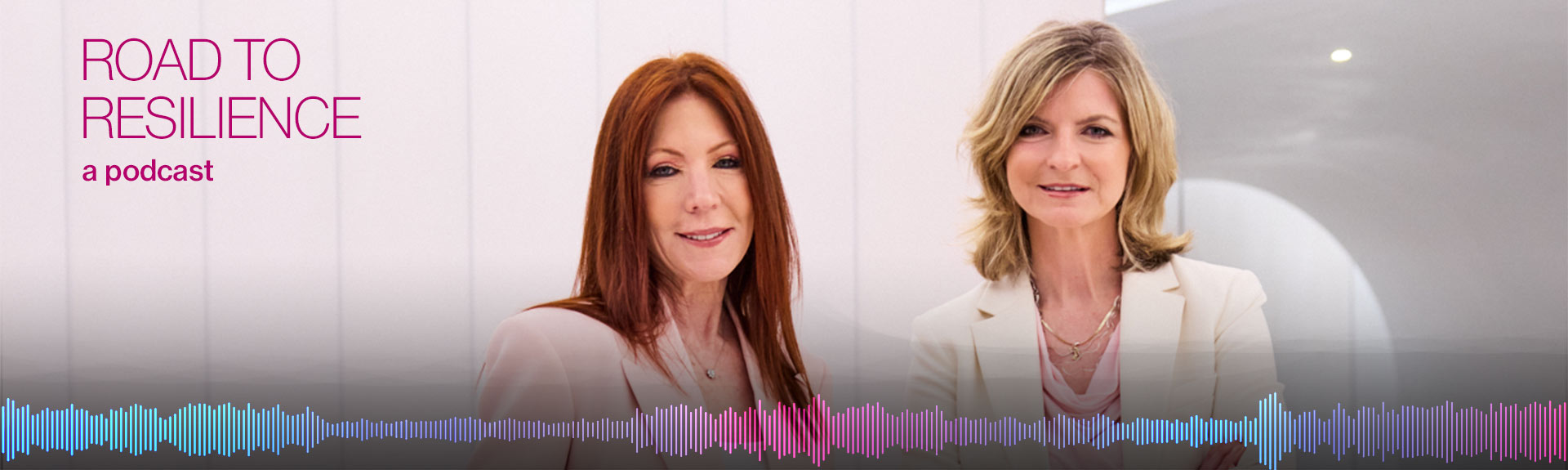
In this episode of Road to Resilience, host Stephen Calabria sits down with two leaders at the forefront of a new era in women's healthcare: Dr. Joanne Stone, Chair of Obstetrics, Gynecology and Reproductive Science at Mount Sinai, and Dr. Anna Barbieri, gynecologist, menopause specialist, and clinical strategy leader for the Carolyn Rowan Center for Women’s Health and Wellness.
Together, they explore how women’s health is expanding beyond traditional boundaries to encompass cardiovascular health, mental health, aging, cancer prevention, hormonal health, and overall well-being across the lifespan. They discuss the longstanding disparities that have shaped research, diagnosis, and treatment for women, and how those gaps continue to affect patient care today.
Stephen Calabria: From the Mount Sinai Health System in New York City, this is Road to Resilience, a podcast about facing adversity. I'm your host, Stephen Calabria, Mount Sinai's director of podcasting.
Today we're taking a closer look at the state and future of women's health. For generations, women's health has been viewed through a narrow lens.
But today, physicians and researchers are reimagining what comprehensive care can look like across every stage of a woman's life, from adolescence and reproductive health to menopause, aging, and long-term wellness.
Joining us are Dr. Joanne Stone, the chair of Obstetrics, Gynecology, and Reproductive Science at Mount Sinai, and Dr. Anna Barbieri Gynecologist, menopause specialist, and clinical strategy leader for the Carolyn Rowan Center for Women's Health and Wellness at Mount Sinai.
Together, they're helping build a new model of coordinated, whole person care designed around the unique needs of women.
Doctors Stone and Barbieri, welcome to Road to Resilience.
Joanne Stone: Thank you for [00:01:00] having us.
Stephen Calabria: So when people hear the phrase women's health, they often think mostly about pregnancy and reproductive care. From your perspective, we'll start with Dr. Barbieri, what does women's health actually encompass in 2026?
Anna Barbieri: Oh, Stephen, you hit on one of my favorite topics to talk about. For many years, decades really, women's health has focused on reproductive issues, and those are very important. How to get pregnant, how to not get pregnant, care of pregnancy, care of postpartum, fertility care, that kind of came about maybe a few decades ago.
But we really here trying to expand the lens on women's health to include other things. Mental health is women's health. Cardiology and your cardiovascular health is women's health.
Aging is women health. Cancer prevention is women's health. And the issue is that women's health, even though obviously it's human health and crosses over, there are some specific areas [00:02:00] that pertain to women, and female physiology may look different.
So we're here to really expand that lens, connect the dots and offer care that is female physiology-specific.
Joanne Stone: And I think that's a great answer, and I would add to that, we know that there's certain conditions that occur more commonly in women. So, autoimmune diseases, for example. Alzheimer's disease is more common.
So there's certain diseases that are more common that we really need to focus on and pay attention to because a lot of these diseases that affect women disproportionately have been ignored or under prioritized in terms of how we manage them as well as the research that's being conducted.
Anna Barbieri: Yeah, I think that's a great point. So there are conditions that occur only in women, let's say endometriosis. There's conditions like ISSA, Dr. Stone, that may occur at higher rates in women, like autoimmune conditions.
Then there are conditions that present differently in women and behave differently in women, including cardiovascular [00:03:00] disease. Really important.
Full Episode Transcript
[00:00:00]
Introduction to Women's Health
Stephen Calabria: From the Mount Sinai Health System in New York City, this is Road to Resilience, a podcast about facing adversity. I'm your host, Stephen Calabria, Mount Sinai's director of podcasting.
Today we're taking a closer look at the state and future of women's health. For generations, women's health has been viewed through a narrow lens.
But today, physicians and researchers are reimagining what comprehensive care can look like across every stage of a woman's life, from adolescence and reproductive health to menopause, aging, and long-term wellness.
Joining us are Dr. Joanne Stone, the chair of Obstetrics, Gynecology, and Reproductive Science at Mount Sinai, and Dr. Anna Barbieri Gynecologist, menopause specialist, and clinical strategy leader for the Carolyn Rowan Center for Women's Health and Wellness at Mount Sinai.
Together, they're helping build a new model of coordinated, whole person care designed around the unique needs of women.
Doctors Stone and Barbieri, welcome to Road to Resilience.
Joanne Stone: Thank you for [00:01:00] having us.
Redefining Women's Health
Stephen Calabria: So when people hear the phrase women's health, they often think mostly about pregnancy and reproductive care. From your perspective, we'll start with Dr. Barbieri, what does women's health actually encompass in 2026?
Anna Barbieri: Oh, Stephen, you hit on one of my favorite topics to talk about. For many years, decades really, women's health has focused on reproductive issues, and those are very important. How to get pregnant, how to not get pregnant, care of pregnancy, care of postpartum, fertility care, that kind of came about maybe a few decades ago.
But we really here trying to expand the lens on women's health to include other things. Mental health is women's health. Cardiology and your cardiovascular health is women's health.
Aging is women health. Cancer prevention is women's health. And the issue is that women's health, even though obviously it's human health and crosses over, there are some specific areas [00:02:00] that pertain to women, and female physiology may look different.
So we're here to really expand that lens, connect the dots and offer care that is female physiology-specific.
Joanne Stone: And I think that's a great answer, and I would add to that, we know that there's certain conditions that occur more commonly in women. So, autoimmune diseases, for example. Alzheimer's disease is more common.
So there's certain diseases that are more common that we really need to focus on and pay attention to because a lot of these diseases that affect women disproportionately have been ignored or under prioritized in terms of how we manage them as well as the research that's being conducted.
Anna Barbieri: Yeah, I think that's a great point. So there are conditions that occur only in women, let's say endometriosis. There's conditions like ISSA, Dr. Stone, that may occur at higher rates in women, like autoimmune conditions.
Then there are conditions that present differently in women and behave differently in women, including cardiovascular [00:03:00] disease. Really important.
Disparities in Women's Healthcare
Stephen Calabria: Are you suggesting, Dr. Stone, that there are disparities in how people and institutions may approach the health of women versus the health of men?
Joanne Stone: Yes, I have to say that I totally would agree with that. We see disparities all the time. So in women's health th- for example, if you're postpartum, a lot of times you're not given the amount of time that you need to take care of yourself.
Sometimes in the workforce, people are almost penalized for having a child or raising children, having a family. Certainly in the research, it's so underfunded, research in women's health.
I've said this, before, but the National Institute of Health, which is where much of the funding goes to, if you're going to study a specific condition that's related to women's health and you apply to the NICHD, which stands for the National Institute of Health and Childhood Development, where does that say women in that?
That's just [00:04:00] crazy. That's child health and development. So as Anna mentioned earlier, big focus was on fertility and pregnancy, but we're so much beyond that. Women are living much longer lives, and we're so focused on not only living longer, but also healthier lives.
Stephen Calabria: So a cynic might say that a title like that only involves women when it has something to do with men. The reproductive angle as opposed to just women in general. Why would you say women's health historically has been underrepresented in medical research, and what impact do you think that has on patient care?
Joanne Stone: I think one is that some female animals where the studies are being conducted are more expensive, so they've been over- overlooked.
So many of the trials were done only on male, like male rats and things like that male mice. And so some of the medications that have come out of that research have only been studied in men and have not traditionally been looked at in women. I think there's a big push to try to change that [00:05:00] now and I hope we move forward with that change.
But it's just been completely the priority that you see these days that men are just always been the main focus and the priority in so many different aspects, not only in health, but you see it in disparities in pay.
A woman and a man, that do the same jobs, the woman is generally underpaid for the same services that they provide.
Anna Barbieri: I do agree that we have a number of different sort of more systemic issues that make that difference very divisible in practice. I think the research issue is very important. For a very long time, women, especially women of reproductive age, were not participants in clinical trials.
That arose from this, what seemed to be a noble idea of protecting a woman and potentially her unborn child from the effects of a medication or intervention that didn't have known effects.
But what we ended up with is several medications and drugs that were approved based on [00:06:00] being studied in men, and again, based on what we said before, female physiology may be very different.
The average weight of a woman is different, for example. That's just a simple one. So that's the consequence of really restrictive research participation that took place for many decades.
Then we have the issues of how complex health is, and especially women's health. So much of women's health has a hormonal element to it, and that's going to cross over into many different aspects of health.
Again, mental health reproductive health, cardiovascular health, bone health, all of that. Where do we put that bucket in our healthcare system? Our healthcare system can be quite siloed.
You see a dermatologist for your skin. You see a cardiologist for palpitations. But if symptoms stem from an underlying hormonal issue, who owns that? And that leads to a lot of fragmentation of care.
Then we've got the system of care, right? We're all [00:07:00] familiar with the ten-minute visit, the impossible to address a, a complex issue in those ten minutes, and that obviously applies to all healthcare, not just women's health, but it's particularly visible in women's health.
And then lastly, the issue of reimbursement and pay, which is so tied to how our healthcare system works.
There are studies that look at reimbursements for the same procedures, and if that procedure, the code may be the same, but that procedure will be reimbursed less if it's done on a woman than if it's done on a man.
Stephen Calabria: Seriously?
Joanne Stone: Oh, absolutely. Absolutely.
Anna Barbieri: So then what do you get? You get, we live in a system that's driven a lot by finances. Gotta keep the lights on. People want to make money and so on. So what does that mean? People and, organizations in the system will try to go in the direction of higher reimbursement.
Does that drive people away from going into women's health? [00:08:00] What consequences does that have? So that's some examples of the differences between the two, and I think, we have a lot to fix in our healthcare system. And as somebody that's been in women's health for over 25 years it's especially visible in this field.
Stephen Calabria: Entering into a paradigm here where women off the bat are not treated equally.
Women as Healthcare Advocates
Stephen Calabria: One theme of this podcast is resilience. Do you think women have had to become their own advocates, and in some cases their own care coordinators, in ways that men often have not?
Joanne Stone: Absolutely, and I think that we're born, many of us, with a degree of resilience because we are the ones that are giving birth. Let's be frank about it. Taking care of the child, taking care of the husband, paying the bills, going back to work, taking care of the parents. I mean-
Anna Barbieri: Taking care of their healthcare coordination.
Joanne Stone: Yes. Yes, my husband would not have seen a doctor had I not made the visit for him, and also taking care of your parents as well. So you're really doing like, multiple [00:09:00] roles while a lot of men think that their job is just to bring home the bacon, we're bringing home the bacon plus, and paying for it as well.
Anna Barbieri: I think a lot of women have accepted the notion that we should be able to stand anything and do everything. Part of that frankly I'm grateful for. I certainly don't want to be told that I can't do something because I'm a woman.
But I think we kid ourselves when we don't accept the cost of that either. Just this morning, I was telling Dr. Stone this I had a discussion with the colleagues in our practice about certain women's health events that are not that uncommon, how we went through it.
I had a miscarriage where I woke up in a pool of blood, and I didn't take the day off. I went in, had an ultrasound off hours, because that's the office I worked in, and saw 40 patients that day, that is really not something that we should be pressed to perform over.
[00:10:00] And yet we do, and that is part of women's resilience.
Stephen Calabria: I will say some men are remotely self-sufficient. I just wanna put that out there.
Anna Barbieri: I don't disagree. Yeah.
Stephen Calabria: But continuing in the vein of inequality. Many women spend years trying to get answers for symptoms that are dismissed, misunderstood, or treated in isolation.
Is there data suggesting that happens more to women than to men? And what effect does that have on a person's resilience and trust in a healthcare system?
Joanne Stone: I think that there's a really good example in when we talk about cardiovascular disease. Women present with infarctions very differently, so some of the symptoms are often really overlooked, and they don't get that attention that they should get.
I think some of the other symptoms that people have, depending on what phase of life they're in also become normalized.
So if you're, for example, in perimenopause, men- menopausal transition, and you're having that brain fog, you don't even notice that you've gained [00:11:00] weight, and you're just normalizing this and not bringing it to the attention of a physician for improvement in your overall health.
So I think that there's a lot more that we can do. I think education and empowerment of people to stand up, advocate for yourself, saying, "No, this is a real issue that I'm suffering." And you shouldn't have to go to 10 different specialists to get that diagnosis that is clearly out there in front of you.
Anna Barbieri: Yeah, I think, just to piggyback on what you just said, the data on cardiovascular disease is perhaps cleanest when we look at a controlled environment like the emergency room and time to intervention for a heart attack, okay?
That data clearly shows a longer time to intervention if a woman presents than a guy. The other bucket is, conditions that are more female oriented, that are complex, and that are under-recognized because we have also normalized a lot of pain for women.
So 15% of women, for example, have endometriosis, and [00:12:00] on average, it takes many years, I think the number is seven years, to get properly diagnosed with that. I will tell you, Stephen, I have patients who only end up being diagnosed with endometriosis after 20-some odd years of pain.
When they are done with their children, they've decided to have a hysterectomy in their 40s because they are bleeding, and finally they have an explanation for that, and they never got diagnosed, and they never received treatment for it.
Stephen Calabria: How much of that could come down to anybody who is dealing with pain can just chalk it up to, "Hey, I fell the other day," or, "My life is stressful," and you don't seem to notice the creeping increase in that pain?
Anna Barbieri: For sure it can be generalized, yes.
Joanne Stone: Yeah, and I think that what somebody needs to do really is, okay, if there's an acute event, like you fell and you have an injury or you woke up with back pain, does it improve with some nonsteroidal anti-inflammatories and and acetaminophen [00:13:00] or is it chronic?
And I think if it's chronic and not improving, you have to address it. It's not going to go away on its own. So many people are averse to going to see a clinician because they feel like they're just not going to get better, or they have back pain and they say, "Oh, there's no way I'm going to do spine surgery, so I'm just gonna ignore seeking out the help."
There's a lot of other different ways that we can treat this other than necessarily surgical or some other ways that you can improve your health through other means, physical therapy, acupuncture. All these other areas are good ways to pursue alternative treatment options.
Stephen Calabria: We're talking about individual patients here or a series of individual patients. Can you share a story, without identifying details, of a patient whose journey changed the way you think about women's healthcare and resilience?
Joanne Stone: So I'll tell you about a patient who is really amazing and really changed a lot for me. At Mount [00:14:00] Sinai, this is a patient who came to me, she was 40 years old, got pregnant with her last embryo from IVF, and had bleeding throughout the first and second trimester, which puts her at a much higher risk for preterm delivery or breaking the water, what we call rupture of membranes. I- so I scanned her every one to two weeks, saw her all the time.
I was so concerned on an ultrasound that was about 20, 21 weeks, where there was a clear separation of two layers, the chorion and the amnion, and I really thought that there was a very high risk that she would have a pre-viable delivery. Sure enough, around 22 and a half weeks, she went into preterm labor, broke her water, and the baby didn't survive.
She was able to hold the baby, which was so important to her but didn't survive, and that was her last embryo. And in touch for [00:15:00] the next few years, and then she called me about two years later.
She'd gotten pregnant through insemination, her own just s- stimulation of her own her own ov- eggs from her ovaries. She couldn't afford another IVF cycle, but she got pregnant.
So nervous and, we have this Rainbow Clinic in Mount Sinai, which I think is the epitome of resilience. People who have had a stillbirth or a pregnancy loss. And she came, and saw her every two weeks.
First thing was looking at the heartbeat, looking at the amniotic fluid, looking at the cervix, making sure everything looked good, and she had an amazing, uncomplicated pregnancy. Her delivery, we induced her around 39 weeks.
She had a m- fabulous doula with her, who put this beautiful lighting on, this calm atmosphere, and she had an amazing delivery. And it took so much strength and resilience for her to attempt this again after what she went through and left with this beautiful baby.
It was interesting [00:16:00] because when I saw her for her six-week postpartum visit, typically we do a depression screening, and she screened in positive, and I blew my mind because I was like, "She's she has this child. How can she be screening positive?"
And we talked about it, and I said, what is going on?" She said, she said, "I just- every hour I'm checking in on the baby to make sure that the baby's still alive, right? What she went through and the resilience it took and the strength that it took, and she really wasn't depressed.
This is a screening. She had a really good explanation for why she tested positive for this, but one of the most amazing individuals that I know. And so for me, that changed the way I look at my, my patients.
Anna Barbieri: I'll share a story with you, and I just to warn you, I sometimes get emotional when I think about this story, and this patient is one of the really heroes of my life. She's taught me a lot taught my colleagues and m- [00:17:00] many medical students a lot.
This was someone who had moved here from the UK. She's actually a physician there, and she was used to a different, very different healthcare system. She had two children at the time and came to see me. I was a practicing obstetrician. I'm no longer online. I just do gynecology now. But at the time, I took care of a lot of pregnant women, and she was pregnant again and started to bleed.
She did not want to come in because she told me in the UK at the time, if you had bleeding early on, you were not really evaluated unless something terrible was happening. I said that's not how we do things here.
Why don't you come in? We'll figure out what's going on with this pregnancy." And she was just about five, six weeks pregnant. Turned out she had an ectopic pregnancy that we managed to catch early, and we treated her with methotrexate, which is an outpatient treatment for an ectopic.
And she did very well as far as the resolution of that pregnancy. But about two, three weeks post-treatment, she developed rectal bleeding. She [00:18:00] had never had any GI issues. She had no, hemorrhoids, nothing like that. She attributed herself to hemorrhoids.
She had two children. These are things that happen are very common, and that's a very common assumption, but it just seemed very odd in terms of timing. I had referred her for a gastroenterology evaluation, and lo and behold, this woman in her early thirties was diagnosed with stage three rectal cancer.
She thinking to that it was probably the ectopic pregnancy treatment that made it bleed because of the effect on rapidly divided-- dividing cells, so was probably caught earlier than it would have been otherwise.
She stopped working, but she was so mission-driven in her life to make other people's lives better and healthier and educate particularly medical students, that she became a teacher through her [00:19:00] own illness.
And when she was admitted many times for treatment and for its complications, she would have medical students come to the bedside and teach them. And unfortunately, eventually she became so ill that she did not survive her disease.
And she touched a lot of people, including myself, with her story and continued to share it until the very end, and her husband and family continued to share it even past that. And it was incredible to watch the resilience of this woman and how she dealt with such a blow to her and her family.
And I know it's a little bit-- I meant to come up with an uplifting story, and I know it didn't have an uplifting end, but how she affected other people's lives and even their entire careers. I use that story in my teaching.
When something does not seem right, go after it in your [00:20:00] patient. Don't assume it's normal. When things don't follow the normal and expected course, something is up. Use a little bit of your intuition. Follow that. Evaluate that. A-and I think that was a priceless
Stephen Calabria: I don't see that as having not been uplifting. It would have been really easy, I think, for someone in that situation to fall down a pit of despair. But this patient turned it around into a way that was helpful and productive for others.
In both of your stories, you discussed early complications, warning signs, et cetera.
Warning Signs Women Shouldn't Ignore
Stephen Calabria: What are some warning signs women should never ignore, regardless of age?
Joanne Stone: I think feeling quite different than you normally feel, just feeling really under the weather for a long time without any good explanation. I think if you've-- certainly if you have any chest pain, shortness of breath, those things have to be evaluated immediately.
[00:21:00] Don't just ignore that. I think if you have-- you're menopausal or post-menopausal and you're having bleeding, address that. You talked about rectal bleeding in this patient. Don't just attribute it to something.
Explore it, look at it so that you can catch it. And I think also think about, even if you're healthy, your family history is so important, so paying attention to your family history, what is there and what genetic testing can be available, screening testing can be available, so you know what you're at risk for and you can focus on that.
Anna Barbieri: I think, and this applies to health across the board, not just women's health, but I think to your point if you know your baseline and you're not at your baseline that's a reason to probably look into it.
And so many of us complain, myself included, "I'm tired. I need more sleep.
I need... I have less energy." Some of it is time passing and aging and all of that, but a good test, and this is literally something I tell my patients, like how do you feel when you have a lighter [00:22:00] week? How do you feel on a weekend?
How do you sleep on a Friday night as opposed to a Monday into Tuesday, right? If you're, if you're feeling great those days, it's probably your lifestyle, your work environment, your level of responsibility and all of that.
But if you constantly cannot drag yourself out of bed and you're missing things, no matter what, no matter the amount of rest you're getting, look into that. In women's health specifically, we deal a lot with bleeding.
Women have periods, so there's a lot of attention in gynecology to bleeding, and I think abnormalities in bleeding are often very minimized, whether that is pain associated with bleeding, frequency of bleeding, or amount of bleeding.
So we need to do, A, a better job about educating women about what's normal and what's not, when to intervene. We have so many different solutions for heavy bleeding, which the issue is not even the bleeding itself, it's the things that bleeding can cause or the things that bleeding is arising from that can be issues.
So everything from [00:23:00] anemia, hair loss, brain fog, weakness, all of that, to potential really abnormal reasons for bleeding. If you are post-menopausal and you have bleeding, that is not normal. That should get evaluated.
Most of the time it's gonna be some benign reason, but sometimes it's going to be uterine cancer. Catching it today versus catching it in six months or a year, it's gonna make a difference.
If cancer is another one of those areas, I'll just bring up one other example ovarian cancer is a very difficult to catch early answer cancer. We don't have good screening tests. The presentation is confusing and often is not obvious until that cancer has progressed very well.
That's why most women still get diagnosed at stage three. With that, the initial symptoms are something that happens, very commonly. Urinary frequency, abdominal pain, not feeling hungry, some pelvic pain.
These symptoms are not going to be ovarian cancer, but if you have them for [00:24:00] months, if you've been treated for a presumed urinary tract infection and you're not feeling better, look into it.
So again, that goes to this if you know your baseline and the typical interventions are not working, what could-- what else could potentially be going on?
Health Conversations for Every Age
Stephen Calabria: And to prevent those complications, what health conversations do you think women should be having in their 20s and 30s that could dramatically impact their health in their 40s, 50s, and beyond?
Joanne Stone: I think looking at the individual, are they obese? We know obesity is increasing so much in this country, and even at, and occurring at way earlier ages, so address obesity because that puts you at risk for cardiovascular disease, hypertension diabetes later in life.
If you are healthy Educate, be educated about bone health. We talk a lot about how you start to lose bone at age 30, so getting on a exercise regimen where you're doing strength training is super important.
So that's at that younger age. Stay up to date [00:25:00] with all the screening. There's screening for breast cancer by mammogram and ultrasound, screening for colorectal cancers, with colonoscopies. These are things you can't ignore.
We, we know that preventive medicine is super important and can really diagnose things at a very early stage that are totally treatable so that you're not in that stage III, stage IV disease.
If you have a history of smoking, there are a lot of different studies out there being done right now looking at MRI and CAT scans and screening for lung cancers and that's a really big, maybe the number one killer for women in terms of cancer.
So there's a lot that you can be proactive about, and just advocate for yourself and don't ignore yourself.
Anna Barbieri: Yeah. I'm gonna maybe put a wider lens on that, and for fear of sounding like an old mom, here is my mom life advice, I think there's a lot of very specific medical advice out there.
Eat this much protein, but not too much, and so on. Healthy life comes down to don't eat junk, or don't eat too much [00:26:00] junk. Exercise whenever you can, hopefully almost every day. Don't smoke. Don't drink too much alcohol.
Have good relationship. Invest in your good relationships with your time and energy. Those are the things that will really affect your health now and in the future. And then think of yourself 10 years down the road, okay?
Even if you're 21, you're gonna get to 31, hopefully sometime. When you're 31, you're gonna look back and be like, "Oh, I wish I was 21." We do this all the time, right? Even now. Like, I'm 52.
Okay, 20 years from now I'm gonna be wishing I was 52, so I better start thinking now what I would like my life to look like at 72. So put yourself 10 or 20 years into the future. Who do you wanna be?
What do you want your life to look like then? And start working on it now without sacrificing kind of the enjoyment of the moment. I'm not talking about only planning from the future, not appreciating the present. That's not [00:27:00] the way to go.
But really examine what do you wanna do? Who do you wanna be? What is your best life you think looks like in 10 years? Yeah.
Joanne Stone: I'm just gonna say I, I love all that and I think that's great, but I will say one thing, that, that I don't know that I want, wanna go back to be 21 or 31 or 41. 27. 27. Yeah, no I don't know that's because I think for a lot of that time you're not quite sure where you wanna be and where you wanna go.
And I'm excited where I am right now, and, the things I get to do, like this podcast with you, Steven, and with you, Anna, never could I imagined that I would be doing this, at that age. And just doing all the wonderful things and having children and just enjoying every aspect of life today I think is fantastic.
So it's not always that younger age is the best. Sometimes the best is yet to come.
Anna Barbieri: Look at my patient's story, right? This was such a turn for her and her family. And even in that [00:28:00] chapter she made something beautiful out of it, and I do think we can find some beauty and enjoyment at any age. That's my message.
The Carolyn Rowan Center
Stephen Calabria: Now, you two are two of the leaders of the new Carolyn Rowan Center for Women's Health and Wellness here at Mount Sinai. So could you walk us through what is the center, why a women's health center, and what sets it apart?
Joanne Stone: It's a amazing, beautiful place where you get so many aspects of your care all under one roof. This was an idea that came up several years ago. We've been working on this for close to four years.
A place where women can get really an integrated approach to their healthcare, looking at the individual holistically. Really, we thought the focus was going to be on perimenopause and menopause, but then we realized, "Why are we excluding women who are in their 20s and in their 90s," right?
So it's a place where we're offering different services, so you can-- If you need to see a urogynecologist because you're having incontinence issues or something like that, you can go see that [00:29:00] individual.
There's also pelvic floor therapy there, which you don't have to go to an outside place for pelvic floor therapy. We have bone density and body composition. We have acupuncture. We have mental health services, cardiology, endocrinology.
So the whole idea behind this is taking a holistic approach to your health and not having to feel that your healthcare is so siloed and episodic. We have navigators to navigate you through your appointments and to make that next appointment for you.
Anna has been critically involved, along with Francesco Calipari, our medical director, in creating these clinical pathways, and I think Anna, you can speak to that, that are incredible differentiator in terms of not having to think yourself about where you need to be.
These are based on different ages and different conditions and how these are curated pathways that address all the different needs throughout that journey. So maybe you want to talk about that.
Anna Barbieri: Yeah, it's been a really incredible journey to get [00:30:00] here, and it has only just begun and it's really been a fantastic project to work on and really meaningful too. So the Carolyn Rowan Center is a women's center. They are popping up in different places these days.
But I will proudly say I think we've got something different going on here. So one, like Dr. Stone said, we're putting a lot of subspecialties and specialties under one roof. That alone already solves for some of the fragmentation, and we're also adding specialties that are typically not at the table.
Sexual health, nutrition right there, mental health services, support services that are oriented towards mind-body interventions like meditation, for example. Two, the lens of care is a little bit different.
So this is an integrative center where we are really promoting the idea that health is not just your physical health.
It's a combination of your physical, your emotional, even your social health, and it's integrated into [00:31:00] your life, right?
The third thing is, how we deliver care. So while patients can access care a la carte, what people are used to, we also came up with the idea of specialty pathways that you can think of as curated, organized, and structured care experiences that unfold over time and then surround a certain theme.
So I think people are used to the idea of like a chef's menu type of experience. You show up, and you proceed through a series of dishes that, that surround an ingredient. It's a similar idea to that. So we already launched the first one. It's called My Path. So My Path is the brand name of the care experiences that we'll offer.
And this one is for women in midlife, so 40 to 60, who really want to improve and have their hormonal health managed and who want to really understand their current and future risks, especially from a cardiovascular and orthopedic perspective.
And that's because metabolic issues, heart-related issues, and joint issues are so [00:32:00] prevalent in this population. So it's really about how do you handle your total health now in a way that will make your future health, that's 10 to 20 years down the road, better?
And we have other pathways or My Path experiences scheduled to launch, including a postpartum experience for women with chronic pelvic pain, care pathways for women who may be older, so over 60 and so on.
And it's been, what, a month, and I think we've seen a really tremendous interest in this type of care, probably four times the projected number of patients who have signed up to receive it.
And then finally, the fourth differentiator is we really would love this center to be a hub for innovation and research.
So not just basic research where we answer a question that will inform care, but also research on the care model itself, because we've got lots of work to do, like we said, in our healthcare system.
So this is a perfect place for acceleration in research and [00:33:00] translation of findings into clinical practice.
Stephen Calabria: Now, that is a great opportunity and a great series of experts for any person who's interested in coming to the center.
Navigating Health Information Online
Stephen Calabria: For those who aren't able, there is an overwhelming amount of health information online, some of it excellent, some not so excellent. How can listeners discern what is good guidance versus not? How can listeners separate evidence-based guidance from misinformation?
Joanne Stone: It's a great question. I think people are more and more turning to AI tools now to answer questions. There was just an article in The New York Times, I think this past week, on the reliability of certain AI technologies.
Many of them are quite good. Many of them offer quite good advice. Some of them even prompted the the individual to ask more questions, and say, "What," "What about this?" or, "What about this?"
I think [00:34:00] they're quite good, but you always should check back with your own clinician, physician, whoever, PA, who's ever taking care of you about the evidence behind some of these recommendations.
I think we do, through the Rowan Center, have some planned webinars and talk- talks to really educate people on different topics.
Hopefully, through different podcast series that we're putting on, HERology is one of them we're providing some really clinical scientific-based evidence for various things that people are struggling with.
So I think there's a lot of resources out there that people can access, and always, always, always you can ask your physician.
Anna Barbieri: Oh, I have a lot to say on this topic. So where to start? Let's start with AI because that is one of my favorite topics. I would agree with you. I think a lot of the models are quite good already and are becoming better, and I think that's gonna be the future of medicine actually for easy things that are very common, straightforward, all of that.
As a clinician, I every [00:35:00] day, all day as tools for various things in practice, including review of research findings on things I am not familiar with. And I think we have to understand, I think we've gotten to the point in the area of knowledge, and I think it especially applies to medicine, it is impossible for a single clinician to be completely up to date on everything that pertains to that patient.
There's just too much to know. There's not enough time to read the studies. So I think it's really... I think we have to be okay with the fact that there is not one clinician out there that knows it all. That's one.
So I do think the models are helpful, especially if you can check them against real studies, and that's where the limitation comes in. Some of the models will still hallucinate certain facts and figures and references.
So when I use it, I always will go to PubMed and actually verify it against a real publication. I think the second thing is, advice that's put out by the [00:36:00] major societies. In our case, it's going to be American College of OBGYN, something like the Menopause Society, the Endocrine Society, all the big organizations.
I think their information is trustworthy, and it's usually based on a lot of work of various experts coming together to put out real evidence-based medicine. Could have a whole other podcast whether a guideline applies to the population or the patient in front of you.
That's a whole different topic. But I think, guidelines are going to be a safe place to go to get general information, but guidelines are guidelines. It does not mean that we always have to do the thing the guideline says.
The third thing, is how to find good information on social media, and I think Wow. That is full of both great information and really terrible information. I think there are some easy, things for a consumer, so any of us to do.
One is who is spreading that information? Is it somebody who has real credentials? What has that person done before? Are they recognized in their field and all of that? [00:37:00] Number two is, are they really extreme? Okay. There's no cure-alls for really complex things.
Are they really promising something that just is too good to be true? It's really let's pay attention and be, if you're getting promised that this, I don't know, turmeric supplement, and I don't mind turmeric, and I do sometimes recommend curcumin, which is the active ingredient for some patients, but somebody's promising you that it's gonna fix it all.
That's not, that's probably not quite right. And the third thing, is this person trying to sell me something? Are they trying to sell me their product? Are they trying to sell me their course?
Is there a real financial motive behind this advice, and how does that apply to me? And use that as a tool of sifting through it.
Stephen Calabria: We're winding down. What is one thing you wish every woman knew about her health?
Anna Barbieri: I want every woman from a young age to understand the basics of how [00:38:00] her hormones work and what aspects of her health they're going to affect. You don't need to be a PhD in physiology, but we all should have a basic knowledge of how that works.
Joanne Stone: I would stress sort of an overall knowledge of how you can live a healthy life and prevent diseases from occurring later on. So just the basics, healthy diet, what's important to have in your diet, exercise, sleep, some mindfulness, work-life balance I think is important.
So I think just the overall impact of all these things to live a happier and healthier life. It's the combination of the two.
Defining Resilience in Women's Health
Stephen Calabria: We often ask on this show what resilience means to our guests. In the context of women's health, how would you define resilience, and how can medicine do a better job of supporting it?
Joanne Stone: For me, I'll use my mother as an example. So my mother, when she was [00:39:00] in her... She's alive and healthy, and thanks to our great geriatric department here. When she was in her 90s, she was in France visiting my sister for my brother-in-law's-
Anna Barbieri: Wait, did you say when she was in her 90s? How old is your mother?
Stephen Calabria: And she is no longer in her 90s?
Joanne Stone: Oh, no.
Anna Barbieri: Wait, how old is your mother?
Joanne Stone: 105.
Anna Barbieri: Oh, wow. Okay.
Stephen Calabria: We do have a great geriatrics- Yes. Yeah ... department. Okay. Please continue.
Joanne Stone: So she was there, and she was leaving the town to get, to catch a plane. She left her hotel room and slipped over a carpet. I was in Greece at the time. I was on I was about to go to the airport to to fly to another island, and I got a call that she broke her hip.
So she fell down. She was taken by ambulance. My sister and her her daughter, who's a physician brought her to a hospital in Grenoble, which is where they live, and that's a ski area, so it's a trauma hospital, so certainly they're used to hip fractures.
We flew over there, and, the care that she got, I, just to say, was very suboptimal. She was considered [00:40:00] not a priority, I think, because she was American. They didn't operate on her. We had to beg to operate on her for three days. They didn't get her out of bed after that.
We ended up flying her, med-vaccing her. She went through Newfoundland. We got her into Mount Sinai. She came with a whopping cellulitis from injections and ended up needing to get re-oped because she had a infected hip.
She grew up Pseudomonas, which is a terrible infection. She was in my house for six weeks getting IV IV antibiotics, got sicker and sicker. And she was on antibiotics and she made it through all of this. They told her, stay on the antibiotics for two years, b- never think it. And then she ended up getting C. diff, which is an infection, GI tract infection.
Because they never thought that she was gonna live for two years after a hip fracture in her 90s. So here she is, 105, plays bridge, twice a week, reads, multiple books a day, sends her cardiologists stock ti-
Anna Barbieri: Wait, does, is she on MyChart? Does she do her own MyChart?
Joanne Stone: She has an aide that does that does [00:41:00] that. Okay. So she's really good. But I think the point is that she always looked at what is the best thing. It's her optimism that takes her to the next step. And, when my dad passed away at 98, she was like, we're not gonna be sad.
We're gonna celebrate his life. Celebrate his life." So I think for me, she's the epitome of resilience and is just, amazing. So that's what resilience is to me.
Anna Barbieri: Wow, I don't know if I can follow that. That's, those are tough shoes to fill. But I think I'm gonna repeat what I said before, I think what resilience means to me health-wise, is identifying the things that are important health-wise and- I don't want to say the word performance, but what are the things that are important to me now, and what are the things that I really want to be doing ten years from now?
And I think for most of us, it's going to look like a version of I want to be physically active. That may mean getting off the chair. [00:42:00] For me, that means hiking with my dogs, it means having relationships in my life.
It means having something meaningful to work towards. Sleeping better, I would like that. And what can I do now, and how resilient can I be in maintaining that habit to really get to that point?
Recognizing that, of course, I don't know. I'm gonna be lucky if I get there in ten years, and bad stuff may happen. I can't control that. We can't control all of that.
But resilience does mean, I agree with you, optimism and hope we have in the moment, and really focusing on the things that we can control in a positive way, sticking to those habits, and not dwelling on the things that we can't control.
Stephen Calabria: That's it for my questions. Was there anything else you wanted to say?
Joanne Stone: Just that my mom was, like, 70 when she had me. Just
Closing Remarks
Stephen Calabria: By way of signing off, I want to encourage our listeners to [00:43:00] check out the new show Herology, which is co-hosted by Doctors Stone and Barbieri, as well as two other amazing women here at Mount Sinai.
Thank you both for being here so much. It is the honor of a lifetime to work with you.
Thanks to Drs. Stone and Barbieri for their time and expertise.
That's all for this episode of Road to Resilience. If you enjoyed it, please rate, review, and subscribe to our podcast on your favorite podcast platform.
Want to get in touch with the show or suggest an idea for a future episode? Email us at podcasts@mountsinai.org.
Tune in to Mount Sinai's two roundtable talk shows, HERology and The Vitals, on YouTube, Apple Podcasts, Spotify, or wherever you get your podcasts.
Road to Resilience is a production of the Mount Sinai Health System. It's produced by me, Stephen Calabria, and our executive producer, Lucia Lee.
From all of us here at Mount Sinai, thanks for listening, and we'll catch you next time.