
Turning Off the Noise
When Lucy Foote suffered her first seizure during a stressful work presentation in 2020, she had no idea it would begin a six-year battle with epilepsy that would eventually lead to brain surgery.
In this deeply personal episode of Road to Resilience, Lucy shares what it was like to navigate fear, uncertainty, and the invisible emotional burden of chronic illness while trying to maintain her independence in New York City. She discusses the role of family support, faith, and radical lifestyle changes in her recovery—and explains how learning to trust others ultimately helped save her life.
On this special episode that marks a special milestone for the guest, Lucy Foote shares how she built a new purpose centered around community, mindfulness, and healing.
Stephen Calabria: From the Mount Sinai Health System in New York City, this is Road to Resilience, a podcast about facing adversity. I'm your host, Stephen Calabria, Mount Sinai's Director of Podcasting.
On this episode, we're joined by Lucy Foote, a 29-year-old New Yorker who experienced a seizure in 2020, followed by a shocking, often debilitating diagnosis. The experience left her uncertain and scared about the future.
It was only after support from family and friends and the treatment she received at Mount Sinai that she believed recovery and resurgence was possible.
Lucy's story illustrates how trust, family, faith, and top-notch surgeons can make the difference between sickness and health. We're honored to welcome Lucy Foote to the show.
Lucy Foote, welcome to Road to Resilience.
Lucy Foote: Thank you.
Stephen Calabria: So tell us about you. You're a native New Yorker. You were born and bred here, and what do you do for a living?
Lucy Foote: I work at a HR tech software company, but my [00:01:00] side projects and passions are really what I like to do, which is I'm a writer. I also do a lot of yoga.
Stephen Calabria: So you started a few years ago experiencing seizures. Is that right?
Lucy Foote: That's correct.
Stephen Calabria: When did you first experience a seizure?
Full Episode Transcript
[00:00:00]
Meet Lucy Foote
Stephen Calabria: From the Mount Sinai Health System in New York City, this is Road to Resilience, a podcast about facing adversity. I'm your host, Stephen Calabria, Mount Sinai's Director of Podcasting.
On this episode, we're joined by Lucy Foote, a 29-year-old New Yorker who experienced a seizure in 2020, followed by a shocking, often debilitating diagnosis. The experience left her uncertain and scared about the future.
It was only after support from family and friends and the treatment she received at Mount Sinai that she believed recovery and resurgence was possible.
Lucy's story illustrates how trust, family, faith, and top-notch surgeons can make the difference between sickness and health. We're honored to welcome Lucy Foote to the show.
Lucy Foote, welcome to Road to Resilience.
Lucy Foote: Thank you.
Stephen Calabria: So tell us about you. You're a native New Yorker. You were born and bred here, and what do you do for a living?
Lucy Foote: I work at a HR tech software company, but my [00:01:00] side projects and passions are really what I like to do, which is I'm a writer. I also do a lot of yoga.
First Seizure Story
Stephen Calabria: So you started a few years ago experiencing seizures. Is that right?
Lucy Foote: That's correct.
Stephen Calabria: When did you first experience a seizure?
Lucy Foote: I was 24 at the time. It was during the pandemic, actually, and during a pretty nerve-wracking work event or work presentation, and I experienced a lot of stress leading up to this presentation.
I was putting way too much stress on my body and brain to do it effectively, and unfortunately, had a tonic-clonic seizure. In that moment my brother actually came and found me, and I had no recollection of what had happened, where I was, who I was, how old I was, and I was immediately admitted into the hospital.
Stephen Calabria: A tonic-clonic seizure.
Lucy Foote: Yes. That is our now more woke term for grand mal seizure.
Stephen Calabria: [00:02:00] Okay. And what differentiates that from other kinds of seizures?
Lucy Foote: I would say just for the listeners on here who have never understood seizures, they only see it through the movies, it's what in the Poltergeist.
It's not-
Stephen Calabria: Never seen it ...
Lucy Foote: like the eyes rolling back in your head and shaking, flailing, all of that. That's what a tonic-clonic seizure is.
But more medically, it is a more advanced and particularly exhaustive seizure on your body. And for me, thankfully, I've only had a few of those in my epilepsy experience, but it is something that typically happens.
That's the first seizure that can happen in someone's epilepsy journey that then indicates that you have epileptic activity in your brain.
Diagnosis And Auras
Stephen Calabria: What does it feel like before and after? You said you couldn't recall it at the time, but what did the feeling- ... feel like afterwards?
Lucy Foote: Yeah. So with a seizure in general, people experience auras. For me, those were experiences of déjà vu. So I had this [00:03:00] feeling as if I had dreamt this before or I'd seen this person before.
In that moment, I had that experience of déjà vu. And then usually that lasts about 30 seconds to a minute, and then your seizure would take place.
Stephen Calabria: After you had this seizure, I assume you went to the doctor and did a bunch of tests. What does that medical journey look like? Where do you even start?
Lucy Foote: So my journey began with this diagnosis because I wasn't taking care of my body that day. I had slept very poorly. I had too much coffee. I was stressed.
And when I got this diagnosis, I did not wanna believe that I had epilepsy because I believed that it was a lifestyle-specific change that I could be making. So when I went into the hospital at the time, I was given a sleep study. And in it, they were able to identify that there was actually epileptic activity in my brain.[00:04:00]
So there was a period of time where I really had to fight tooth and nail with myself around the identity that I was creating around my epilepsy, because I was not believing that it was an actual diagnosis.
Because I had felt like this just happened because I was really stressed out and I didn't eat enough breakfast that day. But turns out, my brain and my doctors had a different story.
Stephen Calabria: Does stress usually play a role in these seizures? Are your seizures exacerbated by the stress of having them?
Lucy Foote: Absolutely. I would say almost every epilepsy patient that I've connected with has told me that the uncertainty of experience is what creates more seizure activity in the brain if it's not treated well.
I would say for me, I definitely found that the uncertainty piece was problematic for when you're living in New York City and commuting to work and not worried about having a seizure [00:05:00] on the subway or at the office in the presence of others.
That tends to be the first experience of fear, I would say, a lot of epilepsy patients experience. So yes, I would say that if you are unable to regulate yourself in your body, mind, spirit, seizures will continue, and I will definitely take that one to my grave.
Understanding Epilepsy
Stephen Calabria: Now for those in the audience and in this podcast studio who have zero background in epilepsy- ... what is it, and what does a diagnosis typically mean for a patient?
Lucy Foote: So epilepsy is a neurological chronic condition that impacts certain areas of your brain. For me in particular, it was the right temporal region in my hippocampus. We also were able to identify in mine that my amygdala was enlarged.
So what we tend to see with epilepsy patients is that certain regions of your brain become, as you could probably call it, electrified with energy. [00:06:00] And the firing of the neurons essentially go in directions they're not supposed to and make your brain work against you in certain behavioral elements.
So, for example, with my seizures, when I had them I would start tapping my hands or doing something behaviorally strange in the process of having my simple partial complex seizures, as we called them.
And this was basically my brain short-circuiting itself because it wasn't operating with its, just-
Stephen Calabria: Would you notice?
Lucy Foote: I wouldn't, no. Only the people that were near me, watching me, coworkers, friends, family. It was never something I ever saw. I would always black out for the one minute to 30 seconds that they were.
Stephen Calabria: And you would presumably fall down if you were sitting or standing?
Lucy Foote: So for my seizures in particular, no. I thankfully was usually in a context of know- my body would know to be seated.[00:07:00]
It actually, it's crazy how the brain can do that, and it knows you're about to be in a serious state of stress, go sit. And so I'd find myself in a seat, and the seizure would happen there. I've never had a seizure now that, except for the first one where I drop attacked to the floor, but that is something that can happen when your body isn't preparing you properly.
But it is something I know that other patients experience and I know is definitely part of the fear factor that folks have in terms of where they are when the seizures do happen.
Family Support System
Stephen Calabria: As you navigated what must have been a terrifying series of experiences and just general diagnosis, what kind of social support did you have?
Lucy Foote: I had an incredible family unit In addition to friends. And if anything, I think one of the biggest things I look back on in those extremely insane times of, being [00:08:00] diagnosed and not wanting to be diagnosed and then forcing myself to take these medicines that I was told were gonna save my brain, I had so many family members, specifically my dad, Sherman Foote, mother, Dana Foote, brother, Dustin Foote, who were there to support me and tell me that it's okay to feel the way that I was feeling.
And if you don't have that in your unit, whether you're going through epilepsy or any other health condition, it's really hard. I think that my experience is not mine alone as it relates to chronic health and having your family to support you.
But it really was about us all becoming on the same page of what this condition meant for me, and for me really being able to set my boundaries around how people could speak to me about it, while also welcoming in the help, because I am someone that doesn't really welcome in help well, and I think a lot of people with epilepsy can probably agree that it's a hard and very burdensome [00:09:00] feeling when you go through epilepsy, and I always felt like I was being a burden.
But having people in my circle that continued to remind me that I wasn't a burden and that they loved me and my beautiful brain was really all that I needed to find strength.
Stephen Calabria: I imagine it's also easier to accept help from family members who you know love you, as opposed to asking for help from a
colleague- or a person on the street, having those sorts of built-in social connections, I imagine, makes a huge difference.
Lucy Foote: Yes, absolutely. I think I had to do a lot of learning through the folks in my extension unit coworkers, friends, even people abroad when I moved away, that I would-- I had to force myself to really be the person in the room that leveled with them and made sure they understood my condition so that I felt safe, because those relationships, safety matters in every relationship you have, but when it comes to any kind of chronic condition or epileptic, epileps- being an epilepsy patient [00:10:00] means you need to find safety, and that safety begins with you being honest and you being open and you being aware that you're not a burden.
Stereo EEG Monitoring
Stephen Calabria: Then last year, you underwent a diagnostic testing surgery called stereotactic electroencephalography, followed by a five-day stay in our epilepsy monitoring unit here in Mount Sinai. Walk us through what happened there.
Lucy Foote: Yes. So this was a two-part diagnostic procedure where I was invited in to the lovely hands of the epilepsy monitoring unit here.
I should say, before even getting into the details, that getting to that point was absolutely terrifying. There's not a single person I know who wants to be told that they have brain surgery, and I'm really grateful that I got to that point.
But when I came here, I was [00:11:00] essentially my first diagnostic portion of the procedure was going in for surgery number one, which was inserting small electrodes onto my brain after drilling 16 tiny holes into my brain and prompting an EEG onto the brain.
So this goes even deeper than the classic EEG that one would get over their head. Instead, it actually drills into the physical element of your brain, which gives you a better read on where their epileptic activity actually sits.
So this was very important in order for the surgery to be successful, because when they went in for the second part of that surgery, they were able to know from the stereo EEG that, oh, her epilepsy exists in her right hippocampus in that very small portion and in that very small portion of her amygdala as well.
Stephen Calabria: So you went in for the surgery. It was a big day for you. What happened?
Pearl Earring Moment
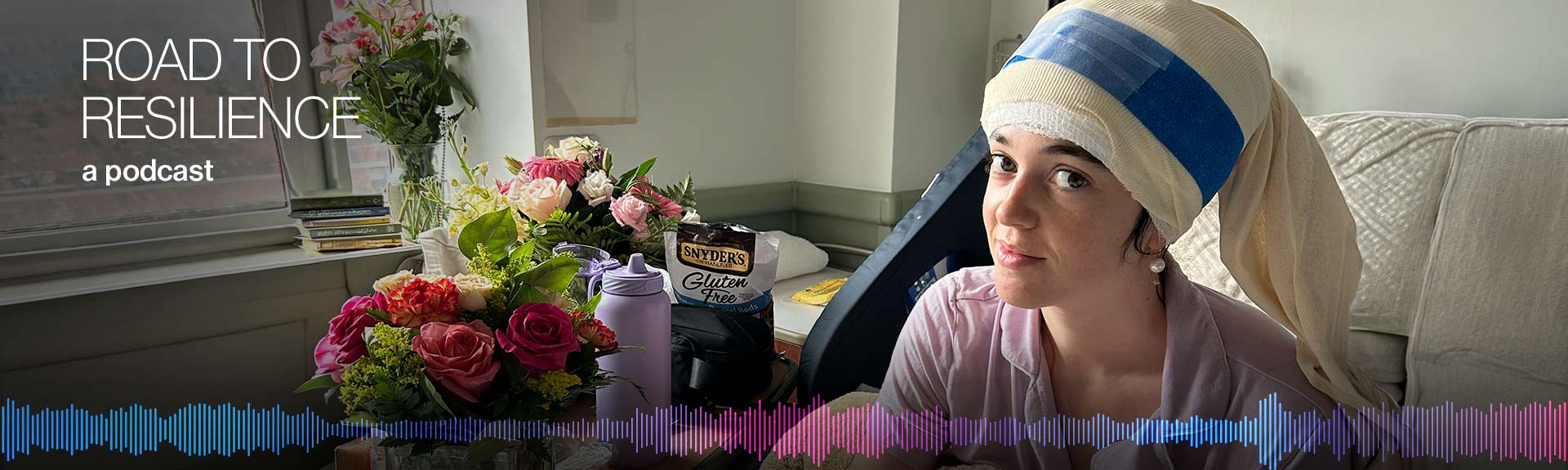
Lucy Foote: [00:12:00] So the surgery for the stereo EEG, the first surgery, was pretty intense, to be honest. I had to go in and get these holes implanted. I then had a huge turban-like hat on my head that was heavy.
Felt I don't know, maybe like a rock, huge rock sitting on top of your head, after they had planted the electrodes into and onto my brain. And my mom, graciously as she was in the hospital room with me for the entire five days, and she looked at me and was like, "Oh my God, Lucy, you look exactly like Vermeer's painting, "Girl with the Pearl Earring."
And I was like, "Mom, come on." I was in my anger and frustration and just wanting the seizure to come out, and she was like, "I have to go home and I have to go grab you this pearl earring, and I need to take a picture for you and send it to your doctor."
And I was like, "Ugh, you're so annoying." She goes home, gets it, eventually get the picture. I show it to Dr. Marcus, [00:13:00] and it becomes what is now considered the viral sensation of the epilepsy monitoring unit and the neurology unit of Mount Sinai, because I think that's partly why I'm here now.
But yeah, it became a very popular picture in the Mount Sinai community, and is now something that I guess is becoming a trending thing.
If we look at the Met Gala, people were dressed up like the Girl with the Pearl Earring. So I'd like to say that my claim to fame was earlier on, but had a nice time with that one.
It was hard to move, is all that is to say. And I had to sit there for five days because I needed to provoke a seizure, and for me, it took five days to provoke that d- tonic-clonic seizure.
Again, going back to that first one I ever had in my entire life, I had to provoke that again in order for my brain to, for my brain surgery to be successful. And I will say that my doctor, Dr. Marcus, she came in [00:14:00] mid probably day three and was like, "Hey, Lucy, how you doing?"
And I was like, "I'm good, just waiting on seizures." And she's "Do you know how many you've had today?" And I was like, "Wait, what?" She was like, "You've had five just this morning," and this was, like, 11:00 AM.
So what was happening, and I didn't realize, and thankfully the stereo EEG was able to identify, was that my brain was having seizures all the time, but they were just so minute that I wasn't recognizing them. So the stereo EEG is something that I, to this day, always say to anyone who is ever struggling with their epilepsy, especially someone like me who was considered a refac-refractory epilepsy patient, someone who doesn't have meds work for them.
The stereo EEG is necessary because clearly my brain was operating at high velocity, and it needed to be silenced.
Laser Ablation Surgery
Stephen Calabria: May 6th, 2025, was a big day for you. What happened?
Lucy Foote: On May 6th, I went in [00:15:00] for the second surgery, which was a 24-hour procedure where my laser interstitial ablation took place, and was discharged from Mount Sinai's Hospital in the hopes of becoming seizure-free.
Stephen Calabria: What was the aftermath of the surgery like? Did you immediately feel better?
Healing Lifestyle Changes
Lucy Foote: I would say no. In general, you wish it could be that quick of a fix, but there was a long period of healing that I thankfully had five months of medical leave from my office, from my work.
And in that time, I dedicated myself to being extremely mindful of what I was doing for my brain to make sure that it was being gifted with good health. So I started cutting out coffee. That was the first thing. Then I started doing a lot of yoga.
Yoga was something that, in my opinion, really saved [00:16:00] my brain, because it provided me a space to really slow down and find a better way of somatically healing myself. I did one yoga retreat during that time, actually.
About a month after my surgery, I just jumped on a plane and went to Portugal and had an e-extremely healing practice with my body to recognize that I can be an, independent and my body can heal, and yoga is something that really grounded me in that process.
And after June 1st, about a month following my procedure, I decided to give up alcohol because my brain really was done with it. And I found it to be one of the biggest privileges of my life, aside from the surgery, because in the past I hadn't ever really been able to give up alcohol.
It was just one of those social things that I always thought I needed in my life. [00:17:00] And when I finally was able to, quite frankly, rewire my brain, I knew, my body knew, that alcohol was no longer serving me. And with meditation, no coffee, no alcohol, my brain has felt almost like a completely new place for me to live.
Stephen Calabria: You're a New York City native, and to cut out coffee and alcohol- ... a true testament to you and your fortitude.
Trust And Letting Go
Stephen Calabria: What was the scariest part of the whole thing for you? Was it the uncertainty? Was it going into the surgery? And how did you face those?
Lucy Foote: I think that uncertainty was something that unfortunately I became super complacent in, and it's what really drove a lot of the activity that I wasn't even aware of. What it really was saying yes to a surgery that you had really no idea would work or not, and really putting the trust in these doctors' hands, literally.[00:18:00]
Dr. Panov is, he is c- I say all the time he could birth my babies if he wanted to, as a neuro- neurologist. I trust him now so much with the, what he's had in his hands.
And I really had to have a turning point in my life to lean in to trust in a completely different way, because I wanted to be independent. I wanted to be this New Yorker that she's gritty, she's graceful, she knows what she's doing.
She can get it done. Nobody else needs to do it for her. And I had to let that go, because that's no way for anybody to live, especially someone with epilepsy.
And I'm really proud of myself that I was able to say yes to surgery, even though I was so resistant to saying yes to my epilepsy diagnosis, even in, from the beginning.
So if anything, yes, uncertainty was totally a part of it, but the trust element was the hardest part.
Community And Faith
Stephen Calabria: Now, we talked about the role of social support in leading up to the [00:19:00] surgeries. Was social support a big factor in your diagnosis and your recovery?
Lucy Foote: I believe so, yeah. It's really difficult for you to do any of this on your own. However, there are ways that you can find social support, and I have found social support through the life changes that I've made.
So whether you have the support or not, for me, in this last year of recovery of this, from this brain surgery, I've built a community that's been centered around no drinking, lots of yoga.
I think what's been so powerful about this surgery and the changes that I've taken from it is that I've opened myself to more communities of people that I can find connection to, and that's been such a blessing in terms of, yes, in New York, there is a private members club that is for [00:20:00] alcohol-free folks, and I have found it, and I have become a founding member, and it's called The Maze, and it's amazing.
And I go to yoga, and I found a new yoga studio that feels really enlivening, and I've met teachers in that community that have inspired me to build my own practice and start my own yoga journey.
And I think that, to me, has been an evolution of the new Lucy that really is formulating in a way that You know, my, my support system was there for me during the times that it needed to, and it maintains that support throughout.
But there's also so many more people that I've opened up into my life to help me see how powerful my brain can be when I start to say yes to new things that aren't good for my brain.
Stephen Calabria: In addition to family, faith was also an important source of strength and guidance for you. Is that right?
Lucy Foote: Absolutely. I couldn't have done any of this without faith. And I [00:21:00] think for folks that might be listening who aren't faithful, that's not to say that you need to be. But I think when you go through something as insane as brain surgery at the age of 28, you have to believe in something far greater than yourself in order to empower yourself to find a way through.
And with opening myself to that world of spirituality, I've only found more abundance in my peacefulness, in my mindfulness, and in the communities of people that I really wanna be surrounded by to help me really find faith and trust in the human experience, because that is really what this comes down to.
Again, as I said in the very beginning, trust was the hardest part. I couldn't trust this diagnosis. I couldn't trust doctors. But now after being on the other side of surgery, I feel as though trust and faith and spirituality is really the three pillars that have gotten me through.
Hope And New Purpose
Stephen Calabria: When you're in the thick of something [00:22:00] like that, over which you had zero role in acquiring epilepsy, was it ever a challenge to maintain optimism?
Lucy Foote: Yeah. I would say it was hard at times, but I prided myself on ensuring that there was always hope, because I do believe that if you sink yourself into this, "Woe is me, this is my life, I have to be on medication forever," you will lose sight of the hopefulness that this condition can provide for you.
And one thing I say all the time now is, "I wouldn't be me without my epilepsy," and that is so true, because I don't want it to be away. As much as, Dr. Marcus, if you're listening, I do want it to be away. But it's something that has built my strength, and it's built my community, and it's built my resilience in a way that I've had to have hope.
I've had to find my trust in this process and not feel [00:23:00] like this is the worst thing that's ever happened to me.
Stephen Calabria: You're now channeling your experience into something bigger. Could you tell us about it?
Lucy Foote: I am, yes. So as of when I was on the news the other day on Epilepsy Awareness Day I launched my brainwave yoga retreats, which I'm doing based on my story with epilepsy, trying to understand that through this healing journey, I've really found that yoga and retreating away from the world that you've been encapsulated in has really healed me, and I want more opportunity for that, not necessarily just for epilepsy patients.
I think this is really just rooted in my own story in why I wanna build it, but I wanna create safe spaces for people to find other shores in their mental health and in their wellbeing that allows for neurological freedom in whatever way that looks like for you.
And I think while [00:24:00] we're living in this age of technology, that this has become a new human luxury, and we're going to start to see that people are getting really excited by getting away from the technology.
And so I'm excited to be building brainwave retreats after going on two during this one year of my freedom. And I'm hopeful that I can get more folks within the Mount Sinai community doctors, therapists, specialists, to even join me on that mission.
One Year Seizure Free
Stephen Calabria: Now, today, the day that we are recording this, marks a milestone for you. You are now one year seizure-free. Congratulations. How do you feel?
Lucy Foote: Wow, it's so great to hear that out loud. I feel like I've been saying that in my head all day and you're the first person to not have it over text.
Stephen Calabria: Everybody here knows. Yeah. Everybody in the hospital knows. I had to tell them to stop.
Lucy Foote: Everyone here. Yeah, it feels, like I can breathe again. That milestone [00:25:00] marker has been here for so long, and I've been looking at it and hopeful for it, and now it's really here, and it's about where do I go from here? Because I've built up all of these exciting things along this last year. I have-- I'm throwing myself a seizure-free party, actually, this weekend and-
Stephen Calabria: No alcohol, I assume.
Lucy Foote: No alcohol. Tea party, let's be very clear. And I've purchased a first-year baby photo hanging picture wall, which shows one month, two month, up to 12 months, and I've put a picture at every month that has been a meaningful part of my year. And I'm just looking--
Every day, I'm walking by this thing that I put up, and I'm just looking at it, and I'm seeing Wow, Lucy, you've accomplished so much in this last year, not just physically from what people can see, but also emotionally, internally, just the changes that I've made, and I've made truly with some semblance of grace, I'd like to say, and [00:26:00] hopefully folks would agree.
But I feel like I can breathe, and that's a really amazing feeling when you're someone who's been battling and you feel like you've been fighting, and this is the time now to lay my sword and surrender.
And I think that does go back into some of what I've shared with spirituality and faithfulness, is that there's a lot that I'm giving up to God now, and it's now, letting my life lead the way and in the success that I've created to this point, and knowing that I have the foundations that are really strong and I believe will take me really far.
Advice And Farewell
Stephen Calabria: If you could talk to someone who's just starting down the road of epilepsy treatment, let's say they just first started getting their seizures, what would you tell them?
Lucy Foote: Find Dr. Marcuse at the Mount Sinai Hospital, and she's your one. No, but I would say that the patience that is required of you is going to be monumental. [00:27:00] Now is your time to really check in and make sure that you're up for that.
If you're not up for that, understand why and find a way to fix it. Because the reality is that this is not going to be an overnight situation. It took me almost six years to get to this point. I know for many other patients, it's a lot longer.
I just got lucky by finding it out early and finding the right doctors. Finding the right doctors is absolutely crucial. And like I said before, the Mount Sinai doctors are your people. This place is truly a second home for me at this point, I think, because of the amount of time I've spent just in monitoring, but also in terms of trust.
I feel as though I'm one of the lucky ones, and if I'm ever able to speak to anyone about their experience, I want them to feel like the lucky ones too.
So if there's ever anyone that wants to speak to me, I do also run an epilepsy blog [00:28:00] that's called Epileptics Anonymous, and I talk to folks all the time about their experience, and it's a really great place for finding community if you don't have one.
And I'm hoping to build more of it as my success continues.
Stephen Calabria: Now, you already answered my last question- ... but I wanna pose it to you anyway. Would you take it all away?
Lucy Foote: Absolutely not. I think that each and every challenging decision that I've made up until this point has been extremely important in defining who I am and who I'm going to be and what my values are as an almost 30-year-old.
And I don't think many women or men or anyone have the opportunity to feel that at this age. So for me, I feel like I'm one of the lucky ones, again, that gets the chance to know what I need and know my boundaries early in life and really set myself up for understanding where I want [00:29:00] my health to be when I'm 83.
Stephen Calabria: That's it for my questions. Was there anything else you wanted to say?
Lucy Foote: No, I think if anything, if you are an epilepsy carer or patient interested in finding more community, feel free to follow me at Epileptics underscore Anonymous. I'm also there on Instagram. You can also follow my brainwave yoga retreat building experience by following at brainwave.retreats and would love to have anyone join me.
Stephen Calabria: Lucy Foote, thank you so much for your time.
Lucy Foote: Thank you. I loved being here, and I always am happy to share my story.
Closing Credits
Stephen Calabria: Thanks again to Lucy Foote for her time and her story. That's all for this episode of Road to Resilience. If you enjoyed it, please rate, review, and subscribe to our podcast on your favorite podcast platform.
Wanna get in touch with the show or suggest an idea for a future episode? Email us at podcasts@mountsinai.org.
Tune in to Mount Sinai's two roundtable [00:30:00] talk shows, Herology and The Vitals, on YouTube, Apple Podcasts, Spotify, or wherever you get your podcasts.
Road to Resilience is a production of the Mount Sinai Health System. It's produced by me, Stephen Calabria, and our executive producer, Lucia Lee.
From all of us here at Mount Sinai, thanks for listening, and we'll catch you next time.