
The AI Revolution in Medicine

Artificial intelligence is transforming nearly every industry—but few places have more at stake than medicine.
From ambient AI that allows clinicians to spend more time with patients to predictive tools that can identify patients at risk of deterioration, AI is already changing the way healthcare is delivered.
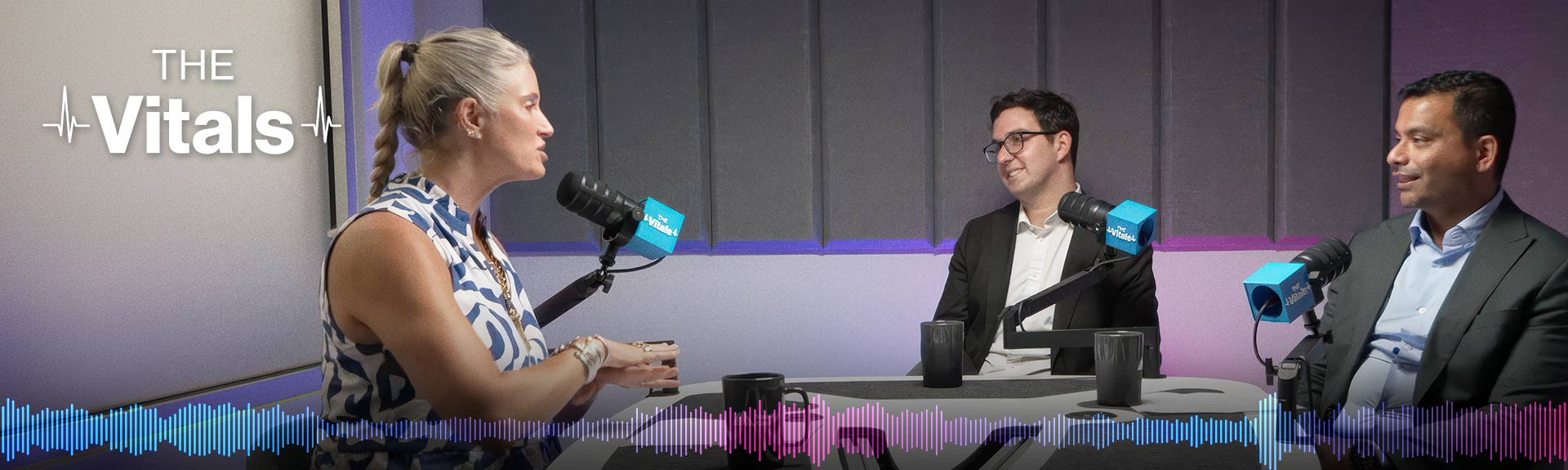
On this episode of The Vitals, host Leslie Schlachter sits down with Dr. Robbie Freeman and Dr. Girish Nadkarni to explore how AI is being used across Mount Sinai—from the back office and research lab to the hospital bedside and directly into patients’ hands.
They discuss how AI can reduce the burden of clinical documentation, support patient safety, predict health risks, analyze ECGs, improve handoffs, and help patients navigate their care. They also look toward the hospital of the future, where voice and vision AI could seamlessly document clinical encounters, monitor patients, and provide clinicians with more time to focus on what matters most.
Girish Nadkarni: I think of AI as a crane for the mind because it amplifies your intelligence and it amplifies your effort and enables you to do things that were not possible before. That is where human judgment, human intuition, and human compassion come in, and there is no chance that AI is gonna replace that, right?
Leslie Schlachter: Hello, and welcome back to The Vitals, the Mount Sinai Health System show that brings you the latest in medical news, research, and innovation. I'm your host, Leslie Schlachter, a neurosurgery physician assistant here at the Mount Sinai Hospital. Artificial intelligence seems to be everywhere these days. It can write essays, generate images, but perhaps nowhere near its greater potential or stakes higher than in medicine.
But what exactly can AI do in a hospital? Does it really help practitioners make better decisions? And what will healthcare look like in five or 10 years from now as [00:01:00] AI becomes increasingly woven into everyday clinical practice? Joining us to answer these questions are two leaders helping us shape that future from different perspectives, Dr.
Robbie Freeman and Dr. Girish Nadkarni. You guys, thank you. This is very exciting. I'm happy that you guys are here.
Leslie Schlachter: Can you guys just give us, like, an overview of how we're using it here and what you've, how you've heard it makes us so much happier?
Girish Nadkarni: AI is being used, uh, from the back office to the bench to the bedside and back again, right?