New Research Reveals Autism Risk Genes Are Shared Across Ancestries
Large-scale genomic analysis of Latin American cohort supports universal genetic architecture of autism and advances equity in precision medicine
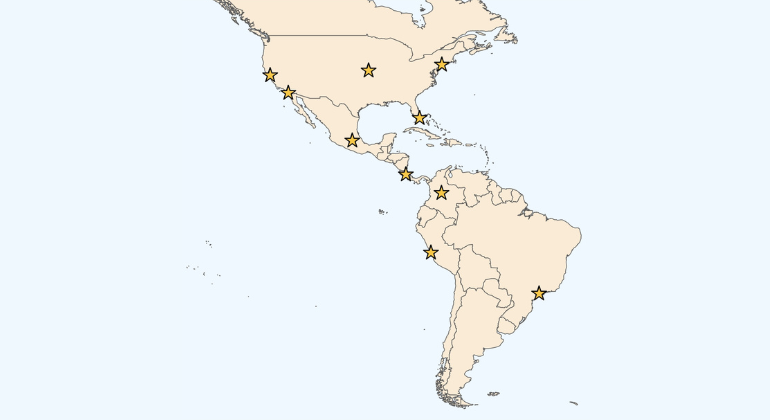
Map of GALA collection sites across the Americas. Credit: Marina Natividad Avila, MSc
A new study, co-led by researchers at the Icahn School of Medicine at Mount Sinai and published March 30 in Nature Medicine, demonstrates that genes associated with autism risk are largely the same across people of different ancestries.
The findings, based on one of the largest genomic studies of Latin American individuals to date, provide strong evidence that the genetic architecture of autism is consistent across diverse populations. They underscore the importance of expanding genetic research beyond individuals of European ancestry.
Over the past decade, scientists have identified numerous rare genetic variants that confer substantial risk for autism and other neurodevelopmental disorders. However, most of these discoveries were made in cohorts composed predominantly of individuals of European ancestry, leaving open the question of whether autism’s genetic underpinnings differ across populations. This knowledge gap has contributed to disparities in genetic testing, including higher rates of inconclusive results among non-European individuals due to limited reference data.
To address this issue, the research team analyzed exome and genome sequencing data from more than 15,000 Latin American individuals across North, Central, and South America, including approximately 4,700 individuals diagnosed with autism. Latin American populations represent the largest recently mixed-ancestry group globally, with heritage that frequently includes Indigenous American, West African, and European origins. This rich genetic diversity provides a powerful opportunity to refine gene-disease associations, which can improve health outcomes for all populations.
The study examined more than 18,000 genes for enrichment of rare, deleterious coding variants—genetic changes that can have immediate and profound clinical implications for diagnosis, treatment, and family counseling.
Consistent with prior research, rare, deleterious variants in highly conserved genes—genes that remain similar across species and populations over long periods of time—were disproportionately observed in individuals with autism. Researchers identified 35 genes significantly associated with autism in the Latin American cohort. These genes showed extensive overlap with those previously identified in genome-wide studies of individuals of European ancestry. The findings also provide support for several recently identified “emerging” autism-associated genes.
“Our results indicate that the core genetic architecture of autism is shared across ancestries,” said study senior author Joseph D. Buxbaum, PhD, Director of the Seaver Autism Center for Research and Treatment at Mount Sinai. “This suggests that the biology underlying autism is universal and reinforces the importance of ensuring that diverse populations are represented in genetic research.”
The study also evaluated widely used metrics that assess evolutionary conservation of genes, an important tool for prioritizing genes in clinical genetic analyses of neurodevelopmental disorders. The researchers found that these metrics, which were again largely derived from European-ancestry datasets, may overestimate conservation overall due to limited ancestral diversity in European populations. However, the metrics remain highly accurate for the most strongly conserved genes—including those most relevant to autism and other neurodevelopmental disorders.
The authors note that continued sequencing of diverse populations will further improve conservation metrics, particularly for less conserved genes, ultimately enhancing the accuracy of clinical genetic testing.
“These findings provide a road map for improving genetic diagnosis across ancestral groups,” said Dr. Buxbaum. “Expanding genomic research in underrepresented populations is essential to reducing health disparities and advancing precision medicine for autism and related conditions across all ancestral populations.”
The study’s results align with growing evidence that both rare and common genetic risk factors for complex disorders are shared across diverse populations. By demonstrating broad overlap in autism risk genes across ancestries, the research supports more inclusive approaches to genomic medicine and reinforces the universal biological foundations of autism.
About the Mount Sinai Health System
Mount Sinai Health System is one of the nation’s leading integrated academic health systems and one of the largest in the New York metropolitan area. Its comprehensive system includes seven hospitals, more than 400 outpatient practices, over 600 research and clinical laboratories, the Icahn School of Medicine at Mount Sinai, the Graduate School of Biomedical Sciences, and the Mount Sinai Phillips School of Nursing. Together, the Health System comprises approximately 48,000 employees, more than 9,000 physicians, and 8,600 nurses.
As a leading learning health system, Mount Sinai combines clinical expertise with scientific discovery to improve patient care while training the next generation of health care and biomedical leaders. The Health System provides care across every stage of life, from prenatal care through geriatrics, while advancing personalized medicine through artificial intelligence, data science, and biomedical research.
Mount Sinai is consistently recognized among the nation’s leading academic health systems for patient care, research, and education. The Mount Sinai Hospital is ranked No. 1 in New York by Newsweek® and No. 7 in the U.S. on the magazine’s World’s Best Hospitals 2026 list. The Icahn School of Medicine at Mount Sinai ranks No. 9 among U.S. medical schools and No. 1 among freestanding medical schools for National Institutes of Health grant funding, reflecting the strength of its scientific enterprise and leadership in biomedical research.