
Icahn School of Medicine at Mount Sinai Reaches Top 10 as a National Institutes of Health-Funded Academic Medical Center
A different model for medical school and a bold approach to biomedical research
It was a bold, even audacious, idea—establish a new medical school without the traditional moorings of a university, the entrenched model for nearly every academic medical center in the country. Since its founding in 1968, the Icahn School of Medicine at Mount Sinai, as it was renamed in 2013, has become a leading research enterprise with an integrated science-plus-medicine formula for success in the pursuit of life-saving discoveries.
“This has been a milestone year for Mount Sinai’s research and education enterprises. From our humble beginnings in a vacant bus garage in upper Manhattan to becoming a life-sciences and educational powerhouse, we have propelled science and medicine thanks in part to our passion and grit,” says Eric J. Nestler, MD, PhD, Anne and Joel Ehrenkranz Dean, Icahn School of Medicine at Mount Sinai.
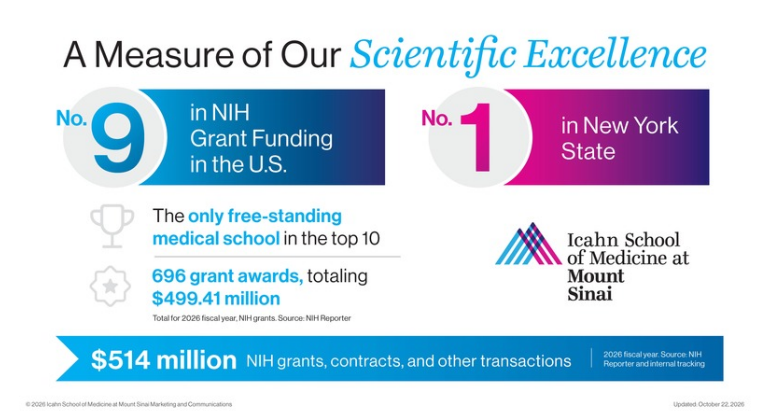
In fiscal year 2026, which ended September 30, the School advanced for the first time into the top 10 medical schools nationally in research grants from the NIH. Ranked No. 5 in North America and No. 6 globally for health care research in the 2026 Nature Index Research Leaders Rankings, Mount Sinai was also recognized this year by the Blue Ridge Institute for Medical Research for 13 of its specialties making the top 10 nationwide for National Institutes of Health (NIH) funding, a reflection of awards garnered in 2025.
"We are proud to be one of the nation’s top 10 recipients of NIH funding. The Icahn School of Medicine at Mount Sinai is a free-standing medical school—the only one to stand alongside the country’s leading universities. This accomplishment reflects the exceptional talent and innovation that defines Mount Sinai,” said Brendan G. Carr, MD, MA, MS, Chief Executive Officer, Mount Sinai Health System. "Our unique model brings researchers and clinicians together, allowing discoveries in the lab to move more quickly to the patients and communities who need them most. We are proud to be a leading voice in shaping the future of medicine.”
There is no better evidence of the steady growth and momentum it has achieved than this new milestone: placing No. 9 nationally in biomedical research grant funding from the NIH. The Icahn School of Medicine now ranks higher than any other medical school in New York State in NIH-funded biomedical research and has the distinction of being the only freestanding medical school among the top 10 NIH grant recipients. In fiscal year 2026, Mount Sinai investigators secured more than $514 million in total NIH funding across 696 grants and contracts in areas as diverse as the brain, immunology, cancer, heart, genomics, AI and human health, and vaccines and pandemic preparedness.
Mount Sinai’s educational efforts are closely aligned with its research and clinical enterprises. The Icahn School of Medicine, Graduate School of Biomedical Sciences, and Mount Sinai Phillips School of Nursing are training the next generations of physicians, scientists, nurses, and public health and administrative practitioners.
“We were determined nearly 60 years ago to break the mold in biomedical research and education by creating a school within a hospital, one that could build on the hospital’s legacy of state-of-the-art and compassionate care for a unique patient population,” says Dr. Nestler. “Reaching these milestones in a singular year is a testament to our resolve and boldness. Our investigators share a collective ethos—a commitment to scientific discovery, a willingness to tackle difficult questions, and a relentless pursuit of new knowledge—and their north star is making discoveries that become life-saving therapies that change peoples’ lives. That is the ultimate achievement.”
Creating Next-Generation Therapies for Brain Disorders
In a field where progress has been notoriously slow, few research teams have dug deeper than Mount Sinai’s into the complex cellular architecture of brain disorders that are among the leading causes of disability worldwide, like Alzheimer’s disease and Parkinson’s disease. Mount Sinai investigators have played leading roles in the global network known as the PsychAD Consortium, which has produced a landmark collection of nine papers enhancing the field’s understanding of why Alzheimer’s disease, for one, progresses differently among individuals. The work offers new insights that may inform future precision medicine strategies. Mount Sinai has also been a pioneer in advancing, through decades of small NIH-funded studies, deep brain stimulation (DBS). Mount Sinai’s Living Brain Project, an NIH-funded investigation, was developed to evaluate DBS for Parkinson’s disease, obsessive-compulsive disorder, essential tremor, dystonia, and depression. The surgical treatment, which, involves implanting electrodes into the brain has been a game-changer for many of these common disorders. In 2025, Mount Sinai was the first to use DBS for depression in the United States as part of a multi-site randomized control trial.
Changing the Standards of Cancer Care Worldwide
Mount Sinai Tisch Cancer Center’s (TCC) designation in 2025 as a “Comprehensive Cancer Center” by the National Cancer Institute represents the highest designation awarded to cancer centers in the United States. This recognition places Mount Sinai among the top 1 percent of cancer centers nationwide and affirms the breadth and depth of its cancer research, clinical excellence, and commitment to health equity. This milestone, along with Mount Sinai’s top 10 funding in cancer research, underscores our sustained investment in cancer science, commitment to training the next generation of investigators, and a promise to improve cancer care. Mount Sinai oncologists have advanced the field on several fronts, including cancer vaccines, bone marrow transplantation, blood cancers, multiple myeloma, bladder cancer, and other solid tumors. Researchers at TCC have led transformative studies across a wide spectrum of cancers, advancing treatments that are changing standards of care worldwide including pioneering trials resulting in the FDA approval of a therapy to prevent recurrence in patients with muscle-invasive bladder cancer, an innovative vaccine for urothelial cancer and a new vaccine platform for solid and hematologic malignancies.
Women and Children Among Beneficiaries of Heart Research
Advances in heart disease, the No. 1 killer of Americans, have been a critical focus for Mount Sinai investigators who have turned their lens to the less-studied populations of women and children. A newly launched NIH-funded study, led by Mount Sinai Fuster Heart Hospital, is focused on uncovering the optimal therapy for spontaneous coronary artery dissection, the disease that took the life of U.S. Senator Lindsey Graham in July 2026. This condition disproportionately affects women, often at a young age, without the traditional warning signs of heart disease. Another research grant for $8.5 million is continuing cutting-edge work aimed at improving long-term outcomes for children with congenital heart disease, while a $10.2 million award is bringing the institution closer to identifying the risk factors for malignant ventricular arrhythmias in mitral valve prolapse. Mount Sinai proudly applauded the appointment in March 2026 of Roxana Mehran, MD, Mount Sinai Professor in Cardiovascular Clinical Research and Outcomes, as the 74th President of the American College of Cardiology.
Advancing Science Against Challenging Autoimmune Diseases
Autoimmune diseases like rheumatoid arthritis, type 1 diabetes, inflammatory bowel disease, and psoriasis are becoming increasingly common in developed nations. Autoimmune diseases affect more than 15 million Americans across more than 105 conditions that can damage nearly every organ system. Mount Sinai researchers have focused on new discoveries for patients wrestling with the hallmarks of autoimmune disease, including unpredictable cycles of flare and remission, delayed diagnosis, and limited treatment options, by applying cellular science and precision medicine. This year, the institution garnered a new $5 million private grant to establish the Colton Center for Autoimmunity. Residing within Mount Sinai’s Precision Immunology Institute (PrIISM), the center will work with international partners to create large-scale datasets across multiple autoimmune diseases and apply AI-enabled analytics to help fundamentally change how autoimmune diseases are detected, treated, and prevented.
A Global Role in Vaccine Development and Pandemic Preparedness
The rapid spread of viruses like influenza, dengue, hantavirus, and COVID-19 has thrust Mount Sinai into prominent national and global roles focused on disease prevention. Mount Sinai researchers recently received a five-year award of nearly $21 million to advance next-generation technologies against respiratory threats. The project will begin with an H5N1 flu vaccine prototype and development of a vaccine platform framework for broader, safer, and more durable immune protection. This undertaking will include finding a novel way of approaching influenza in search of protection that is more far-reaching, rather than narrowly focused on a single circulating influenza virus variant.
During the recent outbreak of hantavirus pulmonary syndrome on a cruise ship resulting in 12 confirmed cases and three deaths, Mount Sinai investigators helped coordinate the international response teams and scientific inquiry that followed. That experience triggered a new $11.8 million federal grant to Mount Sinai to fundamentally change this country’s course of vaccine development. Known as the DOORs project, the research team, led by distinguished virologists Gustavo Palacios, PhD, and Adolfo García-Sastre, PhD in the Department of Microbiology, is charged with identifying and closing the critical “doors” that whole families of viruses exploit to infect, replicate, and spread.
“This approach to pandemic preparedness and vaccine development underlines how we move medicine and science forward, finding new paths and ways of doing things for the good of humankind,” says Dr. Nestler.
About the Icahn School of Medicine at Mount Sinai
The Icahn School of Medicine at Mount Sinai is internationally renowned for its outstanding research, educational, and clinical care programs. It is the sole academic partner for the seven member hospitals* of the Mount Sinai Health System, one of the largest academic health systems in the United States, providing care to New York City’s large and diverse patient population.
The Icahn School of Medicine at Mount Sinai offers highly competitive MD, PhD, MD-PhD, and master’s degree programs, with enrollment of more than 1,200 students. It has the largest graduate medical education program in the country, with more than 2,700 clinical residents and fellows training throughout the Health System. The Graduate School of Biomedical Sciences offers 12 degree-granting programs, conducts innovative basic and translational research, and trains more than 470 postdoctoral research fellows.
Ranked No. 9 nationwide in National Institutes of Health (NIH) grant funding, the Icahn School of Medicine at Mount Sinai is among the 90th percentile of U.S. private medical schools in Sponsored Programs Direct Expenditures per Principal Investigator, according to the Association of American Medical Colleges. More than 6,900 scientists, educators, and clinicians work within and across dozens of academic departments and multidisciplinary institutes with an emphasis on translational research and therapeutics. Through Mount Sinai Innovation Partners (MSIP), the Health System facilitates the real-world application and commercialization of medical breakthroughs made at Mount Sinai.
-------------------------------------------------------
* Mount Sinai Health System member hospitals: The Mount Sinai Hospital; Mount Sinai Brooklyn; Mount Sinai Morningside; Mount Sinai Queens; Mount Sinai South Nassau; Mount Sinai West; and New York Eye and Ear Infirmary of Mount Sinai.
About the Mount Sinai Health System
Mount Sinai Health System is one of the nation’s leading integrated academic health systems and one of the largest in the New York metropolitan area. Its comprehensive system includes seven hospitals, more than 400 outpatient practices, over 600 research and clinical laboratories, the Icahn School of Medicine at Mount Sinai, the Graduate School of Biomedical Sciences, and the Mount Sinai Phillips School of Nursing. Together, the Health System comprises approximately 48,000 employees, more than 9,000 physicians, and 8,600 nurses.
As a leading learning health system, Mount Sinai combines clinical expertise with scientific discovery to improve patient care while training the next generation of health care and biomedical leaders. The Health System provides care across every stage of life, from prenatal care through geriatrics, while advancing personalized medicine through artificial intelligence, data science, and biomedical research.
Mount Sinai is consistently recognized among the nation’s leading academic health systems for patient care, research, and education. The Mount Sinai Hospital is ranked No. 1 in New York by Newsweek® and No. 7 in the U.S. on the magazine’s World’s Best Hospitals 2026 list. The Icahn School of Medicine at Mount Sinai ranks No. 9 among U.S. medical schools and No. 1 among freestanding medical schools for National Institutes of Health grant funding, reflecting the strength of its scientific enterprise and leadership in biomedical research.
Scott J. Russo, PhD, Appointed Chair of the Nash Family Department of Neuroscience
Oct 13, 2026 View All Press Releases

Eva A. Mistry, MBBS, MSCI, FAHA, Appointed Mount Sinai Health System Chair of Neurology
Sep 09, 2026 View All Press Releases

The Mount Sinai Hospital Ranked Among Top in the Nation by U.S. News & World Report®
Aug 04, 2026 View All Press Releases


The Mount Sinai Hospital Ranked Among World’s Best in Newsweek/Statista Rankings
Mar 10, 2026 View All Press Releases