Paul J. Kenny, PhD, Named Chair of Pharmacology and Systems Therapeutics at the Icahn School of Medicine at Mount Sinai
Dr. Kenny plans to build a hub for small molecule development and next generation therapeutics.
Paul J. Kenny, PhD, has been named Chairman of the Dorothy H. and Lewis Rosenstiel Department of Pharmacology and Systems Therapeutics, and Ward-Coleman Professor at the Icahn School of Medicine at Mount Sinai, according to an announcement today by Dennis S. Charney, MD, Anne and Joel Ehrenkranz Dean of the Icahn School of Medicine at Mount Sinai, and President for Academic Affairs of the Mount Sinai Health System. Dr. Kenny will also serve as Director of the Experimental Therapeutics Institute.
In making the announcement, Dr. Charney said, "Dr. Kenny brings outstanding academic credentials, an innovative approach to discovery, and a commitment to translational science to Mount Sinai."
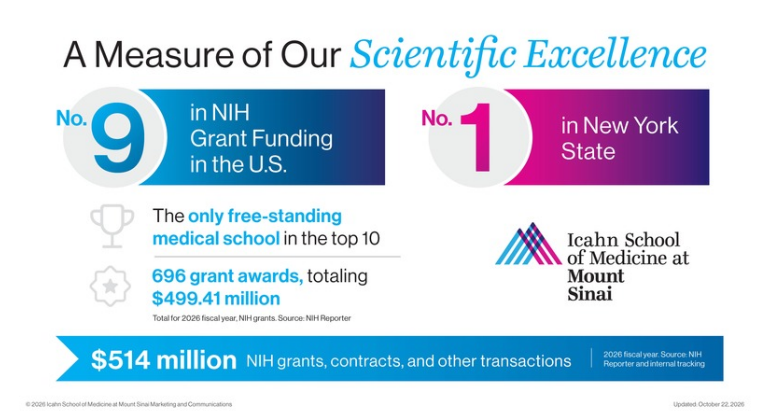
Dr. Charney applauded Ravi Iyengar, PhD, who has chaired the department for the past 15 years. "Under Dr. Iyengar's stewardship, Mount Sinai has always been highly ranked in National Institutes of Health (NIH) funding, in the top 10 nationally. The department has grown from a group of 8 to 25 faculty, and Mount Sinai has attracted multidisciplinary researchers at the top of their fields."
A world-renowned researcher in the neurobiology of obesity and drug addiction, Dr. Kenny's work has helped advance the understanding of the mechanisms behind addiction-like behaviors and has led to the development of medications for these behaviors. His multidisciplinary research involves the study of behavioral paradigms, physiological analyses, and the molecular underpinnings of neurobehavioral disorders.
Dr. Kenny is actively investigating the brains of rodents to uncover new signaling cascades that may play a role in addiction-like behaviors.
In joining Mount Sinai, Dr. Kenny said: "Everything we need to drive new world-class science and translate those findings into new therapeutics is here. Mount Sinai attracted me because so many tremendous investigators are here, and the infrastructure is top-notch. My goal is the build a department that does cutting-edge science and catalyzes early-stage drug development."
Dr. Kenny comes to Mount Sinai from Scripps Research Institute, Jupiter, Florida, where he was an Associate Professor. Within a year, he plans to move his research laboratory from Scripps to Mount Sinai.
A graduate of Trinity College in Dublin, Dr. Kenny earned his BA in Biochemistry. He completed his PhD in Neuroscience at King's College London. After postdoctoral training at the Scripps Research Institute in La Jolla, CA, Dr. Kenny became Assistant Professor of Molecular Therapeutics at Scripps Research Institute in Florida. He was promoted to Associate Professor in 2006, and in 2011, became tenured. Dr. Kenny has also served as Director of the Medications Development Program in Substance-Related Disorders at Scripps.
He has won numerous awards, including several Young Investigator Awards from groups that include the Society for Neuroscience, the National Alliance for Research on Schizophrenia and Depression, and the Society for Research on Nicotine and Tobacco. In 2009, he was elected a full member of the American College of Neuropsychopharmacology. Dr. Kenny has published almost 100 research papers, and has also discussed his findings on television and radio, and in lay publications. He is an editor of the Journal of Neuroscience and Journal of Neurochemistry, and an editorial board member of several journals, including Neuropsychopharmacology, Neuropharmacology, and Frontiers in Behavioural Neuroscience.
Dr. Kenny also is a member of the Board of Scientific Counselors for the Intramural Research Program of the National Institute on Drug Abuse, and the Molecular Neurogenetics Study Section of the National Institutes of Health.
About the Department of Pharmacology and Systems Therapeutics
The Dorothy H. and Lewis Rosenstiel Department of Pharmacology and Systems Therapeutics at the Icahn School of Medicine at Mount Sinai is devoted to the study of biological processes at molecular, cellular, tissue, and organismal levels in order to understand the mechanisms by which these processes function and how these processes can be modulated for therapeutic purposes. Studies often involve analysis of interactions of exogenous and endogenous substances with biological systems and the development of new therapeutics based on our understanding of cellular and molecular interactions.
About the Mount Sinai Health System
Mount Sinai Health System is one of the nation’s leading integrated academic health systems and one of the largest in the New York metropolitan area. Its comprehensive system includes seven hospitals, more than 400 outpatient practices, over 600 research and clinical laboratories, the Icahn School of Medicine at Mount Sinai, the Graduate School of Biomedical Sciences, and the Mount Sinai Phillips School of Nursing. Together, the Health System comprises approximately 48,000 employees, more than 9,000 physicians, and 8,600 nurses.
As a leading learning health system, Mount Sinai combines clinical expertise with scientific discovery to improve patient care while training the next generation of health care and biomedical leaders. The Health System provides care across every stage of life, from prenatal care through geriatrics, while advancing personalized medicine through artificial intelligence, data science, and biomedical research.
Mount Sinai is consistently recognized among the nation’s leading academic health systems for patient care, research, and education. The Mount Sinai Hospital is ranked No. 1 in New York by Newsweek® and No. 7 in the U.S. on the magazine’s 2026 World’s Best Hospitals list and No. 3 in the world in its World’s Best Smart Hospitals list. The Icahn School of Medicine at Mount Sinai ranks No. 9 among U.S. medical schools and No. 1 among freestanding medical schools for National Institutes of Health grant funding, reflecting the strength of its scientific enterprise and leadership in biomedical research.