Study Identifies Brain Pathways Linked to Sustained Improvement in Those Receiving Deep Brain Stimulation for Treatment-Resistant Depression
Brain connectivity findings support individualized targeting of this groundbreaking therapy
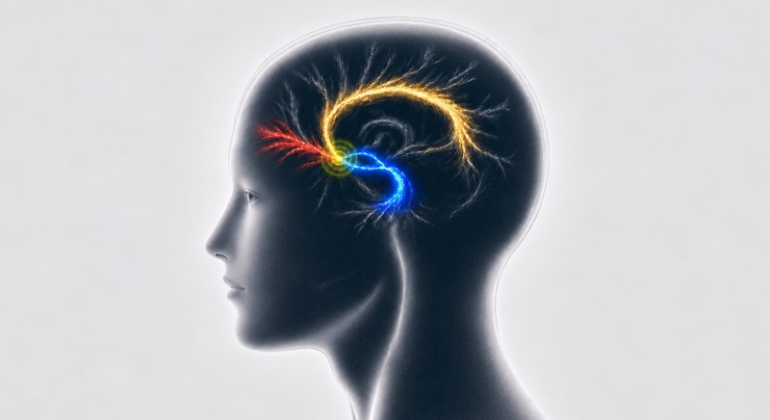
Three white matter bundles that are critical for successful subcallosal cingulate (SCC) deep brain stimulation for treatment-resistant depression: the cingulum bundle (yellow), forceps minor (red), and medial uncinate fasciculus/ventral amygdalofugal pathway (blue). Credit: Ha Neul Song, PhD student at the Icahn School of Medicine and first author of the manuscript.
Stimulation of specific brain connections was associated with sustained improvement in people receiving deep brain stimulation (DBS) for treatment-resistant depression, Mount Sinai researchers reported. The findings could help researchers refine how they target this investigational treatment.
Published October 1 in the American Journal of Psychiatry, the study examined the largest multi-cohort group to date of patients who received subcallosal cingulate deep brain stimulation (SCC DBS) for treatment-resistant depression. Across independent patient groups, sustained clinical improvement was associated with stimulation of three white matter pathways: the cingulum bundle, forceps minor, and medial uncinate fasciculus/ventral amygdalofugal pathways.
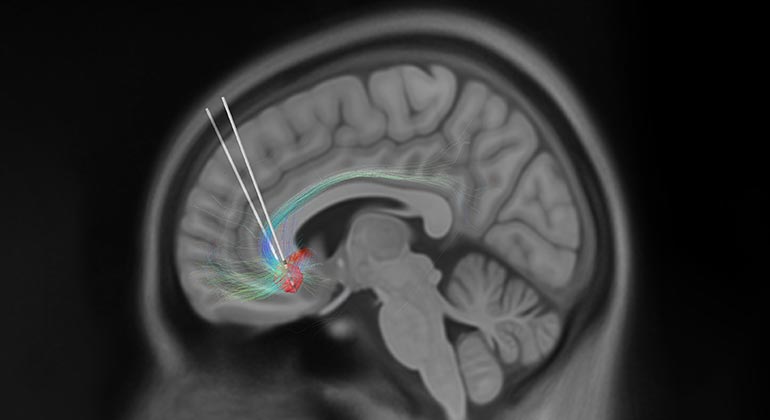
The results support connectome-based targeting, which uses maps of the brain’s structural connections to guide placement of DBS electrodes instead of relying on anatomical landmarks. This approach has informed the ongoing Abbott TRANSCEND clinical trial, a randomized, controlled trial in which patient-specific connectome-guided targeting is used for SCC DBS.
“This study underscores the importance of individualized surgical targeting for achieving optimal outcomes with deep brain stimulation for depression,” said Helen Mayberg, MD, Mount Sinai Professor in Neurotherapeutics and founding Director of the Nash Family Center for Advanced Circuit Therapeutics at the Icahn School of Medicine at Mount Sinai. “In any randomized controlled trial of a neuromodulation treatment, precise lead placement and confirmation that the intended brain target has been engaged are essential first steps. We still have much to learn about which patients are most likely to benefit from stimulation of this particular target, but developing imaging-based signatures that can match patients to their optimal treatment remains a central goal of our research.”
Treatment-resistant depression is depression that has not improved adequately with standard treatments. Researchers are studying DBS as a potential option for people with severe, persistent depression. DBS involves surgically implanted electrodes that deliver electrical stimulation to specific brain circuits.
A central challenge in DBS is identifying which brain connections need to be stimulated. The treatment affects more than the tissue immediately surrounding an electrode: its effects also depend on the networks and white matter pathways reached by stimulation.
In studies published between 2014 and 2023 in Biological Psychiatry, Molecular Psychiatry, and Nature, teams from Mount Sinai and Emory University identified white matter pathways associated with successful SCC DBS and developed a prospective connectome-based targeting method. The new study assessed whether those findings held across independent patient groups at different centers and whether pathway engagement might help explain why some patients did not respond.
The researchers analyzed data from several clinical studies, including the BROADEN trial and a University of Toronto cohort, where SCC DBS was initially developed. They combined models of DBS electrical fields with brain connectivity maps to assess how consistently stimulation reached the previously identified pathways.
Across patient groups, sustained improvement was associated with stimulation of the cingulum bundle, forceps minor, and medial uncinate fasciculus/ventral amygdalofugal pathways. After two years of treatment, patients who did not respond to DBS across study sites were characterized by a lack of engagement of the left cingulum bundle.
The researchers did not test whether repositioning electrodes to reach the missing pathway would improve outcomes. Still, the findings may help explain why patients with electrodes placed in the same anatomical region can have different responses: an electrode may be in the intended location without stimulating every pathway associated with sustained improvement.
“This study addresses an important question in DBS: not simply which area of the brain to stimulate, but which connections within that area need to be engaged,” said Brian Kopell, MD, Director of the Center for Neuromodulation at Mount Sinai. “For a network disorder such as depression, millimeters can determine whether stimulation reaches the pathways we intend to modulate. Identifying and reproducibly engaging those pathways gives us a more precise surgical target and a framework for understanding why otherwise similar electrode placements may produce different clinical outcomes.”
The researchers caution that engaging the identified pathways is unlikely to be the only factor determining response. This study focused on where to deliver stimulation; further research must establish which patients are most likely to benefit and how to adjust stimulation over time.
The study had an imaging limitation: patient-specific diffusion MRI data were unavailable for some participants, so the researchers relied on generalized connectivity maps for much of the analysis. In the Emory cohort, results were consistent when the researchers compared generalized maps with patient-specific diffusion data. This consistency supports the pathway findings but does not eliminate the need to study patient-specific imaging further.
Future studies will examine whether individual measures of white matter integrity, functional connectivity, and other imaging features can further improve patient selection, targeting, and stimulation strategies.
“Our findings show precisely engaging these white matter pathways is a critical first step toward sustained response,” said Ki Sueng Choi, PhD, Associate Professor, Imaging Core Leader at the Center for Advanced Circuit Therapeutics at Mount Sinai, and corresponding author of the study. “The next step is to characterize abnormal functional and structural brain states along these pathways to build more detailed models for setting patient-specific stimulation parameters, including amplitude, frequency, and pulse width, for precision medicine.”
The analyses were supported by the National Institutes of Health BRAIN Initiative grant UH3NS103550, the Hope for Depression Research Foundation, and the DANA Foundation. Data from the BROADEN trial were provided by Abbott’s Neuromodulation business. Abbott was not involved in the design or analysis of the present study.
COI Disclosures: Dr. Brian Kopell is a paid consultant for Abbott Laboratories. Dr. Helen Mayberg is a named co-inventor on a novel method for using deep brain stimulation (DBS) in a specific region of the brain (the subcallosal cingulate area) as therapy for treatment resistant depression. This method had been licensed to Abbott Laboratories and Dr. Mayberg has received and is entitled to receive future royalty payments from Functional Neuroscience related to this method. Dr. Mayberg is a paid consultant for Abbott Laboratories for their clinical trials of DBS for depression. Dr. Ki Seung Choi and Dr. Martijn Figee are paid consultants for Abbott Laboratories. Dr. Mayberg, Dr. Kopell, and Dr. Ki Sueng Choi are named co-inventors on a patent application that describes a method of determining the optimal electrode placement for deep brain stimulation for the treatment of depression. This technology is filed through Mount Sinai and currently unlicensed, but the technology was utilized in the TRANSCEND trial.
About the Mount Sinai Health System
Mount Sinai Health System is one of the nation’s leading integrated academic health systems and one of the largest in the New York metropolitan area. Its comprehensive system includes seven hospitals, more than 400 outpatient practices, over 600 research and clinical laboratories, the Icahn School of Medicine at Mount Sinai, the Graduate School of Biomedical Sciences, and the Mount Sinai Phillips School of Nursing. Together, the Health System comprises approximately 48,000 employees, more than 9,000 physicians, and 8,600 nurses.
As a leading learning health system, Mount Sinai combines clinical expertise with scientific discovery to improve patient care while training the next generation of health care and biomedical leaders. The Health System provides care across every stage of life, from prenatal care through geriatrics, while advancing personalized medicine through artificial intelligence, data science, and biomedical research.
Mount Sinai is consistently recognized among the nation’s leading academic health systems for patient care, research, and education. The Mount Sinai Hospital is ranked No. 1 in New York by Newsweek and No. 5 on the magazine’s World’s Best Hospitals list. The Icahn School of Medicine at Mount Sinai ranks No. 11 among U.S. medical schools and No. 1 among freestanding medical schools for National Institutes of Health funding, reflecting the strength of its scientific enterprise and leadership in biomedical research.