
Mount Sinai Study Identifies Single Amino Acid Change That Alters Andes Virus Protein Behavior in Human Cells
Research compares rodent- and human-derived Andes virus isolates and identifies differences in viral protein movement and particle release
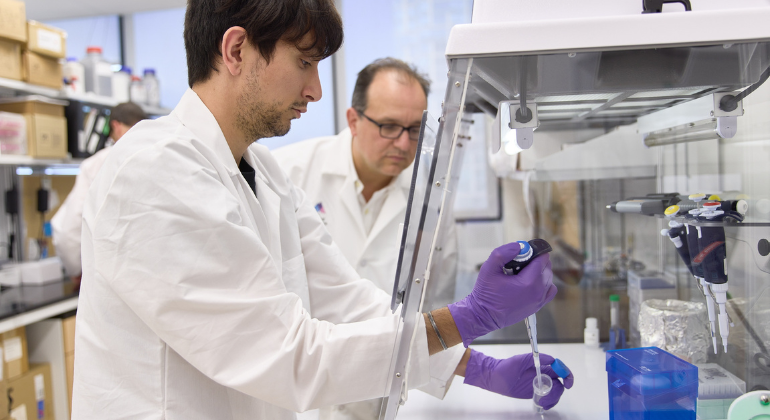
Dr. Santiago Vidal-Freire (left) and Dr. Gustavo Palacios (right) perform research in Palacios lab at the Icahn School of Medicine at Mount Sinai.
Mount Sinai researchers have identified a single amino acid difference between rodent- and human-derived Andes virus isolates that changes how a key viral protein behaves inside human cells. The findings help explain biological differences between closely related virus isolates.
Published November 6 in Science Advances, the study found that this difference affects how an Andes virus glycoprotein moves through human cells and how quickly virus-like particles are released.
Andes virus is a rodent-borne RNA virus that can cause hantavirus pulmonary syndrome, a severe and potentially life-threatening illness. It was the virus involved in the fatal 2026 outbreak aboard the cruise ship Hondius. Unlike other known hantaviruses, Andes virus can spread from person to person. Understanding its biological behavior may help researchers investigate factors involved in human infection and transmission.
Researchers in the Palacios Lab at the Icahn School of Medicine at Mount Sinai compared an Andes virus isolate from a rodent host with a human-derived isolate collected during the 2018-2019 outbreak in Epuyén, Argentina. That outbreak involved person-to-person transmission and resulted in 11 deaths. Previous research identified biological differences between the genetically similar isolates.
The researchers identified 25 amino acid differences between the isolates. They focused on one difference near a part of the virus known as the glycoprotein cleavage domain because of its potential relevance to glycoprotein processing and virus assembly.

Microscopy images show the cell membrane, Golgi apparatus, and differences in the cellular localization of Andes virus glycoproteins between ARG-Epuyén wild-type and I641T variants. Credit: Science Advances and Natalia Ferressini Gerpe/Icahn School of Medicine at Mount Sinai
The rodent-derived isolate grew faster than the human-derived isolate, although both eventually reached similar levels. After finding no major changes in viral RNA production that could explain the difference, the researchers investigated later stages of the viral lifecycle. They changed one amino acid in the human-derived isolate’s glycoprotein to match the rodent-derived version. The modified protein spent less time in the Golgi apparatus, a cell compartment involved in protein processing, and virus-like particles were released more quickly.
“We still know relatively little about the viral features that may influence how Andes virus behaves in humans. What this study gives us is a specific molecular difference that we can connect to a measurable biological change. Understanding those connections is an important step toward identifying the viral features that may shape how these pathogens adapt, spread, and cause disease,” said corresponding author Gustavo Palacios, PhD, Professor of Microbiology at the Icahn School of Medicine at Mount Sinai.
The results provide a starting point for studying how genetic differences between rodent- and human-derived Andes virus isolates affect viral biology.
The team used molecular expression systems and virus-like particles, not genetically modified infectious Andes virus. The results do not show that this amino acid change causes person-to-person transmission or adaptation to humans. Further research is needed to determine its effects in the complete virus and any relationship to disease or transmission.
“Among the differences between these two viruses, we focused on this particular change because of its location in a key viral protein. Understanding how such a small molecular difference can affect viral protein processing and the release of new viral particles could help identify new targets for antiviral therapies. It may also provide valuable insights into the molecular factors that contribute to differences in viral pathogenicity, ultimately helping guide future research toward better treatments,” said first author Santiago Vidal-Freire, PhD, an associate scientist and postdoctoral fellow in Microbiology at the Icahn School of Medicine at Mount Sinai.
The researchers also noted that viral sequences from the Hondius outbreak could support future studies. Using similar experimental systems, researchers could examine changes identified in the glycoprotein transmembrane domain of the Hondius isolate and assess their effects on viral protein behavior. Such studies may help clarify which molecular differences influence Andes virus biology.
Mount Sinai researchers collaborated with scientists from the Administración Nacional de Laboratorios e Institutos de Salud Dr. Carlos G. Malbrán (ANLIS) in Argentina; Centro Ciencia y Vida and Universidad San Sebastián in Chile; the U.S. Army Medical Research Institute of Infectious Diseases; and the National Institute of Allergy and Infectious Diseases. Research support came from the Advanced Research Projects Agency for Health (ARPA-H), the Icahn School of Medicine at Mount Sinai, the Global Health and Emerging Pathogens Institute, Centro Ciencia y Vida, and the National Institute of Allergy and Infectious Diseases.
About the Mount Sinai Health System
Mount Sinai Health System is one of the nation’s leading integrated academic health systems and one of the largest in the New York metropolitan area. Its comprehensive system includes seven hospitals, more than 400 outpatient practices, over 600 research and clinical laboratories, the Icahn School of Medicine at Mount Sinai, the Graduate School of Biomedical Sciences, and the Mount Sinai Phillips School of Nursing. Together, the Health System comprises approximately 48,000 employees, more than 9,000 physicians, and 8,600 nurses.
As a leading learning health system, Mount Sinai combines clinical expertise with scientific discovery to improve patient care while training the next generation of health care and biomedical leaders. The Health System provides care across every stage of life, from prenatal care through geriatrics, while advancing personalized medicine through artificial intelligence, data science, and biomedical research.
Mount Sinai is consistently recognized among the nation’s leading academic health systems for patient care, research, and education. The Mount Sinai Hospital is ranked No. 1 in New York by Newsweek® and No. 7 in the U.S. on the magazine’s 2026 World’s Best Hospitals list and No. 3 in the world in its World’s Best Smart Hospitals list. The Icahn School of Medicine at Mount Sinai ranks No. 9 among U.S. medical schools and No. 1 among freestanding medical schools for National Institutes of Health grant funding, reflecting the strength of its scientific enterprise and leadership in biomedical research.