
Mount Sinai Performs New York City’s First Robotic Nipple-Sparing Mastectomy
FDA-approved approach enables breast tissue removal through a small underarm incision, followed by immediate reconstruction
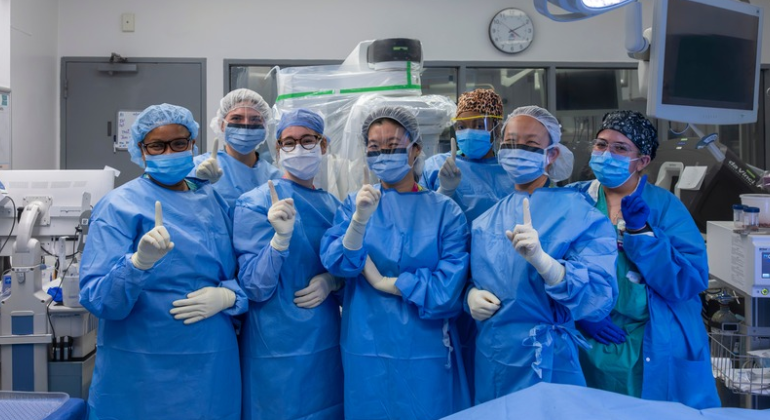
Mount Sinai Tisch Cancer Center has performed the first robotic nipple-sparing mastectomy in New York City. The procedure, which used Intuitive Surgical’s da Vinci Single-Port (SP) robotic system following U.S. Food and Drug Administration (FDA) clearance earlier this year, marks a milestone in breast surgery and introduces an emerging minimally invasive capability at Mount Sinai.
On Wednesday, October 28, during Breast Cancer Awareness Month, Tristen S. Park, MD, a breast surgical oncologist and Associate Professor of Surgery at the Icahn School of Medicine at Mount Sinai, performed a bilateral robotic nipple-sparing mastectomy on a 44-year-old patient with a BRCA1 genetic mutation. Alice Yao, MD, Associate Professor of Surgery (Plastic and Reconstructive Surgery), performed immediate implant-based breast reconstruction. The patient recovered well and returned home the day after surgery.
The robotic system enables surgeons to remove breast tissue through an approximately 3.5-centimeter incision below the armpit while preserving the breast skin and nipple-areolar complex. The incision is away from the breast itself. Combined with immediate reconstruction, this approach aims to preserve the breast’s external appearance without traditional mastectomy incisions.
“The successful completion of this procedure is an exciting milestone for Mount Sinai and reflects the extraordinary dedication and collaboration of our surgical teams,” said Elisa Port, MD, Chief of Breast Surgery at Mount Sinai and the Director of the Dubin Breast Center at The Mount Sinai Hospital. “Congratulations to Tristen Park on a tremendous achievement and thank you to everyone in the operating room for your invaluable contributions and partnership. This is an important step in advancing innovative, patient-centered breast cancer care and exemplifies Mount Sinai breast surgery and plastic surgical teams’ commitment to delivering the highest and most advanced level of breast cancer care on all fronts.”
Nipple-sparing mastectomy may be an option for selected patients undergoing surgery for breast cancer or to reduce their risk of developing it. For people with BRCA1 or BRCA2 mutations, preventive mastectomy can significantly reduce breast cancer risk. Preserving the nipple and breast skin may also support body image and emotional well-being after surgery.
“Robotic-assisted nipple-sparing mastectomy can offer substantially improved precision and visualization for the surgeon. Published data thus far have demonstrated promising outcomes in preserving sensation, as well as patient satisfaction and quality-of-life measures compared with traditional approaches,” said Dr. Park. “I am also deeply grateful to our Chief of Breast Surgery, Dr. Port, our hospital and operating room leadership, and our exceptional surgical team for their support and dedication throughout this effort.”
Dr. Park began exploring robotic breast surgery in 2022, when she traveled to South Korea as a visiting professor and observed Professor Han-Byoel Lee, MD, PhD, and his team perform robotic breast surgery at Seoul National University. She subsequently pursued mentorship and training with robotic breast surgeons in France, South Korea, Taiwan, and the United States.
As of the surgery on October 28, 2026, Dr. Park was one of the first breast surgeons credentialed to perform this procedure with this robotic system in the United States and the first one in New York City. She also serves on the American Society of Breast Surgeons’ Robotic Surgery Task Force, which is working to develop national guidelines and best practices, establish a nationwide robotic breast surgery registry, and advance surgeon education.
This procedure reflects Mount Sinai Tisch Cancer Center’s commitment to advancing breast cancer care through surgical innovation, multidisciplinary collaboration, and treatment tailored to each patient.
About the Mount Sinai Tisch Cancer Center
The Mount Sinai Tisch Cancer Center is a vital component of the Icahn School of Medicine at Mount Sinai and the Mount Sinai Health System, which encompasses seven hospitals and more than 400 physician practices across the New York City metropolitan area. The mission of the Mount Sinai Tisch Cancer Center—a National Cancer Institute-designated Comprehensive Cancer Center—is to advance basic, clinical, and population health cancer research in order to prevent cancer in healthy individuals and improve the lives of people with cancer and their families in its communities. Its research programs are focused on the needs of its catchment area population and include extensive research in liver, prostate, breast, bladder, and lung cancers; myeloid preleukemia and leukemia; and multiple myeloma. The Mount Sinai Tisch Cancer Center features multidisciplinary, innovative cancer care. It has a robust portfolio of cancer clinical trials and an Early-Phase Trial Unit focused on novel therapies for optimal patient outcomes. Construction of the state-of-the-art Mount Sinai Tisch Cancer Hospital began in spring 2026 and is expected to be completed in the coming years, further expanding Mount Sinai’s capacity to deliver innovative, patient-centered cancer care.
* Mount Sinai Health System hospitals: The Mount Sinai Hospital; Mount Sinai Brooklyn; Mount Sinai Morningside; Mount Sinai Queens; Mount Sinai South Nassau; Mount Sinai West; and New York Eye and Ear Infirmary of Mount Sinai.
About the Mount Sinai Health System
Mount Sinai Health System is one of the nation’s leading integrated academic health systems and one of the largest in the New York metropolitan area. Its comprehensive system includes seven hospitals, more than 400 outpatient practices, over 600 research and clinical laboratories, the Icahn School of Medicine at Mount Sinai, the Graduate School of Biomedical Sciences, and the Mount Sinai Phillips School of Nursing. Together, the Health System comprises approximately 48,000 employees, more than 9,000 physicians, and 8,600 nurses.
As a leading learning health system, Mount Sinai combines clinical expertise with scientific discovery to improve patient care while training the next generation of health care and biomedical leaders. The Health System provides care across every stage of life, from prenatal care through geriatrics, while advancing personalized medicine through artificial intelligence, data science, and biomedical research.
Mount Sinai is consistently recognized among the nation’s leading academic health systems for patient care, research, and education. The Mount Sinai Hospital is ranked No. 1 in New York by Newsweek® and No. 7 in the U.S. on the magazine’s 2026 World’s Best Hospitals list and No. 3 in the world in its World’s Best Smart Hospitals list. The Icahn School of Medicine at Mount Sinai ranks No. 9 among U.S. medical schools and No. 1 among freestanding medical schools for National Institutes of Health grant funding, reflecting the strength of its scientific enterprise and leadership in biomedical research.
The Tisch Cancer Institute Emphasizes Critical Role of BRCA Testing For All Genders
Oct 14, 2024 View All Press Releases
Mount Sinai Launches Clinic to Help Breast Cancer Patients in Need of Legal Services
Aug 02, 2023 View All Press Releases
Mount Sinai’s Dubin Breast Center Raises More than $3 Million for 12th Anniversary
Dec 16, 2022 View All Press Releases
Mount Sinai’s Dubin Breast Center Annual Benefit Raises Over $2.5 Million
Feb 08, 2022 View All Press Releases