Mount Sinai Researchers Uncover a Key Neural Mechanism Believed to Support Advanced Cognitive Abilities
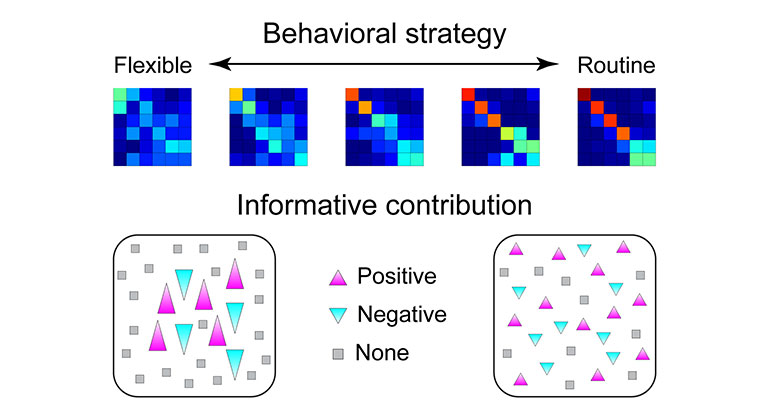
Mount Sinai scientists have discovered a neural mechanism that is believed to support advanced cognitive abilities such as planning and problem-solving. It does so by distributing information from single neurons to larger populations of neurons in the prefrontal cortex, the area of the brain that temporarily stores and manipulates information.
It is well established that humans can only hold a limited amount of information in mind at a time, and that they enlist different cognitive strategies, like organizing information into lists or groups, to overcome these constraints. The research team found that when the brain uses these strategies to organize information, neural codes in the prefrontal cortex become less dependent on the highly selective responses of single neurons. Instead, they become distributed among a larger pool of neurons, which may make the information more reliable or robust. The findings were published online in Neuron on December 20.
“Our study gives the field an important new perspective on how the brain allocates its resources to improve cognitive performance,” says senior author Erin Rich, MD, PhD, Associate Professor of Neuroscience at the Icahn School of Medicine at Mount Sinai. “Findings from our study will help scientists to better understand, and in the future to potentially treat, disorders of memory and cognition.”
The study was led by Feng-Kuei Chiang, PhD, a postdoctoral fellow in Dr. Rich’s lab who has previously studied functions of the prefrontal cortex in sequencing tasks.
Traditionally, studies of neural coding—which transforms electrical impulses from the neurons into memories, knowledge, decisions, and actions—have focused on selective responses of single neurons. The Mount Sinai team demonstrated the shortcomings of such an approach by designing a task to probe changes in the prefrontal cortex that result in improved cognitive performance. The task allowed the subjects to use a mnemonic (or memory aid) strategy to order information into a sequence.
“We found that subjects spontaneously generated different selection patterns, including routine sequences, to decrease the working memory demands of the task,” said Dr. Chiang.
Researchers were surprised to find that interpretable responses of single neurons were a poor predictor of memory performance when subjects used the sequencing strategy to organize information held in the mind. Using the strategy reduced error rates in the task, but the activity of single neurons appeared to convey less information. They were able to reconcile these findings by showing that the information was not lost, but more widely distributed among a larger population of neurons. The task-relevant information could be recovered as well or better than when the codes were dominated by a smaller number of highly tuned neurons, and the distributed codes appeared to be more reliable, since they improved behavioral performance.
“This is a brand-new discovery in the nature of prefrontal codes, and it could point to a key neural mechanism that supports advanced cognitive abilities like planning, strategizing, and problem-solving that depend on real-time organization of information,” explains Dr. Rich. “By shifting the focus from selective responses of single neurons, we’ve shown that the collective activity of neural populations needs to be considered when developing new strategies to improve cognitive performance or treat cognitive disorders.”
About the Mount Sinai Health System
Mount Sinai Health System is one of the nation’s leading integrated academic health systems and one of the largest in the New York metropolitan area. Its comprehensive system includes seven hospitals, more than 400 outpatient practices, over 600 research and clinical laboratories, the Icahn School of Medicine at Mount Sinai, the Graduate School of Biomedical Sciences, and the Mount Sinai Phillips School of Nursing. Together, the Health System comprises approximately 48,000 employees, more than 9,000 physicians, and 8,600 nurses.
As a leading learning health system, Mount Sinai combines clinical expertise with scientific discovery to improve patient care while training the next generation of health care and biomedical leaders. The Health System provides care across every stage of life, from prenatal care through geriatrics, while advancing personalized medicine through artificial intelligence, data science, and biomedical research.
Mount Sinai is consistently recognized among the nation’s leading academic health systems for patient care, research, and education. The Mount Sinai Hospital is ranked No. 1 in New York by Newsweek and No. 5 on the magazine’s World’s Best Hospitals list. The Icahn School of Medicine at Mount Sinai ranks No. 11 among U.S. medical schools and No. 1 among freestanding medical schools for National Institutes of Health funding, reflecting the strength of its scientific enterprise and leadership in biomedical research.

Researchers Discover Rare Cortical Neurons That Can Help Put the Brain to Sleep
Sep 11, 2026 View All Press Releases