Deep Brain Stimulation Remodels Brain Wiring and Alters Functional Changes to Brain-Wide Networks, Landmark Depression Study Reveals
Findings provide first direct evidence that DBS rewires white matter pathways, opening new directions for psychiatric treatment
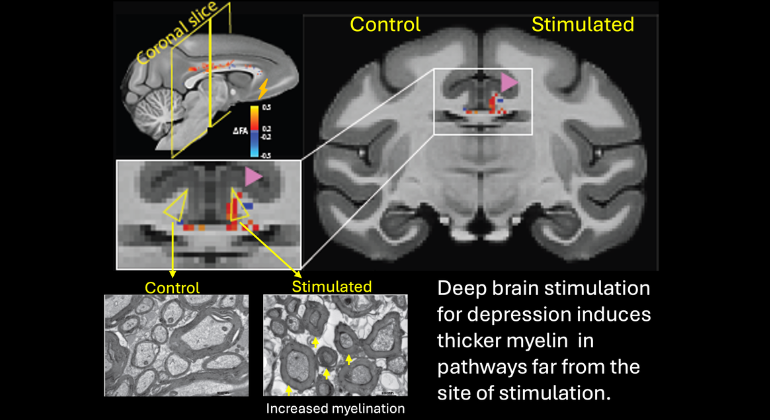
Researchers from the Icahn School of Medicine at Mount Sinai have uncovered the first direct evidence that deep brain stimulation (DBS) can remodel white matter pathways in the brain and alter communication across large-scale neural networks, revealing a previously unrecognized mechanism that may explain how the therapy helps patients recover from severe depression.
The study, published June 1 in Nature Neuroscience [DOI: https://doi.org/10.1038/s41593-026-02301-4D], provides critical insight into the biological basis of DBS, an emerging therapy for treatment-resistant depression and other neuropsychiatric disorders.
Deep brain stimulation, approved by the U.S. Food and Drug Administration to treat essential tremor, Parkinson’s disease, epilepsy, and obsessive-compulsive disorder, is a neurosurgical procedure involving placement of a neurostimulator (sometimes referred to as a “brain pacemaker”), which sends high-frequency electrical impulses through implanted electrodes deep in the brain to specific areas responsible for the symptoms of each disorder.
Although DBS has shown sustained clinical benefit for many patients with severe depression who do not respond to medications, psychotherapy, and electroconvulsive therapy, the mechanisms underlying its therapeutic effects have remained poorly understood.
“What is exciting about our findings is that they change how we think about deep brain stimulation,” said Peter Rudebeck, PhD, Professor of Neuroscience, and Psychiatry, at the Icahn School of Medicine at Mount Sinai and co-senior author of the paper. “For the first time, we show that DBS does not simply alter electrical activity in the brain in the short term—it can actually remodel white matter structure, essentially rewiring brain circuits associated with depression.”
In the study, investigators delivered DBS to white matter pathways adjacent to the subcallosal anterior cingulate cortex (SCC), a brain region previously identified as an effective target for treating depression in humans. White matter is a type of tissue found below the surface or cortex of the brain and consists mainly of bundles of axons, which are extensions of brain cells that transmit electrical signals. Using a non-human primate model, researchers were able to isolate the direct biological effects of stimulation without the confounding influence of underlying disease.
The team found that SCC-DBS selectively increased fractional anisotropy—a marker associated with white matter integrity and organization—within the cingulum bundle, one of the major white matter tracts implicated in mood regulation. At the cellular level, DBS increased both the number of myelinated oligodendrocytes and the degree of myelination within the pathway. Oligodendrocytes are the support cells in the white matter of the brain that help to promote the propagation of neural signals; an increase in these cells suggests that stimulation promotes structural remodeling of brain circuitry.
Researchers also observed widespread changes in functional connectivity across the brain, particularly involving the default mode network, a network of areas strongly implicated in depression and rumination.
“Previously, it was not clear how deep brain stimulation affected brain structure and function,” said Helen Mayberg, MD, Professor of Neurology, Neurosurgery, Psychiatry, and Neuroscience at the Icahn School of Medicine and co-senior author of the paper. “This study addresses a major gap in our understanding and points to an unappreciated mechanism contributing to sustained long-term recovery, something we have observed in our DBS depression clinical research over many years and an important focus of our current National Institutes of Health BRAIN initiative-funded studies.”
The findings may have important implications for improving DBS therapies and developing entirely new treatment strategies aimed at promoting white matter remodeling.
“Now that we know DBS can drive structural plasticity in white matter, we can begin thinking about how to optimize stimulation approaches and potentially develop novel therapies that target these mechanisms through nonsurgical means,” said Dr. Mayberg.
The study also opens broader questions about whether similar mechanisms may contribute to recovery in other psychiatric and neurological disorders treated with DBS.
Dr. Mayberg and her team at the Nash Family Center for Advanced Circuit Therapeutics at Mount Sinai are now investigating whether the same white matter remodeling effects occur in human patients undergoing DBS for depression. Future work will also examine how DBS alters patterns of activity in individual neurons across brain networks.
“Understanding how brain circuits physically and functionally change in response to stimulation could hasten development of next-generation therapies for psychiatric disorders,” said Brian Russ, PhD, co-senior study author and Research Scientist at the Nathan Kline Institute for Psychiatric Research, a facility of the New York State Office of Mental Health.
About the Icahn School of Medicine at Mount Sinai
The Icahn School of Medicine at Mount Sinai is internationally renowned for its outstanding research, educational, and clinical care programs. It is the sole academic partner for the seven member hospitals* of the Mount Sinai Health System, one of the largest academic health systems in the United States, providing care to New York City’s large and diverse patient population.
The Icahn School of Medicine at Mount Sinai offers highly competitive MD, PhD, MD-PhD, and master’s degree programs, with enrollment of more than 1,200 students. It has the largest graduate medical education program in the country, with more than 2,700 clinical residents and fellows training throughout the Health System. The Graduate School of Biomedical Sciences offers 13 degree-granting programs, conducts innovative basic and translational research, and trains more than 470 postdoctoral research fellows.
Ranked 11th nationwide in National Institutes of Health (NIH) funding, the Icahn School of Medicine at Mount Sinai is among the 90th percentile of U.S. private medical schools in Sponsored Programs Direct Expenditures per Principal Investigator, according to the Association of American Medical Colleges. More than 6,900 scientists, educators, and clinicians work within and across dozens of academic departments and multidisciplinary institutes with an emphasis on translational research and therapeutics. Through Mount Sinai Innovation Partners (MSIP), the Health System facilitates the real-world application and commercialization of medical breakthroughs made at Mount Sinai.
-------------------------------------------------------
* Mount Sinai Health System member hospitals: The Mount Sinai Hospital; Mount Sinai Brooklyn; Mount Sinai Morningside; Mount Sinai Queens; Mount Sinai South Nassau; Mount Sinai West; and New York Eye and Ear Infirmary of Mount Sinai.
About the Mount Sinai Health System
Mount Sinai Health System is one of the nation’s leading integrated academic health systems and one of the largest in the New York metropolitan area. Its comprehensive system includes seven hospitals, more than 400 outpatient practices, over 600 research and clinical laboratories, the Icahn School of Medicine at Mount Sinai, the Graduate School of Biomedical Sciences, and the Mount Sinai Phillips School of Nursing. Together, the Health System comprises approximately 48,000 employees, more than 9,000 physicians, and 8,600 nurses.
As a leading learning health system, Mount Sinai combines clinical expertise with scientific discovery to improve patient care while training the next generation of health care and biomedical leaders. The Health System provides care across every stage of life, from prenatal care through geriatrics, while advancing personalized medicine through artificial intelligence, data science, and biomedical research.
Mount Sinai is consistently recognized among the nation’s leading academic health systems for patient care, research, and education. The Mount Sinai Hospital is ranked No. 1 in New York by Newsweek® and No. 7 in the U.S. on the magazine’s World’s Best Hospitals 2026 list. The Icahn School of Medicine at Mount Sinai ranks No. 9 among U.S. medical schools and No. 1 among freestanding medical schools for National Institutes of Health grant funding, reflecting the strength of its scientific enterprise and leadership in biomedical research.