
Study Reveals Structure of Brain Protein and Identifies Potential Drug Target for Epilepsy Research
Findings could also help advance understanding of other brain disorders
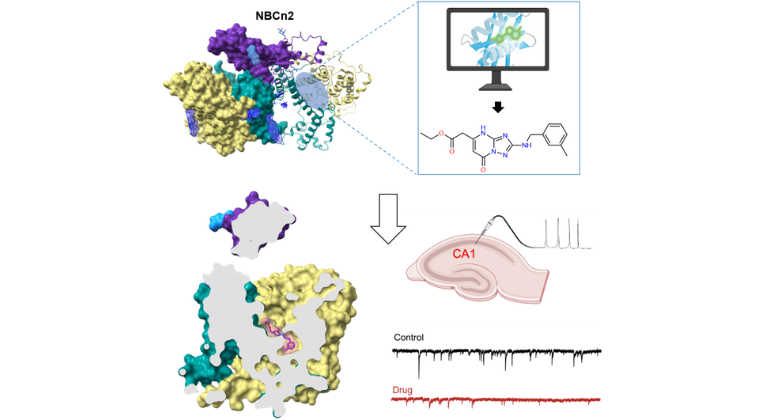
Researchers at the Icahn School of Medicine at Mount Sinai mapped a brain protein linked to autism and epilepsy and developed a compound that blocks it, reducing brain activity in tissue studies and pointing to a potential new treatment approach. Wacker et al., Nature Communications.
Scientists at the Icahn School of Medicine at Mount Sinai have uncovered the first high-resolution structure of NBCn2, a brain protein linked to epilepsy, autism spectrum disorder, and other neurological conditions, and developed the first compounds capable of inhibiting its activity. The findings provide a new framework for studying how altered brain signaling contributes to disease and may help advance future therapeutic research.
Their findings were published today by Nature Communications [DOI:10.1038/S41467-026-75444-4].
The study focuses on the protein, NBCn2, which helps regulate acid-base balance inside brain cells. Although genetic variants affecting NBCn2 have been associated with multiple neurological disorders, scientists previously knew very little about how the protein worked or how to target it with drugs.
Using cryo-electron microscopy, the researchers captured the first highly detailed structural images of NBCn2, revealing how it transports sodium and carbonate ions, which help regulate cellular acidity, into cells to help control brain cell activity.
“This protein had been largely overlooked, despite clear links to serious neurological disorders,” says senior and co-corresponding author Daniel Wacker, PhD, Associate Professor of Pharmacological Sciences, and Neuroscience, at the Icahn School of Medicine at Mount Sinai. “We wanted to understand how NBCn2 functions at a molecular level and whether it could become a viable target for future therapies for neurological disorders.”
The team then used the structural data as a blueprint to design and test compounds that could inhibit NBCn2. In experiments using brain cells and brain tissue from mice, one of the compounds reduced electrical signaling between neurons.
“For the first time, we were able to pharmacologically control this transporter and directly observe effects on neuronal activity,” says co-corresponding author Bin Zhang, PhD, Willard T.C. Johnson Research Professor of Neurogenetics and Director of the Mount Sinai Center for Transformative Disease Modeling. “That gives us an important starting point for understanding how NBCn2 contributes to brain function and neurological disease.”
In addition to cryo-electron microscopy, the investigators used computer modeling, AI-based structural predictions, and large-scale virtual screening of millions of chemical compounds to conduct the study. Candidate compounds were first tested in cells and then evaluated in neurons and mouse brain tissue using electrical recording techniques.
The researchers also discovered unexpected details about how NBCn2 binds sodium and carbonate ions. The arrangement differed from related proteins, suggesting that even closely related transporters may operate in distinct ways.
“One surprising finding was that NBCn2 uses a substrate binding mechanism we had not seen before in related proteins,” says Shifan Yang, PhD, first author of this study and Senior Scientist in the Department of Genetics and Genomic Sciences at the Icahn School of Medicine at Mount Sinai. “That difference may ultimately help all scientists design more selective drugs in the future.”
The findings could help researchers better study disorders involving excessive neuronal activity, including epilepsy. However, they caution that the compounds developed in the study are early-stage research tools and are not ready for use in patients.
“These compounds are not drugs,” says Avner Schlessinger, PhD, a co-corresponding author and Professor of Pharmacological Sciences, Director of the Small Molecule AI Drug Discovery Center, and Associate Director of the Mount Sinai Center for Therapeutics Discovery at the Icahn School of Medicine at Mount Sinai. “Much more work is needed to improve their potency and selectivity and to test them in more complex disease models, including animals and human-derived systems before any therapeutic conclusions can be made.”
The research team plans to continue refining the compounds and studying whether targeting NBCn2 could help reduce seizures or influence other neurological conditions. They also hope the work provides a framework for studying other understudied transporter proteins involved in brain disease across the wider research community.
The paper is titled “Structural insights enable drug discovery for the neuronal NBCn2 carbonate transporter.”
The authors, as listed in the journal, are Shifan Yang, Yihan Zhao, Sezen Vatansever, Gregory Zilberg, Michael J. Capper, Jinglong Zhang, Joshua Stamos, Keino Hutchinson, Audrey L. Warren, Alexander C. Stone, Anwar Abbassi, Eric Purisic, Lap Ho, Aiqun Li, Jinye Dai, Avner Schlessinger, Bin Zhang, and Daniel Wacker.
For details on funding and conflicts of interest, see the study at Nature Communications [DOI:10.1038/S41467-026-75444-4].
About the Icahn School of Medicine at Mount Sinai
The Icahn School of Medicine at Mount Sinai is internationally renowned for its outstanding research, educational, and clinical care programs. It is the sole academic partner for the seven member hospitals* of the Mount Sinai Health System, one of the largest academic health systems in the United States, providing care to New York City’s large and diverse patient population.
The Icahn School of Medicine at Mount Sinai offers highly competitive MD, PhD, MD-PhD, and master’s degree programs, with enrollment of more than 1,200 students. It has the largest graduate medical education program in the country, with more than 2,700 clinical residents and fellows training throughout the Health System. The Graduate School of Biomedical Sciences offers 13 degree-granting programs, conducts innovative basic and translational research, and trains more than 470 postdoctoral research fellows.
Ranked 11th nationwide in National Institutes of Health (NIH) funding, the Icahn School of Medicine at Mount Sinai is among the 90th percentile of U.S. private medical schools in Sponsored Programs Direct Expenditures per Principal Investigator, according to the Association of American Medical Colleges. More than 6,900 scientists, educators, and clinicians work within and across dozens of academic departments and multidisciplinary institutes with an emphasis on translational research and therapeutics. Through Mount Sinai Innovation Partners (MSIP), the Health System facilitates the real-world application and commercialization of medical breakthroughs made at Mount Sinai.
-------------------------------------------------------
* Mount Sinai Health System member hospitals: The Mount Sinai Hospital; Mount Sinai Brooklyn; Mount Sinai Morningside; Mount Sinai Queens; Mount Sinai South Nassau; Mount Sinai West; and New York Eye and Ear Infirmary of Mount Sinai.
About the Mount Sinai Health System
Mount Sinai Health System is one of the nation’s leading integrated academic health systems and one of the largest in the New York metropolitan area. Its comprehensive system includes seven hospitals, more than 400 outpatient practices, over 600 research and clinical laboratories, the Icahn School of Medicine at Mount Sinai, the Graduate School of Biomedical Sciences, and the Mount Sinai Phillips School of Nursing. Together, the Health System comprises approximately 48,000 employees, more than 9,000 physicians, and 8,600 nurses.
As a leading learning health system, Mount Sinai combines clinical expertise with scientific discovery to improve patient care while training the next generation of health care and biomedical leaders. The Health System provides care across every stage of life, from prenatal care through geriatrics, while advancing personalized medicine through artificial intelligence, data science, and biomedical research.
Mount Sinai is consistently recognized among the nation’s leading academic health systems for patient care, research, and education. The Mount Sinai Hospital is ranked No. 1 in New York by Newsweek and No. 5 on the magazine’s World’s Best Hospitals list. The Icahn School of Medicine at Mount Sinai ranks No. 11 among U.S. medical schools and No. 1 among freestanding medical schools for National Institutes of Health funding, reflecting the strength of its scientific enterprise and leadership in biomedical research.