
Mount Sinai Researchers Identify a Shared Molecular Weakness in Glioblastoma Tumor Cells That May Offer a New Treatment Target
Study identifies POU3F3 as a protein that helps tumor cells take advantage of a cell trait normally active during brain development
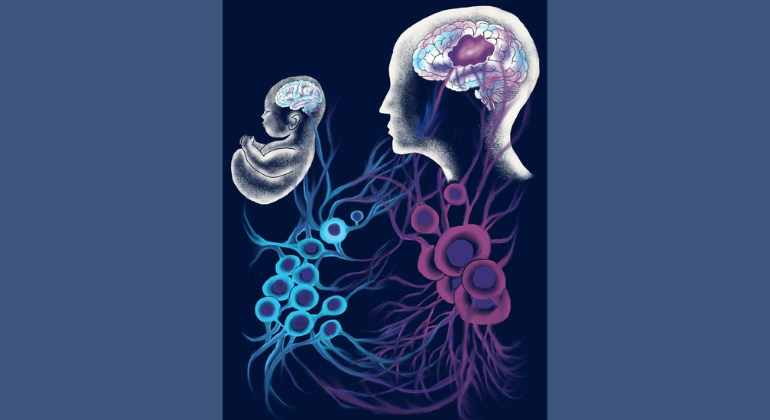
The artistic illustration depicts the concept of oncofetal signaling in glioblastoma (GBM), in which malignant brain tumor cells co-opt signaling programs normally active during brain development. The blue cells represent neurodevelopmental glial intermediate progenitor cells (gIPCs), while the maroon cells represent GBM tumor cells. The interwoven, thread-like structures connecting the two cell populations symbolize the rewiring of developmental signaling networks and the reactivation of oncofetal programs through which GBM cells exploit lineage plasticity. These oncofetal programs may reveal targetable vulnerabilities in malignant brain tumors, offering potential avenues for therapeutic intervention. Credit: Somlee Gupta, PhD
Researchers at the Icahn School of Medicine at Mount Sinai have identified a shared molecular trait in glioblastoma, an aggressive brain cancer in adults. It resembles one used by immature cells during brain development and may reveal a target for future treatments.
The study, published online November 11 in Neuron, found that many glioblastoma cells resemble glial intermediate progenitor cells (gIPCs), immature cells involved in brain development. Researchers identified POU3F3, a protein that regulates gene activity, as an important factor in maintaining this resemblance. In patient-derived tumor cell models, reducing POU3F3 activity made tumor cells less aggressive, suggesting a potential direction for future drug development.
"Glioblastoma is a devastating disease, and current treatments have limited success. One of the biggest challenges is that these tumors are made up of many different types of cancer cells, making them difficult to eliminate,” said Nadejda (Nadia) Tsankova, MD, PhD, Professor of Pathology and Laboratory Medicine, and Neuroscience, and Director of Neuropathology at the Icahn School of Medicine at Mount Sinai. “We were very excited to find a shared biological program that glioblastoma cells have in common, despite their notorious heterogeneity, and to identify the transcription factor POU3F3 as a key protein that helps maintain this program in tumor cells. While more research is needed before this approach can be tested in humans, the discovery provides a new direction for developing therapies against this difficult-to-treat cancer.”
A Shared Developmental Program Across Glioblastoma Tumors
Glioblastoma is difficult to treat in part because its cells can differ substantially, even within a single tumor. This diversity, or heterogeneity, makes it hard to target all cells in the tumor with one approach.
Despite tumor heterogeneity, researchers found that many glioblastomas share a pattern of gene activity resembling that of gIPCs, which help generate supporting brain cells and can divide and move through developing tissue.
The researchers found that glioblastoma cells may reactivate aspects of this developmental program to support growth, infiltration through brain tissue, and continued production of tumor cells. The pattern appeared in samples from multiple patients, including newly diagnosed and recurrent glioblastomas, and across different tumor regions and genetic backgrounds.
POU3F3: A Potential Molecular Target in Glioblastoma
POU3F3 is a transcription factor, a protein that helps control which genes are active. The researchers identified it as an important regulator of the gIPC-like state in glioblastoma cells.
In experiments using primary tumor cells derived from patients, lowering POU3F3 levels reduced features associated with aggressive tumor behavior, including the ability to keep producing tumor cells, multiply, and invade surrounding tissue. Increasing POU3F3 activity promoted a return to a more immature, stem-cell like state that sustains tumor proliferation and invasion.
These preclinical findings suggest that POU3F3 or the biological processes it regulates could be investigated as targets for future glioblastoma treatments.
How Brain Development Research Informed the Glioblastoma Study
The study builds on earlier research by Dr. Tsankova and her team identifying gIPCs as a distinct brain cell type present during late pregnancy and early infancy. That earlier discovery provided a detailed picture of how these cells behave during normal brain development. The team used that knowledge to investigate whether cancer cells might reuse some of the same biological instructions.
For this study, the team mapped gene activity in individual cells from the developing human brain and compared those patterns with glioblastoma tumor data. Computational analyses and laboratory experiments helped identify developmental programs shared by the tumor cells.
Among the developing brain cell types examined, glioblastoma cells most closely resembled gIPCs, linking a normal developmental cell program with aggressive brain tumor biology.
“We believe this shared feature could represent a new weakness in glioblastoma that researchers may be able to target with future treatments," said Dr. Tsankova.
What the Findings Could Mean for Future Glioblastoma Treatments
The findings suggest that researchers could explore this shared developmental program in glioblastoma alongside the genetic mutations that differ from tumor to tumor.
Because the gIPC-like program appeared in newly diagnosed and recurrent tumors, it may be relevant across different stages of the disease. Researchers next need to determine whether blocking POU3F3 or related processes can safely and effectively slow glioblastoma growth.
The findings provide a foundation for investigating treatments directed at a biological feature shared by many glioblastomas.
The study was led by postdoctoral fellows Susana Isabel Ramos, PhD, and Mohammad Imran Khalil Khan, PhD, in Dr. Tsankova’s laboratory. Collaborators included researchers and clinicians in Pathology and Laboratory Medicine, Neuroscience, Neurosurgery, Neurology, and Genetics and Genomic Sciences at Mount Sinai.
About the Icahn School of Medicine at Mount Sinai
The Icahn School of Medicine at Mount Sinai is internationally renowned for its outstanding research, educational, and clinical care programs. It is the sole academic partner for the seven member hospitals* of the Mount Sinai Health System, one of the largest academic health systems in the United States, providing care to New York City’s large and diverse patient population.
The Icahn School of Medicine at Mount Sinai offers highly competitive MD, PhD, MD-PhD, and master’s degree programs, with enrollment of more than 1,200 students. It has the largest graduate medical education program in the country, with more than 2,700 clinical residents and fellows training throughout the Health System. The Graduate School of Biomedical Sciences offers 12 degree-granting programs, conducts innovative basic and translational research, and trains more than 470 postdoctoral research fellows.
Ranked No. 9 nationwide in National Institutes of Health (NIH) grant funding, the Icahn School of Medicine at Mount Sinai is among the 90th percentile of U.S. private medical schools in Sponsored Programs Direct Expenditures per Principal Investigator, according to the Association of American Medical Colleges. More than 6,900 scientists, educators, and clinicians work within and across dozens of academic departments and multidisciplinary institutes with an emphasis on translational research and therapeutics. Through Mount Sinai Innovation Partners (MSIP), the Health System facilitates the real-world application and commercialization of medical breakthroughs made at Mount Sinai.
-------------------------------------------------------
* Mount Sinai Health System member hospitals: The Mount Sinai Hospital; Mount Sinai Brooklyn; Mount Sinai Morningside; Mount Sinai Queens; Mount Sinai South Nassau; Mount Sinai West; and New York Eye and Ear Infirmary of Mount Sinai.
About the Mount Sinai Health System
Mount Sinai Health System is one of the nation’s leading integrated academic health systems and one of the largest in the New York metropolitan area. Its comprehensive system includes seven hospitals, more than 400 outpatient practices, over 600 research and clinical laboratories, the Icahn School of Medicine at Mount Sinai, the Graduate School of Biomedical Sciences, and the Mount Sinai Phillips School of Nursing. Together, the Health System comprises approximately 48,000 employees, more than 9,000 physicians, and 8,600 nurses.
As a leading learning health system, Mount Sinai combines clinical expertise with scientific discovery to improve patient care while training the next generation of health care and biomedical leaders. The Health System provides care across every stage of life, from prenatal care through geriatrics, while advancing personalized medicine through artificial intelligence, data science, and biomedical research.
Mount Sinai is consistently recognized among the nation’s leading academic health systems for patient care, research, and education. The Mount Sinai Hospital is ranked No. 1 in New York by Newsweek® and No. 7 in the U.S. on the magazine’s 2026 World’s Best Hospitals list and No. 3 in the world in its World’s Best Smart Hospitals list. The Icahn School of Medicine at Mount Sinai ranks No. 9 among U.S. medical schools and No. 1 among freestanding medical schools for National Institutes of Health grant funding, reflecting the strength of its scientific enterprise and leadership in biomedical research.