
Mindfulness-Based Therapy May Change Brain Responses to Drug Cues in People With Opioid Use Disorder, Mount Sinai Study Finds
Randomized clinical trial links changes in prefrontal brain activity to reduced opioid craving and finds longer periods of abstinence
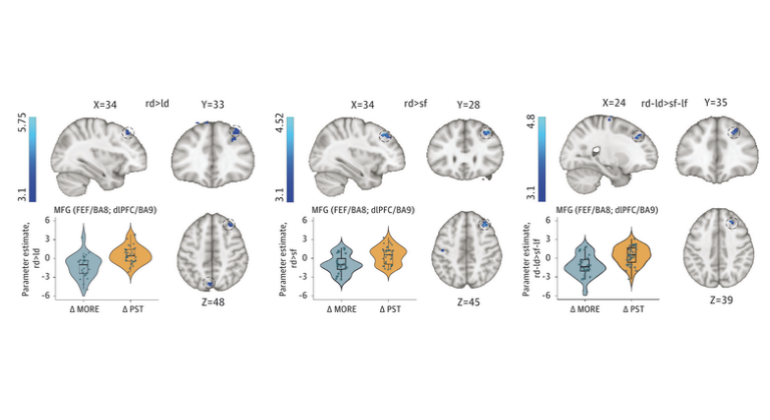
After eight weeks of Mindfulness-Oriented Recovery Enhancement, people with opioid use disorder showed reduced prefrontal cortical responses to drug cues while regulating their reactions to drug-related images; shifts away from drug cues and toward natural rewards tracked reductions in craving (Huang et al., JAMA Psychiatry, 2026). Credit: Huang et al., Neuropsychoimaging of Addiction and Related Conditions (NARC) program, Icahn School of Medicine at Mount Sinai.
Mindfulness-Oriented Recovery Enhancement (MORE), a behavioral therapy used alongside medication treatment, may help people with opioid use disorder respond differently to drug-related cues and natural rewards, according to a randomized clinical trial led by researchers at the Icahn School of Medicine at Mount Sinai. The findings offer insight into how MORE may reduce opioid craving and support recovery.
Published in JAMA Psychiatry, the study used brain imaging to examine how MORE affects the prefrontal cortex, which helps regulate behavior, make decisions, and evaluate rewards. After eight weeks, participants who received MORE showed changes in brain activity while regulating their responses to drug-related images. These changes were associated with greater reductions in craving. At a follow-up visit approximately four months after treatment, participants receiving MORE also had greater increases in the duration of abstinence than those receiving a comparison therapy.
“Opioid use disorder is a chronic condition that can involve persistent cravings and a risk of relapse, even among people receiving medications such as methadone or buprenorphine,” says Rita Z. Goldstein, PhD, Mount Sinai Professor in Neuroimaging of Addiction, Icahn School of Medicine at Mount Sinai, and senior author of the paper. “While these medications are established treatments, additional approaches that help people manage cravings and engage with rewarding experiences beyond drug use could further support recovery.”
“The prefrontal cortex sits at the top of the brain’s hierarchy for self-control and for assigning value to our experiences, and in addiction these functions are hijacked by drug cues at the expense of other rewards,” Dr. Goldstein continues. “Showing that two months of a behavioral treatment can begin to restore this balance tells us that prefrontal function in addiction is not fixed, and that recovery of brain function is possible. The mechanistic insights we uncovered could guide efforts to optimize this mindfulness training and to develop treatments that engage the same brain mechanisms directly.”
MORE combines mindfulness training, cognitive reappraisal (changing how a person interprets and responds to drug-related triggers), and savoring (paying attention to and enjoying everyday positive experiences). The treatment aims to reduce the influence of drug-related cues while strengthening responses to natural rewards. Study co-author Eric L. Garland, PhD, of the University of California San Diego developed MORE.
Previous studies have found that MORE can improve clinical outcomes for people with opioid misuse or opioid use disorder. However, researchers have not fully understood the brain mechanisms behind these effects.
The trial drew on the impaired response inhibition and salience attribution (iRISA) model of addiction. This model proposes that drug cues can command disproportionate attention and reward-related responses, while the brain's ability to regulate behavior weakens. The study focused on two regions: the lateral prefrontal cortex, which helps regulate craving, and the ventromedial prefrontal cortex, which helps assign value to drug-related and other rewards.
Researchers enrolled 86 people with opioid use disorder at a long-term inpatient treatment facility managed by Samaritan Daytop Village in New York City. All participants were receiving methadone or buprenorphine. They were randomly assigned to eight weeks of MORE or psychoeducational supportive therapy, a comparison treatment matched for duration and group format. Using functional magnetic resonance imaging (fMRI) before and after treatment, researchers measured brain responses to drug-related images, natural rewards, and drug-related scenes from the film Trainspotting. According to the researchers, this was the first randomized clinical trial to use fMRI to examine how MORE or a similar mindfulness-based intervention changes brain function in addiction.
Brain imaging revealed differences between the treatment groups. When participants were asked to reinterpret drug-related images to reduce their emotional impact, the MORE group showed less drug-related activity in the lateral prefrontal cortex than the comparison group. Within the MORE group, greater changes in prefrontal responses to drug cues and increased ventromedial prefrontal activity while savoring positive food-related images were associated with larger reductions in craving.
The movie-watching task revealed another difference. Participants receiving MORE showed less synchronized activity in the medial prefrontal cortex while viewing the same drug-related scenes than those receiving the comparison therapy. These similarities in brain activity across people, called inter-subject correlations, were the basis for the movie analyses. Across all participants, larger reductions in synchronized medial prefrontal responses were associated with larger reductions in craving triggered by the scenes. The findings suggest that realistic movie scenes may complement other methods for studying responses to drug cues, particularly in detecting early recovery of bottom-up drug-biased reactivity. Importantly, MORE was studied as an addition to medication treatment, not a replacement.
“Medications for opioid use disorder save lives, but they are not designed to retrain how the brain responds to the cues that trigger craving,” says first author Yuefeng Huang, PhD, a postdoctoral fellow in the Department of Psychiatry at the Icahn School of Medicine at Mount Sinai at the time of the study, who is now starting his lab at the Institute for Human Neuroscience at Boys Town National Research Hospital in Boys Town, Nebraska. “We found that after MORE, the prefrontal regions that support effortful self-control showed less drug-biased activity when participants regulated their responses to drug cues, and the more a person’s brain shifted from drug cues toward natural rewards, the more their craving dropped. That shift may free up brain resources that drug cues had been monopolizing, so people can once again enjoy everyday non-drug rewards. It may be part of what recovery looks like in the brain.”
Together, the findings suggest that MORE may support recovery by changing brain responses to reminders of drug use and to natural rewards. They may also help researchers refine behavioral treatments and investigate other approaches that directly influence brain activity.
The team is now studying whether transcranial direct current stimulation, a noninvasive technique that uses a weak electrical current to influence brain activity, can be combined with cognitive reappraisal training. Researchers are also testing whether real-time fMRI neurofeedback can be used to train the shared prefrontal responses observed during movie viewing.
Larger studies involving more diverse participants are needed to determine whether the findings apply in other treatment settings. The team aims to recruit more women to examine whether sex-related and hormonal factors influence treatment response. Future research could help identify which addiction treatments may work best for individual patients and when to deliver them.
The study, “Prefrontal Cortical Changes With Mindfulness-Oriented Recovery Enhancement in Opioid Use Disorder: A Randomized Clinical Trial” (doi: 10.1001/jamapsychiatry.2026.3388; ClinicalTrials.gov: NCT04112186), was supported by the National Center for Complementary and Integrative Health (grant R01AT010627), with additional support from the National Institute on Drug Abuse, National Institute of Mental Health, and National Center for Advancing Translational Sciences.
About the Icahn School of Medicine at Mount Sinai
The Icahn School of Medicine at Mount Sinai is internationally renowned for its outstanding research, educational, and clinical care programs. It is the sole academic partner for the seven member hospitals* of the Mount Sinai Health System, one of the largest academic health systems in the United States, providing care to New York City’s large and diverse patient population.
The Icahn School of Medicine at Mount Sinai offers highly competitive MD, PhD, MD-PhD, and master’s degree programs, with enrollment of more than 1,200 students. It has the largest graduate medical education program in the country, with more than 2,700 clinical residents and fellows training throughout the Health System. The Graduate School of Biomedical Sciences offers 12 degree-granting programs, conducts innovative basic and translational research, and trains more than 470 postdoctoral research fellows.
Ranked No. 9 nationwide in National Institutes of Health (NIH) grant funding, the Icahn School of Medicine at Mount Sinai is among the 90th percentile of U.S. private medical schools in Sponsored Programs Direct Expenditures per Principal Investigator, according to the Association of American Medical Colleges. More than 6,900 scientists, educators, and clinicians work within and across dozens of academic departments and multidisciplinary institutes with an emphasis on translational research and therapeutics. Through Mount Sinai Innovation Partners (MSIP), the Health System facilitates the real-world application and commercialization of medical breakthroughs made at Mount Sinai.
-------------------------------------------------------
* Mount Sinai Health System member hospitals: The Mount Sinai Hospital; Mount Sinai Brooklyn; Mount Sinai Morningside; Mount Sinai Queens; Mount Sinai South Nassau; Mount Sinai West; and New York Eye and Ear Infirmary of Mount Sinai.
About the Mount Sinai Health System
Mount Sinai Health System is one of the nation’s leading integrated academic health systems and one of the largest in the New York metropolitan area. Its comprehensive system includes seven hospitals, more than 400 outpatient practices, over 600 research and clinical laboratories, the Icahn School of Medicine at Mount Sinai, the Graduate School of Biomedical Sciences, and the Mount Sinai Phillips School of Nursing. Together, the Health System comprises approximately 48,000 employees, more than 9,000 physicians, and 8,600 nurses.
As a leading learning health system, Mount Sinai combines clinical expertise with scientific discovery to improve patient care while training the next generation of health care and biomedical leaders. The Health System provides care across every stage of life, from prenatal care through geriatrics, while advancing personalized medicine through artificial intelligence, data science, and biomedical research.
Mount Sinai is consistently recognized among the nation’s leading academic health systems for patient care, research, and education. The Mount Sinai Hospital is ranked No. 1 in New York by Newsweek® and No. 7 in the U.S. on the magazine’s World’s Best Hospitals 2026 list. The Icahn School of Medicine at Mount Sinai ranks No. 9 among U.S. medical schools and No. 1 among freestanding medical schools for National Institutes of Health grant funding, reflecting the strength of its scientific enterprise and leadership in biomedical research.