Largest Genetic Study of Schizophrenia and African Ancestry Reveals Shared Biology Across Global Populations
Landmark Nature study identifies more than 100 previously unrecognized schizophrenia risk regions and highlights the importance of inclusive genetic research
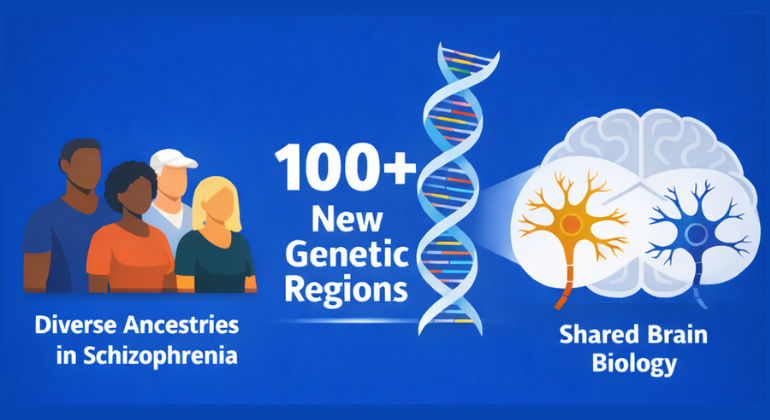
This graphic representation of the study findings was created by Dr. Panos Roussos with the help of ChatGPT.
A team of researchers led by scientists from the Icahn School of Medicine at Mount Sinai, SUNY Downstate Health Sciences University, and the Department of Veterans Affairs has conducted the largest and most comprehensive genome-wide association study (GWAS) to date of schizophrenia in individuals of African ancestry. The study, published January 21 in Nature, identified more than 100 genetic regions associated with schizophrenia that had not been clearly identified in prior research. Importantly, the findings demonstrate that while specific genetic variants may differ across populations, the core biological mechanisms underlying schizophrenia are shared worldwide.
Schizophrenia affects people across all regions and backgrounds, yet most genetic studies to date have focused on individuals of European ancestry. This imbalance has limited scientific understanding of the disorder and reduced the accuracy of genetic tools for millions of people, particularly those of African ancestry.
“Our goal was to address a major gap in psychiatric genetics,” said Panos Roussos, MD, PhD, Professor of Psychiatry, and Genetic and Genomic Sciences, and Director of the Center for Disease Neurogenomics at the Icahn School of Medicine at Mount Sinai; Director of the Center for Precision Medicine and Translational Therapeutics at the James J. Peters VA Medical Center; and senior author of the study. “By expanding representation in genetic research, we not only discovered new schizophrenia-associated regions, but also gained a clearer picture of the shared biological pathways that drive the illness across populations.”
Key Findings
Researchers found more than 100 new regions in the human genome linked to schizophrenia that had not been clearly identified before. Many of these genetic differences are more common in people of African ancestry, which explains why they were missed in earlier studies that mostly included people of European ancestry.
Even though some genetic differences vary by ancestry, the study found that schizophrenia affects the same underlying brain systems across populations. In other words, people around the world may carry different genetic “spelling changes,” but those changes tend to disrupt the same genes and the same brain cells. These cells work together to keep brain signals balanced, and disruptions in this balance appear to be central to schizophrenia.
“These results give us confidence that schizophrenia is biologically similar across populations,” noted Dr. Roussos. “At the same time, they also show how much we gain when genetic research includes people from diverse backgrounds.”
Why This Matters
The study underscores the scientific and ethical necessity of including diverse populations in genetic research. Broader representation not only uncovers ancestry-specific risk regions, but also strengthens confidence in universal biological mechanisms.
By identifying convergent genes, pathways, and brain cell types, the findings provide a stronger foundation for developing biology-informed therapies and genetic tools that are more equitable and applicable across populations.
The researchers emphasized that these genetic discoveries do not diagnose schizophrenia and do not determine who will or will not develop the disorder. “Genetic findings inform biology and research, but do not predict who will or will not develop the illness,” the authors stressed. “Environmental, social, and cultural factors also play critical roles in mental health and are not captured by genetic studies alone.”
While this study represents a major advance, the authors stress that larger and more diverse datasets, particularly from populations of African ancestry, are still urgently needed. Future work will focus on expanding global representation, refining the causal genes and cell types identified, and integrating genetic discoveries with functional studies in human brain tissue. A long-term goal of this research is translating shared biological insights into novel, mechanism-based treatments that can benefit individuals with schizophrenia worldwide.
About the Mount Sinai Health System
Mount Sinai Health System is one of the nation’s leading integrated academic health systems and one of the largest in the New York metropolitan area. Its comprehensive system includes seven hospitals, more than 400 outpatient practices, over 600 research and clinical laboratories, the Icahn School of Medicine at Mount Sinai, the Graduate School of Biomedical Sciences, and the Mount Sinai Phillips School of Nursing. Together, the Health System comprises approximately 48,000 employees, more than 9,000 physicians, and 8,600 nurses.
As a leading learning health system, Mount Sinai combines clinical expertise with scientific discovery to improve patient care while training the next generation of health care and biomedical leaders. The Health System provides care across every stage of life, from prenatal care through geriatrics, while advancing personalized medicine through artificial intelligence, data science, and biomedical research.
Mount Sinai is consistently recognized among the nation’s leading academic health systems for patient care, research, and education. The Mount Sinai Hospital is ranked No. 1 in New York by Newsweek and No. 5 on the magazine’s World’s Best Hospitals list. The Icahn School of Medicine at Mount Sinai ranks No. 11 among U.S. medical schools and No. 1 among freestanding medical schools for National Institutes of Health funding, reflecting the strength of its scientific enterprise and leadership in biomedical research.