Mount Sinai Researchers Identify RNA Biomarkers that Could Offer a Simple Blood Test for Earlier Alzheimer’s Diagnosis
New study identifies brain-specific RNA and protein biomarkers in blood, paving way for early and easier diagnosis
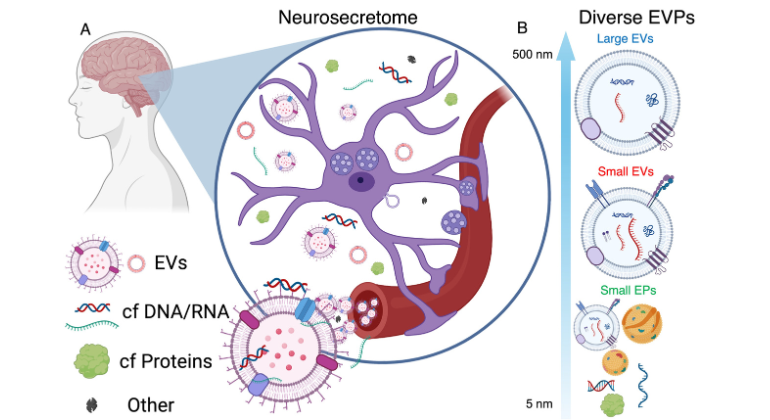
Several brain-derived extracellular vesicles and particles (EVPs) cross the blood brain barrier and reach circulation. Mount Sinai researchers have identified brain-specific RNA biomarkers in blood, paving a way for early and easier diagnosis of Alzheimer’s disease. Photo courtesy of Nature Communications.
Mount Sinai researchers have discovered blood RNA biomarkers that offer a promising minimally invasive approach for earlier diagnosis of Alzheimer’s disease, according to findings published in Nature Communications on June 22.
An estimated 55 million people worldwide are living with Alzheimer’s disease, according to Alzheimer’s Disease International. Yet diagnosis remains challenging because symptoms often overlap with those of other conditions, and current diagnostic methods can be costly or invasive. Blood-based biomarkers could support routine clinical use while reducing the need for lumbar puncture and positron emission tomography (PET) imaging. Recent research has shown that brain-specific RNA biomarkers are present in circulating blood nanoparticles, including exosomes, extracellular vesicles (EVs), and extracellular vesicles and particles (EVPs).
Researchers at the Icahn School of Medicine at Mount Sinai developed a simple, efficient, and cost-effective method to isolate EVPs from blood and brain tissue. They measured RNA biomarkers in blood and brain tissue samples from people with Alzheimer’s disease and from controls to determine gene expression patterns and cellular origins. The researchers separated EVPs into three subpopulations: large EVs, small EVs, and small extracellular particles (EPs).
The researchers also identified small blood nanoparticles known as “SECmeres” that carried Alzheimer’s-related brain signals more clearly than standard EVs. These nanoparticles were enriched with brain-specific markers and may offer a minimally invasive approach for earlier diagnosis of the progressive neurodegenerative disease.
“In 2025, FDA cleared the first protein-based blood test for Alzheimer’s disease diagnoses, which measures the pTau217/ß-amyloid 1-42 ratio,” said co-corresponding author Navneet Dogra, PhD, Assistant Professor of Pathology, Molecular and Cell Based Medicine, and member of the Icahn Genomics Institute at the Icahn School of Medicine at Mount Sinai. “Our study demonstrates that blood EVPs carry brain-specific RNA information that could be used for liquid biopsy approaches, pending validation in larger blinded clinical trials. We believe EVP-derived RNAs may reveal disease-related changes earlier in the disease process, before proteins or pathology become detectable.”
“We provide evidence that novel brain-derived nanoparticles, termed ‘SECmeres,’ may play a key role in neurodegenerative disease development and hold promise as a real-time, non-invasive diagnostic tool for the living human brain,” Dr. Dogra added.
Dr. Dogra said the findings could have important implications for liquid biopsy technologies designed to detect neurodegeneration disorders, cancer, and other diseases through minimally invasive testing.
“Alzheimer’s disease represents a major global health challenge due to its increasing prevalence, profound impact on patients and families, and substantial economic burden,” said co-corresponding author Panos Roussos, MD, PhD, Professor of Psychiatry, and Genetics and Genomic Sciences, and Director of the Center for Disease Neurogenomics at the Icahn School of Medicine at Mount Sinai. “Our findings support the development of RNA-based liquid-biopsy assays that may help advance earlier detection of Alzheimer’s disease.”
Experts from Yale University and Emory University contributed to this research. The study was supported by grants from the National Institutes of Health (P20CA264076, R21 AGO78848, R01CA296581, R01 AG082185 1042, U24 AG087563, R01 AG050986, R01 AG065582, R01AG075820, 1043 F31NS127530), the Friedman Brain Institute at Mount Sinai, the Alzheimer’s Disease Research Institute at Mount Sinai, Joseph and Nancy DiSabato Research Scholar Award, and the Ram Sundaram and Preethi Krishna Research Scholar Award.
About the Icahn School of Medicine at Mount Sinai
The Icahn School of Medicine at Mount Sinai is internationally renowned for its outstanding research, educational, and clinical care programs. It is the sole academic partner for the seven member hospitals* of the Mount Sinai Health System, one of the largest academic health systems in the United States, providing care to New York City’s large and diverse patient population.
The Icahn School of Medicine at Mount Sinai offers highly competitive MD, PhD, MD-PhD, and master’s degree programs, with enrollment of more than 1,200 students. It has the largest graduate medical education program in the country, with more than 2,700 clinical residents and fellows training throughout the Health System. The Graduate School of Biomedical Sciences offers 13 degree-granting programs, conducts innovative basic and translational research, and trains more than 470 postdoctoral research fellows.
Ranked 11th nationwide in National Institutes of Health (NIH) funding, the Icahn School of Medicine at Mount Sinai is among the 90th percentile of U.S. private medical schools in Sponsored Programs Direct Expenditures per Principal Investigator, according to the Association of American Medical Colleges. More than 6,900 scientists, educators, and clinicians work within and across dozens of academic departments and multidisciplinary institutes with an emphasis on translational research and therapeutics. Through Mount Sinai Innovation Partners (MSIP), the Health System facilitates the real-world application and commercialization of medical breakthroughs made at Mount Sinai.
-------------------------------------------------------
* Mount Sinai Health System member hospitals: The Mount Sinai Hospital; Mount Sinai Brooklyn; Mount Sinai Morningside; Mount Sinai Queens; Mount Sinai South Nassau; Mount Sinai West; and New York Eye and Ear Infirmary of Mount Sinai.
About the Mount Sinai Health System
Mount Sinai Health System is one of the nation’s leading integrated academic health systems and one of the largest in the New York metropolitan area. Its comprehensive system includes seven hospitals, more than 400 outpatient practices, over 600 research and clinical laboratories, the Icahn School of Medicine at Mount Sinai, the Graduate School of Biomedical Sciences, and the Mount Sinai Phillips School of Nursing. Together, the Health System comprises approximately 48,000 employees, more than 9,000 physicians, and 8,600 nurses.
As a leading learning health system, Mount Sinai combines clinical expertise with scientific discovery to improve patient care while training the next generation of health care and biomedical leaders. The Health System provides care across every stage of life, from prenatal care through geriatrics, while advancing personalized medicine through artificial intelligence, data science, and biomedical research.
Mount Sinai is consistently recognized among the nation’s leading academic health systems for patient care, research, and education. The Mount Sinai Hospital is ranked No. 1 in New York by Newsweek® and No. 7 in the U.S. on the magazine’s World’s Best Hospitals 2026 list. The Icahn School of Medicine at Mount Sinai ranks No. 9 among U.S. medical schools and No. 1 among freestanding medical schools for National Institutes of Health grant funding, reflecting the strength of its scientific enterprise and leadership in biomedical research.