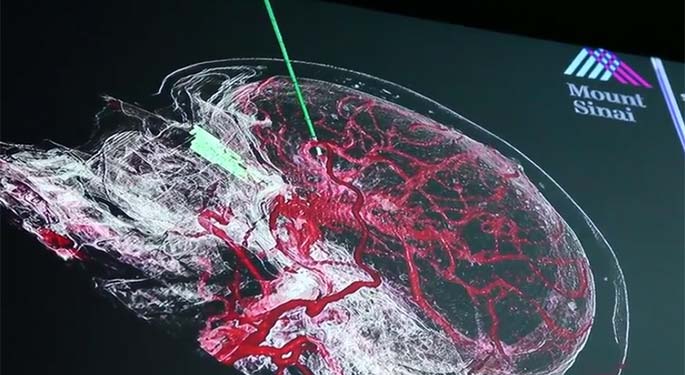
Artificial Intelligence Platform Screens for Acute Neurological Illnesses at Mount Sinai
The study’s findings lay the framework for applying deep learning and computer vision techniques to radiological imaging.
An artificial intelligence platform designed to identify a broad range of acute neurological illnesses, such as stroke, hemorrhage, and hydrocephalus, was shown to identify disease in CT scans in 1.2 seconds, faster than human diagnosis, according to a study conducted at the Icahn School of Medicine at Mount Sinai and published today in the journal Nature Medicine.
“With a total processing and interpretation time of 1.2 seconds, such a triage system can alert physicians to a critical finding that may otherwise remain in a queue for minutes to hours,” says senior author Eric Oermann, MD, Instructor in the Department of Neurosurgery at the Icahn School of Medicine at Mount Sinai. “We’re executing on the vision to develop artificial intelligence in medicine that will solve clinical problems and improve patient care.”
This is the first study to utilize artificial intelligence for detecting a wide range of acute neurologic events and to demonstrate a direct clinical application. Researchers used 37,236 head CT scans to train a deep neural network to identify whether an image contained critical or non-critical findings. The platform was then tested in a blinded, randomized controlled trial in a simulated clinical environment where it triaged head CT scans based on severity. The computer software was tested for how quickly it could recognize and provide notification versus the time it took a radiologist to notice a disease. The average time for the computer algorithm to preprocess an image, run its inference method, and, if necessary, raise an alarm was 150 times shorter than for physicians to read the image.
This study used “weakly supervised learning approaches,” which built on the research team’s expertise in natural language processing and the Mount Sinai Health System’s large clinical datasets. Dr. Oermann says the next phase of this research will entail enhanced computer labeling of CT scans and a shift to “strongly supervised learning approaches” and novel techniques for increasing data efficiency. Researchers estimate the goal of re-engineering the system with these changes will be accomplished within the next two years.
“The expression ‘time is brain’ signifies that rapid response is critical in the treatment of acute neurological illnesses, so any tools that decrease time to diagnosis may lead to improved patient outcomes,” says study co-author Joshua Bederson, MD, Professor and System Chair for the Department of Neurosurgery at Mount Sinai Health System and Clinical Director of the Neurosurgery Simulation Core.
“The application of deep learning and computer vision techniques to radiological imaging is a clear imperative for 21st century medical care,” says study author Burton Drayer, MD, the Charles M. and Marilyn Newman Professor and System Chair of the Department of Radiology for the Mount Sinai Health System, CEO of the Mount Sinai Doctors Faculty Practice, and Dean for Clinical Affairs of the Icahn School of Medicine.
This study was performed by the Mount Sinai AI Consortium, known as “AISINAI”—a group of scientists, physicians, and researchers dedicated to developing artificial intelligence in medicine that will improve patient care and help doctors accurately diagnose disease.
AISINAI’s current research builds on their paper published earlier this year in the journal Radiology, where they presented their work on natural language processing algorithms for identifying clinical concepts in radiology reports for CT scans.
About the Mount Sinai Health System
Mount Sinai Health System is one of the nation’s leading integrated academic health systems and one of the largest in the New York metropolitan area. Its comprehensive system includes seven hospitals, more than 400 outpatient practices, over 600 research and clinical laboratories, the Icahn School of Medicine at Mount Sinai, the Graduate School of Biomedical Sciences, and the Mount Sinai Phillips School of Nursing. Together, the Health System comprises approximately 48,000 employees, more than 9,000 physicians, and 8,600 nurses.
As a leading learning health system, Mount Sinai combines clinical expertise with scientific discovery to improve patient care while training the next generation of health care and biomedical leaders. The Health System provides care across every stage of life, from prenatal care through geriatrics, while advancing personalized medicine through artificial intelligence, data science, and biomedical research.
Mount Sinai is consistently recognized among the nation’s leading academic health systems for patient care, research, and education. The Mount Sinai Hospital is ranked No. 1 in New York by Newsweek and No. 5 on the magazine’s World’s Best Hospitals list. The Icahn School of Medicine at Mount Sinai ranks No. 11 among U.S. medical schools and No. 1 among freestanding medical schools for National Institutes of Health funding, reflecting the strength of its scientific enterprise and leadership in biomedical research.