
State-of-the-Art Microscope Technology Provides 4K and 3D Visualization Beyond the Surface of the Brain
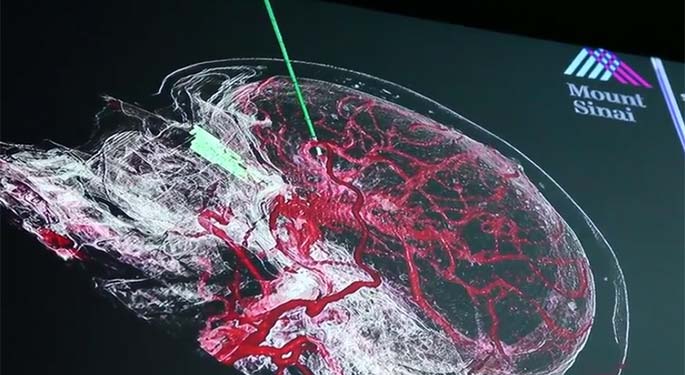

The Department of Neurosurgery at the Icahn School of Medicine at Mount Sinai is one of the first hospitals in the country to use the ZEISS KINEVO® 900 microscope, a new surgeon-driven, robotic visualization system that merges the functionality of a surgical microscope with 4K resolution and 3D visualization along with specialized robotic control. Optical, navigation, and simulation information are streamed into the microscope’s eyepiece and projected on large monitors in the operating room, providing a detailed perspective for the operating room staff, including co-surgeons, surgical assistants, and medical residents, who can all view the high-resolution images in real time. 3D glasses provide an enhanced visualization of neuroanatomy.
“An important question for neurosurgeons has always been, where is the best place to view optical information from the microscope—should one look through the eyepieces as we’ve done traditionally, or should that information be gathered by high-resolution video and projected on a monitor,” says Joshua Bederson, MD, Professor and System Chair for the Department of Neurosurgery at Mount Sinai Health System and Clinical Director of the Neurosurgery Simulation Core.
Dr. Bederson says one advantage to projecting real-time images of the brain onto a video screen is that information sources from outside the microscope can be overlaid on the monitor. This augmented reality includes navigational guidance that alerts the surgeon to “no-fly zones”—neuroanatomy that should be avoided during surgery. The KINEVO® 900 utilizes an open interface that allows for integration with navigation and image-guided software developed by the medical technology companies Brainlab and Surgical Theater.
“The analogy is the heads-up-display that aircraft pilots have when they’re looking at navigation information during flight,” said Dr. Bederson, a licensed pilot. “The operating room of the future is one that integrates multiple information sources streamed into the surgeon’s viewpoint in a way that is non-distracting and can be used in the service of patient safety.”
KINEVO® 900 has several features that are the first of their kind, including a specialized robotic control system called PointLock, which enables the surgeon to focus on a particular point in the surgical field and move the microscope in a spherical arch without losing focus, with the use of a foot pedal. This allows the surgeon to navigate safely around the patient during surgery as opposed to repositioning the patient. PositionMemory stores magnification and focus settings for key regions of the brain. A micro-inspection surgical tool called QEVO® is engineered with an angled design, allowing the surgeon to look around complex structures that are out of the microscope’s range.
“Our team of neurosurgeons is driving and advancing the development of next-generation simulation and virtual reality technology, which can help improve patient outcomes and solve neurosurgical challenges,” says Dr. Bederson.
The Icahn School of Medicine at Mount Sinai purchased the two robotic visualization systems with the generous support of a donor who wishes to remain anonymous. Dr. Bederson is an expert in skull-base and cerebrovascular surgery and has performed more than 3,700neurosurgical operations at Mount Sinai. Dr. Bederson owns equity in Surgical Theater, LLC.
About the Mount Sinai Health System
Mount Sinai Health System is one of the nation’s leading integrated academic health systems and one of the largest in the New York metropolitan area. Its comprehensive system includes seven hospitals, more than 400 outpatient practices, over 600 research and clinical laboratories, the Icahn School of Medicine at Mount Sinai, the Graduate School of Biomedical Sciences, and the Mount Sinai Phillips School of Nursing. Together, the Health System comprises approximately 48,000 employees, more than 9,000 physicians, and 8,600 nurses.
As a leading learning health system, Mount Sinai combines clinical expertise with scientific discovery to improve patient care while training the next generation of health care and biomedical leaders. The Health System provides care across every stage of life, from prenatal care through geriatrics, while advancing personalized medicine through artificial intelligence, data science, and biomedical research.
Mount Sinai is consistently recognized among the nation’s leading academic health systems for patient care, research, and education. The Mount Sinai Hospital is ranked No. 1 in New York by Newsweek and No. 5 on the magazine’s World’s Best Hospitals list. The Icahn School of Medicine at Mount Sinai ranks No. 11 among U.S. medical schools and No. 1 among freestanding medical schools for National Institutes of Health funding, reflecting the strength of its scientific enterprise and leadership in biomedical research.
Artificial Intelligence Platform Screens for Acute Neurological Illnesses at Mount Sinai
Aug 13, 2018 View All Press Releases