
Study Identifies Candidate Treatment Targets for High-Grade Glioma in Children and Young Adults
Mount Sinai-led study finds tumor biology shifts with age and differs by sex
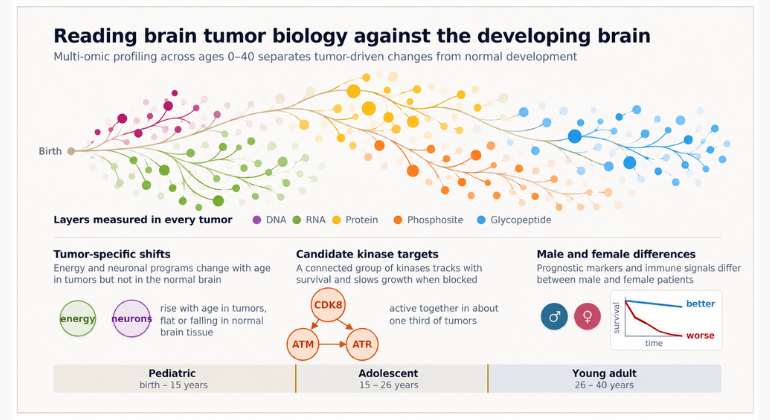
Proteogenomic profiling of high-grade glioma from infancy through age 40 shows age-related tumor changes distinct from normal brain development, candidate kinase targets, and differences between male and female patients.
Researchers at the Icahn School of Medicine at Mount Sinai and collaborators have identified candidate treatment targets and potential prognostic markers for high-grade glioma, an aggressive brain cancer, in children, adolescents, and young adults.
The study found that high-grade glioma varies by developmental stage and sex, showing distinct tumor biology and outcomes across patient groups. Using this information to guide clinical trial design and develop new therapies could advance more precise treatment strategies.
The study was conducted by the Clinical Proteomic Tumor Analysis Consortium (CPTAC) of the National Cancer Institute (NCI), the Children’s Brain Tumor Network, and the Philadelphia Coalition for a Cure. The findings were published in Cell Reports Medicine. For the full author list, see the paper at [DOI: 10.1016/j.xcrm.2026.103024].
High-grade glioma is among the most aggressive primary brain tumors, with a five-year survival rate below 10 percent. Tumors in children differ markedly from those in adults, while adolescents and young adults remain especially understudied because their tumors do not fit neatly into either pediatric or adult disease.
Because age and sex shape normal brain development, the researchers sought to distinguish tumor-related molecular features from those associated with developmental stages.
“Our goal was to understand high-grade glioma from infancy through young adulthood and identify tumor-related changes tied to outcomes such as survival,” says the lead contact author, Pei Wang, PhD, Professor of Genetics and Genomic Sciences at the Icahn School of Medicine at Mount Sinai. “Because age and sex shape normal brain development, we wanted to separate features of the cancer from those associated with a patient’s developmental stage.”
Dr. Wang and Avi Ma’ayan, PhD, Mount Sinai Endowed Professor in Bioinformatics and Director of the Mount Sinai Center for Bioinformatics, are Principal Investigators of the Proteogenomic Data Analysis Center at the Icahn School of Medicine, part of CPTAC.
Tumor samples were collected through the Children’s Brain Tumor Network, a collaborative network dedicated to accelerating research and improving outcomes for children with brain tumors. Working with CPTAC, the team profiled tumors from 112 patients aged 83 days to 40 years, measuring DNA, RNA, proteins, and chemical changes made to proteins after they are produced, including phosphorylation and glycosylation. Those measurements were combined with data from 99 adult glioblastoma tumors and clinical and genetic information from a reference group of more than 5,000 people with high-grade glioma, to trace how tumor biology changes across the lifespan.
Candidate Drug Targets
Using computational analysis and laboratory validation, the team identified several kinases—enzymes that help control cell signaling—as potential treatment targets, including CDK8, ATM, ATR, and LCK.
In tumor-derived cell lines, blocking these kinases through gene editing or drug treatment slowed growth when the corresponding kinase was most active. CDK8 emerged as a particularly notable candidate because it is less well characterized in high-grade glioma than established targets such as ATM and ATR. The analysis indicates that CDK8 suppresses oxidative phosphorylation, a key energy-producing process that this study links to more favorable survival.
A Molecular Shift Around Age 26
By tracing molecular profiles continuously across age rather than sorting patients into established tumor subtypes, the researchers identified a clear shift around age 26 within an age range often grouped clinically as adolescents and young adults. The two study groups (adolescents aged 15 to 26 and young adults aged 26 to 40) had distinct molecular profiles and survival outcomes and relied on different signaling programs.
Comparing tumors with normal brain tissue across the same age span sharpened the picture. Oxidative phosphorylation showed age- and sex-related changes in tumors that were not seen in normal brains, suggesting these differences arise from tumor processes rather than normal development.
Differences Between Male and Female Patients
About 27 percent of the proteins the team measured showed different age-related trajectories in male and female patients. A prognostic score established in earlier work was associated with outcomes in male patients but not in female patients.
Glycosylation, the attachment of sugar structures to proteins, proved especially informative in male patients, with far more survival-associated features than in female patients. Protein-based grouping also revealed a previously unrecognized male subgroup with the poorest survival in the study, distinguished by immune signaling and features of the tissue surrounding the tumor.
“CPTAC allows us to examine the same genes across several layers of biology, from DNA and RNA to proteins and protein modifications,” says Nicole Tignor, PhD, Assistant Professor of Genetics and Genomic Sciences at the Icahn School of Medicine and lead first author. “In this study, glycosylation captured aspects of tumor biology missed in other molecular data. It may be especially valuable for understanding differences between male and female patients in immune responses and, potentially, treatment response.”
Higher levels of infiltrating T cells were associated with better outcomes in female patients but not in male patients, while a pattern involving the immune checkpoint gene PDCD1, which codes the protein PD-1, was seen only in male pediatric and young adult patients. Because PD-1 inhibitors are already being studied in this population, the authors say the findings support further study of treatment strategies that account for these differences.
The authors note that sample sizes are limited, a persistent challenge in rare pediatric cancers that is more pronounced when patient data are divided by age, sex, and tumor features. The team therefore developed an analytic approach that uses molecular trajectories learned in one group to help interpret survival patterns in another. Even so, some findings will need confirmation in larger studies, and targets such as CDK8 will require validation in animal models before clinical testing. The mechanisms underlying the observed differences between male and female patients also remain to be defined.
“Patient data are becoming increasingly rich, but they also reflect cancers arising at different ages and in different biological settings,” says Dr. Wang. “How we account for that variation affects which biological signals we can detect. Analyzing tumors in their developmental context can help us make better use of these data and identify patterns that might otherwise be missed.”
The Children’s Brain Tumor Network and CPTAC are continuing to collect samples and generate data across pediatric brain tumors and other childhood cancers. The team will use those larger datasets to determine which patterns hold across cancers, which are specific to high-grade glioma, and which are most promising for therapeutic development.
The paper is titled “Proteogenomic Analysis of Pediatric and AYA High-Grade Glioma Reveals Age-Dependent Biology, Female-Male Differences, and Kinase Targets.”
The study’s proteogenomic datasets are publicly available through the NCI Proteomic Data Commons and the Children’s Brain Tumor Network, and the analysis code has been released openly.
This work was supported by the NCI and the National Institutes of Health, including awards supporting the Clinical Proteomic Tumor Analysis Consortium, and by the Aven Foundation. Portions of the proteomics work were performed at the Environmental Molecular Sciences Laboratory, a Department of Energy user facility at Pacific Northwest National Laboratory. Computational resources were provided by Scientific Computing and Data at the Icahn School of Medicine at Mount Sinai.
About the Icahn School of Medicine at Mount Sinai
The Icahn School of Medicine at Mount Sinai is internationally renowned for its outstanding research, educational, and clinical care programs. It is the sole academic partner for the seven member hospitals* of the Mount Sinai Health System, one of the largest academic health systems in the United States, providing care to New York City’s large and diverse patient population.
The Icahn School of Medicine at Mount Sinai offers highly competitive MD, PhD, MD-PhD, and master’s degree programs, with enrollment of more than 1,200 students. It has the largest graduate medical education program in the country, with more than 2,700 clinical residents and fellows training throughout the Health System. The Graduate School of Biomedical Sciences offers 12 degree-granting programs, conducts innovative basic and translational research, and trains more than 470 postdoctoral research fellows.
Ranked 11th nationwide in National Institutes of Health (NIH) funding, the Icahn School of Medicine at Mount Sinai is among the 90th percentile of U.S. private medical schools in Sponsored Programs Direct Expenditures per Principal Investigator, according to the Association of American Medical Colleges. More than 6,900 scientists, educators, and clinicians work within and across dozens of academic departments and multidisciplinary institutes with an emphasis on translational research and therapeutics. Through Mount Sinai Innovation Partners (MSIP), the Health System facilitates the real-world application and commercialization of medical breakthroughs made at Mount Sinai.
-------------------------------------------------------
* Mount Sinai Health System member hospitals: The Mount Sinai Hospital; Mount Sinai Brooklyn; Mount Sinai Morningside; Mount Sinai Queens; Mount Sinai South Nassau; Mount Sinai West; and New York Eye and Ear Infirmary of Mount Sinai.
About the Mount Sinai Health System
Mount Sinai Health System is one of the nation’s leading integrated academic health systems and one of the largest in the New York metropolitan area. Its comprehensive system includes seven hospitals, more than 400 outpatient practices, over 600 research and clinical laboratories, the Icahn School of Medicine at Mount Sinai, the Graduate School of Biomedical Sciences, and the Mount Sinai Phillips School of Nursing. Together, the Health System comprises approximately 48,000 employees, more than 9,000 physicians, and 8,600 nurses.
As a leading learning health system, Mount Sinai combines clinical expertise with scientific discovery to improve patient care while training the next generation of health care and biomedical leaders. The Health System provides care across every stage of life, from prenatal care through geriatrics, while advancing personalized medicine through artificial intelligence, data science, and biomedical research.
Mount Sinai is consistently recognized among the nation’s leading academic health systems for patient care, research, and education. The Mount Sinai Hospital is ranked No. 1 in New York by Newsweek and No. 5 on the magazine’s World’s Best Hospitals list. The Icahn School of Medicine at Mount Sinai ranks No. 11 among U.S. medical schools and No. 1 among freestanding medical schools for National Institutes of Health funding, reflecting the strength of its scientific enterprise and leadership in biomedical research.