
Studies Offer New Insights Into Melanoma Immunotherapy
Two studies link tumor protein patterns to immunotherapy outcomes, suggesting potential tests and targets for treatment
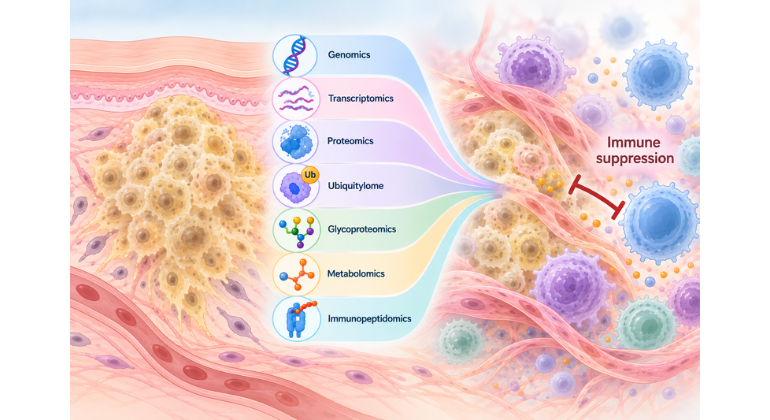
A molecular atlas of skin melanoma links changes in tumor proteins to differences in immune activity in and around the tumor. Credit: Pei Wang
Researchers at the Icahn School of Medicine at Mount Sinai and collaborators in the National Cancer Institute’s Clinical Proteomic Tumor Analysis Consortium have identified protein patterns in skin melanoma linked to treatment response after combination immunotherapy. A companion study provides a comprehensive molecular map of melanoma, including protein fragments displayed for immune recognition and chemical modifications of proteins associated with immune suppression and patient survival. Together, the findings could help researchers develop protein-based tests for future melanoma trials and identify proteins to investigate as potential treatment targets.
The studies, accepted for coordinated publication in Clinical Cancer Research (DOI: 10.1158/1078-0432.CCR-26-2295-ATR) and Cancer Discovery (DOI: 10.1158/2159-8290.CD-26-0302), both journals of the American Association for Cancer Research, examine melanoma from complementary angles. Their aim was to investigate why some patients with melanoma benefit from immunotherapy, while others do not benefit or develop a resistance to the therapy.
The Clinical Cancer Research study links tumor protein patterns to patient outcomes after immunotherapy, including combination treatment with two drugs that block separate signals that can restrain the immune response. The Cancer Discovery study maps melanoma’s molecular features, including protein fragments displayed for immune cells to recognize and chemical changes associated with immune suppression and patient survival.
Pei Wang, PhD, Professor of Genetics and Genomic Sciences at the Icahn School of Medicine, is the lead contact corresponding author of the Cancer Discovery study and a co-corresponding author of the Clinical Cancer Research study. The collaborating principal investigators include Amanda Paulovich, MD, PhD, at Fred Hutchinson Cancer Center; Tao Liu, PhD, at Pacific Northwest National Laboratory; Diwakar Davar, MD, at the University of Pittsburgh; and Marcin Cieslik, PhD, at the University of Michigan.
Immune checkpoint inhibitors help the immune system respond to cancer by blocking signals that can restrain its activity. These treatments have changed care for melanoma, but some patients do not benefit or eventually develop resistance. The two studies examine proteins and the surrounding tissue for clues to those differences. “We wanted to understand what distinguishes melanomas with different outcomes after immunotherapy and what we could learn by looking more closely at their proteins,” says Dr. Wang. “Together, these studies connect patterns linked to treatment outcomes with a more detailed view of the tumor and its immune environment.”
Three Protein Patterns Linked to Treatment Outcomes
“Immune checkpoint inhibitors have transformed melanoma treatment, yet 40 to 60 percent of patients either do not respond or eventually develop resistance,” says Dr. Davar. “By defining the biological differences between tumors with favorable and unfavorable outcomes, this study moves us closer to identifying which patients are most likely to benefit and where new therapeutic strategies are needed.” To bridge this gap, in the Clinical Cancer Research study, the team retrospectively analyzed preserved tumor samples collected before immunotherapy from 207 patients treated at 12 institutions whose skin melanoma had spread. Of these patients, 164 received a combination of drugs targeting the immune checkpoints PD-1 and CTLA-4, and the remaining received PD-1 monotherapy.
Shrabanti Chowdhury, PhD, Assistant Professor of Genetics and Genomic Sciences at the Icahn School of Medicine, is the study’s lead first author. The researchers measured proteins, DNA, and RNA and identified three protein patterns. One was rich in immune activity, another in ribosomes (the structures cells use to make proteins), and a third in features of the tissue surrounding a tumor.
The immune-rich group had the most favorable progression-free survival after combination therapy, meaning patients tended to live longer without their cancer worsening. The two other groups had less favorable outcomes but differed in their molecular features, suggesting that they may warrant different approaches in future treatment research. The validation group’s survival analyses were restricted to tumors sampled from the skin.
The team also developed a classifier, a tool that assigns tumors to these three groups based on their protein patterns. It provides a starting point for a standardized protein-based test for further clinical research.
A Broader Map of Melanoma Biology
The Cancer Discovery study examined tumors from 183 patients, combining 13 types of molecular measurements, including DNA, RNA, proteins, protein modifications, and molecules involved in metabolism. Some measurements were available only for selected tumors.
One part of the atlas directly measured protein fragments displayed on cell surfaces for immune recognition. The researchers identified more than 1,000 candidate tumor antigens, or potential immune targets. These candidates require further testing to determine whether they can trigger an immune response against cancer and be targeted safely.
Chemical changes to proteins revealed additional links to survival and immune activity that measurements of protein levels alone did not capture. The analysis also identifies multiple candidate biomarkers and therapeutic targets, providing new leads to guide patient stratification and treatment development.
Next Steps Toward Clinical Testing
Both studies primarily identify associations and do not establish that the molecular features cause resistance or that targeting them will improve outcomes. Larger, prospective studies in more diverse populations are needed before clinical use. Further studies are warranted to explore whether the classifier could help guide treatment decisions, including identifying patients who may benefit from alternative or additional combination therapies.
Our next step is to translate these findings into a practical clinical test,” said Amanda Paulovich, MD, PhD, of Fred Hutch Cancer Center. “We’ve identified a panel of 127 proteins that can distinguish among three melanoma subtypes associated with different responses to immunotherapy. Now we want to develop a targeted mass spectrometry assay that can reliably classify individual patients’ tumors using routine biopsy samples. Ultimately, our goal is to give oncologists better tools to predict which patients are most likely to benefit from a particular treatment—and which patients may need a different approach.
The Clinical Cancer Research paper is titled “Identification of Proteomic Subtypes with Differential Responses to Immune Checkpoint Inhibition in Cutaneous Melanoma.” The Cancer Discovery paper is titled “A comprehensive proteogenomic, immunopeptidomic, and metabolomic atlas decodes immunogenicity in cutaneous melanoma.”
The studies were supported by the National Cancer Institute, including its Clinical Proteomic Tumor Analysis Consortium (CPTAC), and other funding sources detailed in the papers. Dr. Wang and Avi Ma’ayan, PhD, Mount Sinai Professor in Bioinformatics, and Director of the Mount Sinai Center for Bioinformatics, are principal investigators of the Proteogenomic Data Analysis Center at the Icahn School of Medicine, part of CPTAC. Dr. Paulovich and Dr. Davar are co-principal investigators of a CPTAC Proteogenomic Translational Research Center that led the Clinical Cancer Research study. Dr. Paulovich’s laboratory also received support from the Aven Foundation.
About the Icahn School of Medicine at Mount Sinai
The Icahn School of Medicine at Mount Sinai is internationally renowned for its outstanding research, educational, and clinical care programs. It is the sole academic partner for the seven member hospitals* of the Mount Sinai Health System, one of the largest academic health systems in the United States, providing care to New York City’s large and diverse patient population.
The Icahn School of Medicine at Mount Sinai offers highly competitive MD, PhD, MD-PhD, and master’s degree programs, with enrollment of more than 1,200 students. It has the largest graduate medical education program in the country, with more than 2,700 clinical residents and fellows training throughout the Health System. The Graduate School of Biomedical Sciences offers 12 degree-granting programs, conducts innovative basic and translational research, and trains more than 470 postdoctoral research fellows.
Ranked No. 9 nationwide in National Institutes of Health (NIH) grant funding, the Icahn School of Medicine at Mount Sinai is among the 90th percentile of U.S. private medical schools in Sponsored Programs Direct Expenditures per Principal Investigator, according to the Association of American Medical Colleges. More than 6,900 scientists, educators, and clinicians work within and across dozens of academic departments and multidisciplinary institutes with an emphasis on translational research and therapeutics. Through Mount Sinai Innovation Partners (MSIP), the Health System facilitates the real-world application and commercialization of medical breakthroughs made at Mount Sinai.
-------------------------------------------------------
* Mount Sinai Health System member hospitals: The Mount Sinai Hospital; Mount Sinai Brooklyn; Mount Sinai Morningside; Mount Sinai Queens; Mount Sinai South Nassau; Mount Sinai West; and New York Eye and Ear Infirmary of Mount Sinai.
About the Mount Sinai Health System
Mount Sinai Health System is one of the nation’s leading integrated academic health systems and one of the largest in the New York metropolitan area. Its comprehensive system includes seven hospitals, more than 400 outpatient practices, over 600 research and clinical laboratories, the Icahn School of Medicine at Mount Sinai, the Graduate School of Biomedical Sciences, and the Mount Sinai Phillips School of Nursing. Together, the Health System comprises approximately 48,000 employees, more than 9,000 physicians, and 8,600 nurses.
As a leading learning health system, Mount Sinai combines clinical expertise with scientific discovery to improve patient care while training the next generation of health care and biomedical leaders. The Health System provides care across every stage of life, from prenatal care through geriatrics, while advancing personalized medicine through artificial intelligence, data science, and biomedical research.
Mount Sinai is consistently recognized among the nation’s leading academic health systems for patient care, research, and education. The Mount Sinai Hospital is ranked No. 1 in New York by Newsweek® and No. 7 in the U.S. on the magazine’s 2026 World’s Best Hospitals list and No. 3 in the world in its World’s Best Smart Hospitals list. The Icahn School of Medicine at Mount Sinai ranks No. 9 among U.S. medical schools and No. 1 among freestanding medical schools for National Institutes of Health grant funding, reflecting the strength of its scientific enterprise and leadership in biomedical research.