
Mount Sinai Launches Center for Genomic AI and Microbiome Medicine to Advance Precision Medicine
New center aims to better understand diseases and change their trajectories by studying gut bacteria and human genomes together
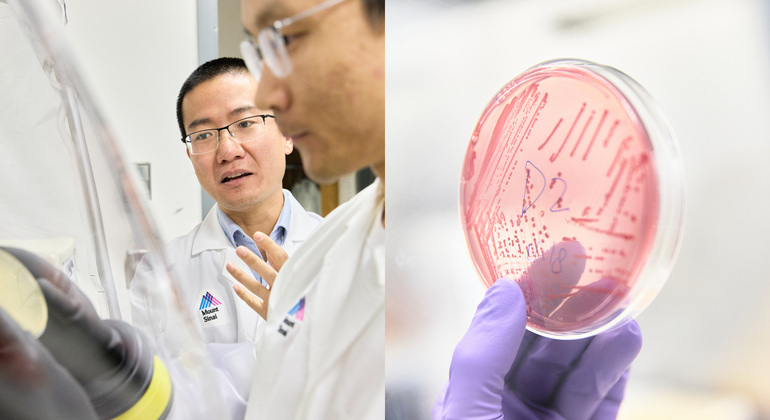
The Icahn School of Medicine at Mount Sinai has launched the Center for Genomic AI and Microbiome Medicine, a research center that will bring together human genetics and microbiome research and use artificial intelligence (AI) to investigate how human genetic variation and the gut microbiome jointly shape disease progression and treatment response.
“This new Center puts us at a turning point as advances in genomics and AI enable us to bring human genetic and microbiome data together to better understand a wide range of diseases,” said Alison M. Goate, DPhil, Jean C. and James W. Crystal Professor and Chair of Genetics and Genomic Sciences at the Icahn School of Medicine at Mount Sinai.
Established within the Department of Genetics and Genomic Sciences, the Center is directed by Gang Fang, PhD, Professor of Genetics and Genomic Sciences at the Icahn School of Medicine at Mount Sinai.
“The big question is, how can we change the trajectory of human disease?” said Dr. Fang. “Why do some patients respond more favorably to a treatment, while others do not? And why do some patients progress faster, while others progress more slowly?”
A person’s genome can reveal inherited risk and other biological differences. The gut microbiome changes in response to diet, medications, environment, and immune activity, and can influence metabolism, inflammation, and biology across the body. The Center will study human genetic and microbial variation together to identify relationships that may help explain differences in disease and treatment response.
The Center’s expertise in long-read sequencing will allow researchers to examine longer stretches of DNA, retain more molecular context, distinguish closely related microbial strains, and study genetic and epigenetic variation in greater detail. Researchers will use genomic AI models to integrate complex human genomic and microbiome data and investigate the biological mechanisms associated with disease trajectory and treatment response.
The Center will initially focus on neurodegenerative diseases, including Alzheimer’s disease and Parkinson’s disease, as well as gastrointestinal cancer. The Center will foster new collaborations across Mount Sinai and draw on expertise in genomics, systems biology, microbiome science, computational modeling, data science, and clinical research.
Two recent studies led by Dr. Fang demonstrate how these methods can track microbiome variation in the context of human disease and treatment. A 2025 Nature Microbiology study used long-read metagenomics to track donor bacterial strains after fecal microbiota transplantation and examine how they persisted and adapted over time. A 2026 Cell Host & Microbe study identified reversible epigenetic states that can help gut bacteria survive disruptions such as antibiotics, offering insight into microbiome resilience and its variability across individuals.
Researchers will examine whether integrated genetic and microbiome profiles can support earlier risk assessment, clarify variation in drug response and toxicity, and identify mechanisms that could inform future diagnostic or therapeutic strategies. Prospective studies across diverse populations will be needed to validate the models and determine how they may translate into clinical use.
About the Center for Genomic AI and Microbiome Medicine
The Center for Genomic AI and Microbiome Medicine was established within the Department of Genetics and Genomic Sciences at the Icahn School of Medicine at Mount Sinai and is directed by Gang Fang, PhD. The Center integrates human genetics, microbiome research, long-read sequencing, and computational modeling to advance research in precision medicine. Learn more: icahn.mssm.edu/research/genomic-ai-microbiome-medicine.
About the Icahn School of Medicine at Mount Sinai
The Icahn School of Medicine at Mount Sinai is internationally renowned for its outstanding research, educational, and clinical care programs. It is the sole academic partner for the seven member hospitals* of the Mount Sinai Health System, one of the largest academic health systems in the United States, providing care to New York City’s large and diverse patient population.
The Icahn School of Medicine at Mount Sinai offers highly competitive MD, PhD, MD-PhD, and master’s degree programs, with enrollment of more than 1,200 students. It has the largest graduate medical education program in the country, with more than 2,700 clinical residents and fellows training throughout the Health System. The Graduate School of Biomedical Sciences offers 13 degree-granting programs, conducts innovative basic and translational research, and trains more than 470 postdoctoral research fellows.
Ranked 11th nationwide in National Institutes of Health (NIH) funding, the Icahn School of Medicine at Mount Sinai is among the 90th percentile of U.S. private medical schools in Sponsored Programs Direct Expenditures per Principal Investigator, according to the Association of American Medical Colleges. More than 6,900 scientists, educators, and clinicians work within and across dozens of academic departments and multidisciplinary institutes with an emphasis on translational research and therapeutics. Through Mount Sinai Innovation Partners (MSIP), the Health System facilitates the real-world application and commercialization of medical breakthroughs made at Mount Sinai.
-------------------------------------------------------
* Mount Sinai Health System member hospitals: The Mount Sinai Hospital; Mount Sinai Brooklyn; Mount Sinai Morningside; Mount Sinai Queens; Mount Sinai South Nassau; Mount Sinai West; and New York Eye and Ear Infirmary of Mount Sinai.
About the Mount Sinai Health System
Mount Sinai Health System is one of the nation’s leading integrated academic health systems and one of the largest in the New York metropolitan area. Its comprehensive system includes seven hospitals, more than 400 outpatient practices, over 600 research and clinical laboratories, the Icahn School of Medicine at Mount Sinai, the Graduate School of Biomedical Sciences, and the Mount Sinai Phillips School of Nursing. Together, the Health System comprises approximately 48,000 employees, more than 9,000 physicians, and 8,600 nurses.
As a leading learning health system, Mount Sinai combines clinical expertise with scientific discovery to improve patient care while training the next generation of health care and biomedical leaders. The Health System provides care across every stage of life, from prenatal care through geriatrics, while advancing personalized medicine through artificial intelligence, data science, and biomedical research.
Mount Sinai is consistently recognized among the nation’s leading academic health systems for patient care, research, and education. The Mount Sinai Hospital is ranked No. 1 in New York by Newsweek and No. 5 on the magazine’s World’s Best Hospitals list. The Icahn School of Medicine at Mount Sinai ranks No. 11 among U.S. medical schools and No. 1 among freestanding medical schools for National Institutes of Health funding, reflecting the strength of its scientific enterprise and leadership in biomedical research.