
Mount Sinai Announces Collaborative Research Agreement to Evaluate Novel Liquid Radioembolic Agent for Brain Tumors
Collaborative research will assess a minimally invasive approach designed to deliver targeted radiation directly through tumor-feeding blood vessels
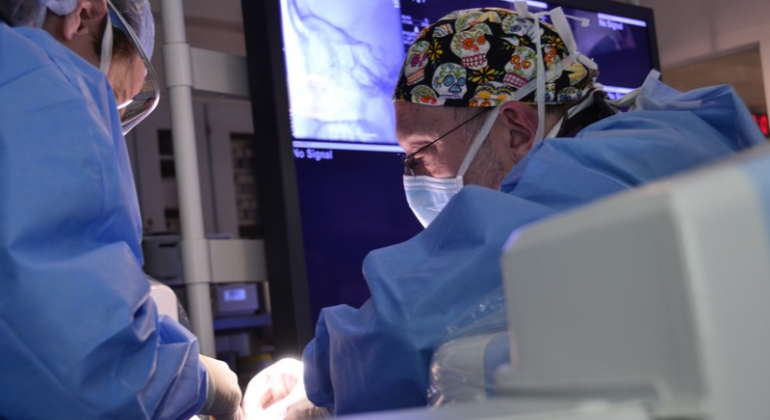
Credit: Mount Sinai Health System
The Icahn School of Medicine at Mount Sinai today announced a collaborative research agreement with Johnson & Johnson[1] to evaluate an investigational liquid radioembolic agent designed to deliver targeted radiation directly to brain tumors through their blood supply.
Developed by Mount Sinai clinical researchers, the investigational approach combines Iodine-131 with Johnson & Johnson’s TRUFILL n-BCA to perform two functions: block blood flow to a tumor and localize radiation within the targeted vessels. The research will initially focus on meningiomas, the most common primary brain tumors in adults.
“By combining targeted embolization with localized radiation delivery, this approach may offer a new way to treat tumors that are difficult to remove surgically or manage with conventional radiation,” said Alejandro Berenstein, MD, Director of the Vascular Malformations Research Center at Mount Sinai and co-lead of the research program. “Our goal is to deliver therapy precisely through the tumor’s own vascular network while limiting exposure to surrounding tissue.”
The Mount Sinai team will collaborate with the neurovascular business to optimize the investigational formulation and delivery approach and evaluate its safety and feasibility. The program will use patient-derived, 3D-printed vascular models and advanced imaging to assess the distribution and localization of the agent before progressing to preclinical evaluation.
“This collaboration brings together clinical, engineering, imaging and industry expertise to evaluate an innovative approach to neuro-oncology,” said Benjamin Rapoport, MD, PhD, Scientific Director of Mount Sinai BioDesign. “The program provides a path for advancing the technology from controlled laboratory testing toward future clinical evaluation.”
"The deployment of this dual approach – ischemic effect of embolization and targeted delivery of radiation bypassing the blood-brain barrier – offers a distinct translational opportunity to maximize therapeutic efficacy," said Munir Ghesani, Co-investigator and Associate Professor of Neurosurgery, Icahn School of Medicine at Mount Sinai.
The research is intended to establish a foundation for potential future clinical studies.
“This joint research effort is reflective of the innovative, integrative work Mount Sinai BioDesign was made for,” said Joshua B. Bederson, MD, he Leonard I. Malis, MD / Corinne and Joseph Graber Professor of Neurosurgery and System Chair for the Department of Neurosurgery at Mount Sinai Health System. “By bringing our team of scientists, clinicians and engineers who have in-depth experience in navigating the complexities of health system integration together with major industry leaders, we have been able to move from problem to solution faster than ever before, extending our ability to develop the next generation of tools to assist clinicians and more broadly improve the lives of patients.”
[1] Agreement with Cerenovus, a Johnson & Johnson company
About the Mount Sinai Health System
Mount Sinai Health System is one of the nation’s leading integrated academic health systems and one of the largest in the New York metropolitan area. Its comprehensive system includes seven hospitals, more than 400 outpatient practices, over 600 research and clinical laboratories, the Icahn School of Medicine at Mount Sinai, the Graduate School of Biomedical Sciences, and the Mount Sinai Phillips School of Nursing. Together, the Health System comprises approximately 48,000 employees, more than 9,000 physicians, and 8,600 nurses.
As a leading learning health system, Mount Sinai combines clinical expertise with scientific discovery to improve patient care while training the next generation of health care and biomedical leaders. The Health System provides care across every stage of life, from prenatal care through geriatrics, while advancing personalized medicine through artificial intelligence, data science, and biomedical research.
Mount Sinai is consistently recognized among the nation’s leading academic health systems for patient care, research, and education. The Mount Sinai Hospital is ranked No. 1 in New York by Newsweek and No. 5 on the magazine’s World’s Best Hospitals list. The Icahn School of Medicine at Mount Sinai ranks No. 11 among U.S. medical schools and No. 1 among freestanding medical schools for National Institutes of Health funding, reflecting the strength of its scientific enterprise and leadership in biomedical research.


Artificial Intelligence Platform Screens for Acute Neurological Illnesses at Mount Sinai
Aug 13, 2018 View All Press Releases