
Mechanism by Which the Brain Weighs Positive vs. Negative Social Experience Is Revealed
Finding has implications for treating common neuropsychiatric disorders
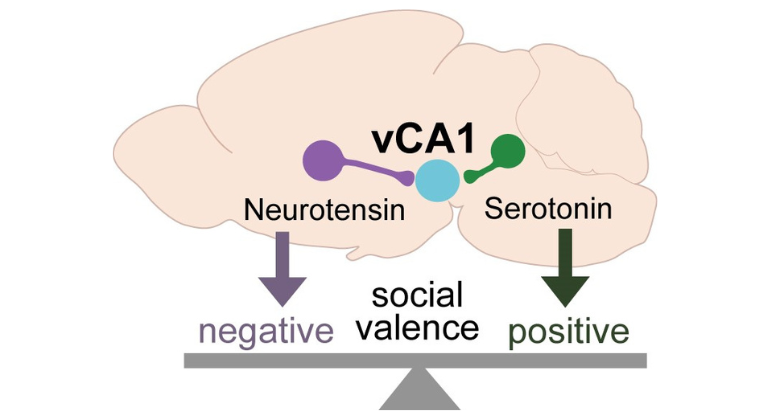
Mount Sinai researchers have identified for the first time the neural mechanisms in the brain that regulate both positive and negative impressions of a social encounter, as well as how an imbalance between the two could lead to common neuropsychiatric disorders like autism spectrum disorder (ASD) and schizophrenia. The study, published April 30 in Nature, also describes how activating a serotonin receptor in the brain of a mouse model ofASD restored positive emotional value (also known as “valence”), with encouraging implications for the development of future therapies.
“The ability to recognize and distinguish unpleasant from pleasant interactions is essential for humans to navigate their social environment,” says Xiaoting Wu, PhD, Assistant Professor of Neuroscience at the Icahn School of Medicine at Mount Sinai, and senior author of the study. “Until now, it has been unclear how the brain assigns positivity or negativity—‘valence’—to social experiences, and how that information can be flexibly updated in a constantly changing environment.”
At the center of this complex neural circuitry is the hippocampus, located deep in the temporal lobe of the brain and responsible for forming new memories, learning, and emotions. The Mount Sinai researchers described how two neuromodulators—serotonin and neurotensin, which influence processes such as mood, arousal, and neural plasticity—are released into the hippocampal subregion known as ventral CA1, where they control opposing social valence assignment. Both neurotransmitters impact distinct populations of ventral CA1 neurons through their respective receptors, serotonin 1B and neurotensin 1.
While deficits in social valence are known to be prevalent in many neuropsychiatric disorders, their underlying neural mechanisms and pathophysiology have remained elusive. “Through our work we’ve provided the first foundational insights into the neural basis of social valence,” notes Dr. Wu. “We have demonstrated that the neuromodulators serotonin and neurotensin signal opposing valence, revealing a fundamental principle of brain function in the form of a neuromodulatory switch that allows behavioral adaptation based on social history.”
Specifically, the team developed a novel social cognitive paradigm that involved exposing mice to negative and positive social encounters. In the negative social encounter, the test mouse was exposed to a mean/aggressive mouse; in the positive encounter, the mouse was exposed to a potential mate. In both assays the mice had negative or neutral/positive or neutral interaction and then got to choose which mouse they would like to spend more time with. Without prior experience, the mice did not have a preference, but with the experience, they associated a mouse with a positive or negative valence and then learned to avoid the “bad” mouse or approach the “good” mouse.”
Just as importantly, the team uncovered specific drug targets for positive and negative valence, knowledge that could potentially factor into future treatments. Specifically, serotonin acting on the serotonin 1B receptor generates a positive impression of a social encounter, while neurotensin acting on the neurotensin 1 receptor creates a negative impression. Imbalanced emotional processing of those two social experiences is known to be a debilitating symptom of ASD. Consequently, by activating the serotonin 1B receptor, researchers were able to restore a positive impression associated with rewarding social experiences.
“We identified a specific neuromodulator receptor which we then targeted to rescue social cognitive deficits in a mouse model of ASD,” Dr. Wu explains. “On a broader scale, our work provides critical insights into complex social behaviors while revealing potential therapeutic targets that can be leveraged to improve social cognitive deficits in common neuropsychiatric disorders.”
This work was supported by funding from NIH K99 Career Development Award (grant no. MH122697), NIMH BRAINS R01 Award (grant no. MH136228), Alkermes Pathways Award, NARSAD Young Investigator Award and Friedman Brain Institute Scholar Award.
About the Mount Sinai Health System
Mount Sinai Health System is one of the nation’s leading integrated academic health systems and one of the largest in the New York metropolitan area. Its comprehensive system includes seven hospitals, more than 400 outpatient practices, over 600 research and clinical laboratories, the Icahn School of Medicine at Mount Sinai, the Graduate School of Biomedical Sciences, and the Mount Sinai Phillips School of Nursing. Together, the Health System comprises approximately 48,000 employees, more than 9,000 physicians, and 8,600 nurses.
As a leading learning health system, Mount Sinai combines clinical expertise with scientific discovery to improve patient care while training the next generation of health care and biomedical leaders. The Health System provides care across every stage of life, from prenatal care through geriatrics, while advancing personalized medicine through artificial intelligence, data science, and biomedical research.
Mount Sinai is consistently recognized among the nation’s leading academic health systems for patient care, research, and education. The Mount Sinai Hospital is ranked No. 1 in New York by Newsweek® and No. 7 in the U.S. on the magazine’s World’s Best Hospitals 2026 list. The Icahn School of Medicine at Mount Sinai ranks No. 9 among U.S. medical schools and No. 1 among freestanding medical schools for National Institutes of Health grant funding, reflecting the strength of its scientific enterprise and leadership in biomedical research.