
Mount Sinai Researchers Uncover Why Some Leukemia Cells May Resist Treatment
Study of RAS-mutant cells appears in prestigious journal Nature
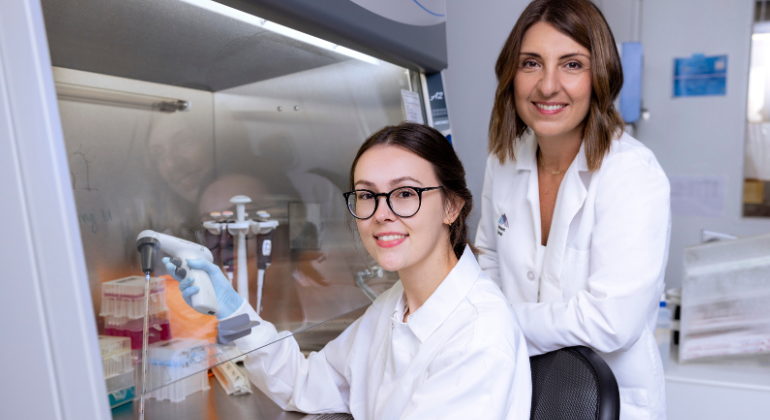
Research from the Icahn School of Medicine at Mount Sinai provides new insights into acute myeloid leukemia (AML) and its resistance to a common treatment. The study, titled “RAS-mutant leukemia stem cells drive clinical resistance to venetoclax” and published this morning in the October issue of Nature, was led by Eirini Papapetrou, MD, PhD, Professor of Oncological Sciences at Icahn Mount Sinai.
Acute myeloid leukemia is a devastating blood cancer that starts in the bone marrow, where blood cells are born. Although AML is a rare disease, approximately 20,800 people will be diagnosed with AML in 2024 in the United States, according to the American Cancer Society.
In this study, researchers found that certain genetic changes, known as RAS mutations, can make leukemia stem cells resistant to drugs. The RAS gene family includes KRAS, HRAS, and NRAS, which encode proteins that control cell signaling, growth, and death. Mutations in these genes typically appear later in the disease and specifically target certain blood cell types, making them more aggressive and harder to treat, the researchers found.
“We discovered that these RAS-mutant leukemia stem cells behave differently from other leukemia stem cells,” said Dr. Papapetrou. “This could explain why some patients do not respond well to the widely used drug venetoclax, which the Food and Drug Administration approved for AML treatment in October 2020.”
This study used innovative genetically engineered models and patient-derived cells, combined with advanced genomic technologies, to investigate the role of RAS mutations in leukemia and their impact on drug response. The researchers discovered that RAS mutations specifically target granulocyte-monocyte progenitors that have already acquired early mutations, transforming them into RAS-mutant leukemia stem cells. This leads to leukemias with distinct characteristics, including resistance to venetoclax. This resistance is caused by changes in proteins that control apoptosis, a form of cell death, impacted by RAS mutations.
“This study has implications for patients with RAS mutations,” Dr. Papapetrou said. “It suggests that treatment with venetoclax might not be effective for these individuals and could even worsen their condition. For these patients, providers should consider a combination of therapies that include new RAS inhibitors, which could improve treatment results.”
The findings highlight the importance of personalized medicine, where treatments are tailored to the specific genetic characteristics of each patient's cancer. This approach could lead to better outcomes and improved quality of life for those battling leukemia.
“Our study supports the rationale of testing combinations of venetoclax with RAS inhibitors, as well as MCL-1 and/or BCL-xL inhibitors,” Dr. Papapetrou said. “Such inhibitors are currently at different stages of preclinical and clinical development and, based on our results, could be tested in combination with venetoclax in patients with AML with RAS mutations.”
The study involved collaboration with several leading medical institutions and received support from the National Institutes of Health and various philanthropic foundations.
About the Mount Sinai Health System
Mount Sinai Health System is one of the nation’s leading integrated academic health systems and one of the largest in the New York metropolitan area. Its comprehensive system includes seven hospitals, more than 400 outpatient practices, over 600 research and clinical laboratories, the Icahn School of Medicine at Mount Sinai, the Graduate School of Biomedical Sciences, and the Mount Sinai Phillips School of Nursing. Together, the Health System comprises approximately 48,000 employees, more than 9,000 physicians, and 8,600 nurses.
As a leading learning health system, Mount Sinai combines clinical expertise with scientific discovery to improve patient care while training the next generation of health care and biomedical leaders. The Health System provides care across every stage of life, from prenatal care through geriatrics, while advancing personalized medicine through artificial intelligence, data science, and biomedical research.
Mount Sinai is consistently recognized among the nation’s leading academic health systems for patient care, research, and education. The Mount Sinai Hospital is ranked No. 1 in New York by Newsweek and No. 5 on the magazine’s World’s Best Hospitals list. The Icahn School of Medicine at Mount Sinai ranks No. 11 among U.S. medical schools and No. 1 among freestanding medical schools for National Institutes of Health funding, reflecting the strength of its scientific enterprise and leadership in biomedical research.