
Mount Sinai Researchers Identify Six-Gene Pattern to Predict Drug Success in Multiple Myeloma Patients
Genetic markers for venetoclax could help personalize treatment and improve outcomes
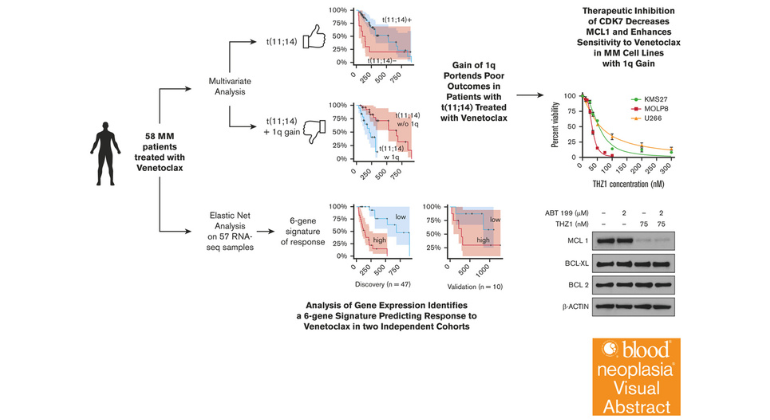
Researchers at the Icahn School of Medicine at Mount Sinai have discovered how genetics can affect the success of venetoclax, a treatment for multiple myeloma, a rare type of blood cancer. Their study, “Predictors of Response to Venetoclax and Therapeutic Potential of CDK7 Inhibition in Multiple Myeloma,” published this month in the journal Blood Neoplasia.
This study is the first to look at genetic markers in patients with multiple myeloma who are receiving venetoclax. Venetoclax is a B cell lymphoma 2 (BCL-2) inhibitor that has shown promising results in treating multiple myeloma at Mount Sinai and other institutions, though it is not yet approved by the Food and Drug Administration for this use. Currently, it has been approved to treat adults with chronic lymphocytic leukemia (CLL) or small lymphocytic lymphoma (SLL). The team identified a special six-gene pattern that can help predict which patients are more likely to respond well to the treatment. They also found that using inhibitors of the enzyme CDK7 alongside venetoclax could make the treatment work even better.
Understanding these genetic factors is important because not all patients respond to venetoclax.
“By knowing which patients might benefit the most, we can customize treatments to improve their chances of success,” said corresponding author Alessandro Lagana, PhD, Assistant Professor of Oncological Sciences at the Icahn School of Medicine at Mount Sinai.
The American Cancer Society estimates that in the United States for 2024, about 35,780 new cases of multiple myeloma will be diagnosed (19,520 in men and 16,260 in women), and approximately 12,540 deaths are expected (7,020 in men and 5,520 in women). Although the average lifetime risk of getting multiple myeloma is less than 1 percent—about 1 in 103 for men and about 1 in 131 for women—individual risk can vary based on specific factors.
Multiple myeloma is most common in older adults, with less than 1 percent of cases diagnosed in people younger than 35. The average age of diagnosis is 69.
“Doctors could use genetic testing to choose the best candidates for venetoclax treatment,” Dr. Lagana said. “In addition, combining venetoclax with CDK7 inhibitors might help more patients respond positively, especially those who might not respond well to venetoclax alone. For patients, this research means someday they could receive more personalized treatment plans based on their genetic information, leading to better outcomes.”
Paula Restrepo, a PhD candidate at the Icahn School of Medicine at Mount Sinai, contributed to this research. The study received funding from the ASH Bridge Grant Award and several grants from the NIH NCI; and support from the Multiple Myeloma Center of Excellence Philanthropic Fund.
Next, the research team plans to confirm these findings in larger groups of patients and explore clinical trials that test the combined use of venetoclax and CDK7 inhibitors.
About the Mount Sinai Health System
Mount Sinai Health System is one of the nation’s leading integrated academic health systems and one of the largest in the New York metropolitan area. Its comprehensive system includes seven hospitals, more than 400 outpatient practices, over 600 research and clinical laboratories, the Icahn School of Medicine at Mount Sinai, the Graduate School of Biomedical Sciences, and the Mount Sinai Phillips School of Nursing. Together, the Health System comprises approximately 48,000 employees, more than 9,000 physicians, and 8,600 nurses.
As a leading learning health system, Mount Sinai combines clinical expertise with scientific discovery to improve patient care while training the next generation of health care and biomedical leaders. The Health System provides care across every stage of life, from prenatal care through geriatrics, while advancing personalized medicine through artificial intelligence, data science, and biomedical research.
Mount Sinai is consistently recognized among the nation’s leading academic health systems for patient care, research, and education. The Mount Sinai Hospital is ranked No. 1 in New York by Newsweek® and No. 7 in the U.S. on the magazine’s World’s Best Hospitals 2026 list. The Icahn School of Medicine at Mount Sinai ranks No. 9 among U.S. medical schools and No. 1 among freestanding medical schools for National Institutes of Health grant funding, reflecting the strength of its scientific enterprise and leadership in biomedical research.


Mount Sinai Researchers Discover Genes That Predict Good Response to Blood Cancer Therapy
Jun 16, 2022 View All Press Releases