
Mount Sinai Researchers Find That Oral Immunotherapy Shows Promise As Treatment for Children with Egg Allergy
The study appears in the New England Journal of Medicine.
A team of researchers from Mount Sinai School of Medicine and four other institutions have found that young children with egg allergies can benefit from treatment with oral immunotherapy. The study titled, "Oral Immunotherapy for Treatment of Egg Allergy in Children," appears online in the New England Journal of Medicine on Wednesday, July 19.
In a multi-center, double-blind, randomized, placebo-controlled study of 55 children with egg allergy, between 5 and 11 years old, 40 children received an egg-white powder as daily oral immunotherapy and 15 children received a cornstarch powder placebo over a 24 month period. Fifty-five children participated in a food challenge, which is a test where a person with food allergy gradually consumes increasing amounts of the allergenic food under medical supervision in order to determine at what level the person experiences allergenic symptoms.
Children who successfully passed the food challenge at 22 months, without having an allergic reaction, discontinued oral immunotherapy and avoided all egg consumption for four to six weeks. At 24 months, these children underwent an oral food challenge with egg-white powder and a cooked egg to test if they had developed tolerance to egg. Children who passed this challenge were placed on a diet with egg consumption and were evaluated again at 30 and 36 months.
"After 10 months of therapy, 55 percent of those who received oral immunotherapy passed the oral food challenge and were considered to be desensitized, compared to none of those on placebo," said Scott Sicherer, MD, Professor of Pediatrics and Chief of the Division of Allergy and Immunology at Mount Sinai School of Medicine. "After 22 months, 75 percent of children in the oral-immunotherapy group were desensitized, meaning with their daily dose they could ingest much more egg than before."
In the oral-immunotherapy group, 28 percent of the children passed the oral food challenge at 24 months after being off daily therapy for 4 to 6 weeks and were considered to no longer have an allergy to egg. At 30 months and 36 months, all children who had passed the oral food challenge at 24 months were consuming egg.
"We found that oral immunotherapy provides protection in a majority of children with egg allergy by raising the reaction threshold," said Hugh Sampson, MD, Dean for Translational Biomedical Sciences, Professor of Pediatrics, and Director of the Jaffe Food Allergy Institute at Mount Sinai School of Medicine. "It represents a promising therapeutic intervention for food allergy and the approach is relatively safe, with most of the reactions to dosing categorized as mild."
Approximately 15 percent of the children who received oral immunotherapy did not complete the therapy due to significant clinical reactions. The mechanisms underlying the success of oral immunotherapy and their relationship to natural immune tolerance are unknown.
"For oral immunotherapy to be recommended as a standard of care, it will be important to better define the risks of oral immunotherapy versus avoiding the food the child is allergic to, and determine the correct dosing regimens with the most favorable outcomes," said Dr. Sampson. "It is also important to identify patients who are most likely to benefit from oral immunotherapy, and develop strategies that promote long-term tolerance."
The trial was conducted by the National Institute of Allergy and Infectious Diseases (NIAID)-supported Consortium of Food Allergy Research (CoFAR) at clinical sites in Baltimore; Chapel Hill, N.C.; Denver; Little Rock, Ark.; and New York City.
About The Mount Sinai Medical Center
The Mount Sinai Medical Center encompasses both The Mount Sinai Hospital and Mount Sinai School of Medicine. Established in 1968, Mount Sinai School of Medicine is one of the leading medical schools in the United States. The Medical School is noted for innovation in education, biomedical research, clinical care delivery, and local and global community service. It has more than 3,400 faculty in 32 departments and 14 research institutes, and ranks among the top 20 medical schools both in National Institutes of Health (NIH) funding and by U.S. News and World Report.
The Mount Sinai Hospital, founded in 1852, is a 1,171-bed tertiary- and quaternary-care teaching facility and one of the nation's oldest, largest and most-respected voluntary hospitals. In 2011, U.S. News and World Report ranked The Mount Sinai Hospital 16th on its elite Honor Roll of the nation's top hospitals based on reputation, safety, and other patient-care factors. Of the top 20 hospitals in the United States, Mount Sinai is one of 12 integrated academic medical centers whose medical school ranks among the top 20 in NIH funding and U.S. News and World Report and whose hospital is on the U.S. News and World Report Honor Roll. Nearly 60,000 people were treated at Mount Sinai as inpatients last year, and approximately 560,000 outpatient visits took place.
For more information, visit http://www.mountsinai.org/.
Find Mount Sinai on:
Facebook: http://www.facebook.com/mountsinainyc
Twitter @mountsinainyc
YouTube: http://www.youtube.com/mountsinainy
About the Mount Sinai Health System
Mount Sinai Health System is one of the nation’s leading integrated academic health systems and one of the largest in the New York metropolitan area. Its comprehensive system includes seven hospitals, more than 400 outpatient practices, over 600 research and clinical laboratories, the Icahn School of Medicine at Mount Sinai, the Graduate School of Biomedical Sciences, and the Mount Sinai Phillips School of Nursing. Together, the Health System comprises approximately 48,000 employees, more than 9,000 physicians, and 8,600 nurses.
As a leading learning health system, Mount Sinai combines clinical expertise with scientific discovery to improve patient care while training the next generation of health care and biomedical leaders. The Health System provides care across every stage of life, from prenatal care through geriatrics, while advancing personalized medicine through artificial intelligence, data science, and biomedical research.
Mount Sinai is consistently recognized among the nation’s leading academic health systems for patient care, research, and education. The Mount Sinai Hospital is ranked No. 1 in New York by Newsweek® and No. 7 in the U.S. on the magazine’s 2026 World’s Best Hospitals list and No. 3 in the world in its World’s Best Smart Hospitals list. The Icahn School of Medicine at Mount Sinai ranks No. 9 among U.S. medical schools and No. 1 among freestanding medical schools for National Institutes of Health grant funding, reflecting the strength of its scientific enterprise and leadership in biomedical research.
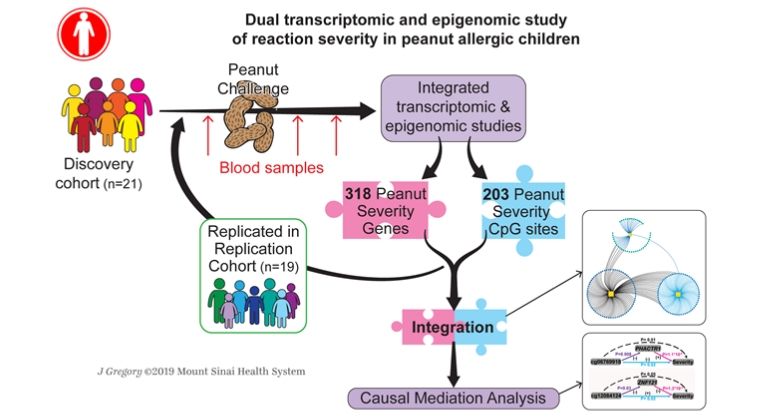
Multi-omics Approach Offers New Insights into Peanut Allergy Severity
Dec 12, 2019 View All Press Releases