
Two Mount Sinai Researchers Named Inaugural Cumming Global Fellows for Pandemic Therapeutics Research
Goran Bajic, PhD, and Raianna Fantin, PhD, receive three-year fellowships to develop broadly protective antibody therapies for emerging viral threats, including Nipah virus and mpox
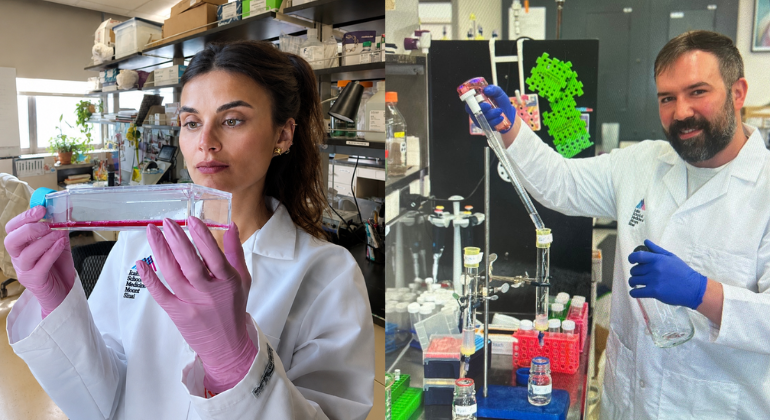
Two microbiology researchers at the Icahn School of Medicine at Mount Sinai have been named inaugural Cumming Global Fellows, receiving three-year fellowships to advance antibody therapies against emerging viruses with pandemic potential.
Goran Bajic, PhD, and Raianna Fantin, PhD, researchers in the Department of Microbiology at the Icahn School of Medicine at Mount Sinai, are two of four early- and mid-career scientists selected through a competitive international application process. Each fellow will receive three years of funding to advance research on new treatments for emerging infectious diseases.
The Cumming Global Centre for Pandemic Therapeutics in Melbourne, Australia, established the program to support the next generation of pandemic therapeutics researchers and strengthen international collaboration and preparedness for future health threats.
Goran Bajic, PhD:
Broadly Protective Antibodies Against Henipaviruses
Dr. Bajic will investigate broadly protective antibody therapies against henipaviruses, including Nipah and Hendra viruses, which can cause severe and often deadly outbreaks. His mentor, Benhur Lee, MD, Ward-Coleman Chair in Microbiology, Icahn School of Medicine at Mount Sinai, will support the work. Dr. Bajic will develop nanoparticles that display proteins from multiple henipaviruses to generate fully human antibodies and smaller, adaptable nanobodies designed to block multiple viral strains.
The project will combine virology and structural biology to identify promising antibody candidates and determine how they interact with henipaviruses. The goal is to develop antibody-based therapies that provide broader protection against known and emerging henipaviruses and reveal viral vulnerabilities that could inform future treatments.
“Henipaviruses represent a significant pandemic threat, and there are currently no approved vaccines or broadly effective antibody treatments,” said Dr. Bajic. “This fellowship will allow us to explore new approaches for developing antibody therapeutics that could provide protection across multiple henipaviruses and, ultimately, help us respond more rapidly when new viral threats emerge.”
Raianna Fantin, PhD:
Advancing Monoclonal Antibody Countermeasures for Orthopoxviruses
Dr. Fantin will focus on developing a potential antibody treatment for mpox, an ongoing global public health threat for which improved therapeutic options are needed. Supported by her mentor, Camila Coelho, PhD, Assistant Professor of Microbiology at the Icahn School of Medicine, Dr. Fantin will advance EV35-6, a human monoclonal antibody that targets a conserved viral protein involved in the systemic spread of mpox.
Previous research has shown that EV35-6 can protect mice from mpox infection when administered before or after infection. Through the fellowship, Dr. Fantin will evaluate EV35-6 in nonhuman primates, examining therapeutic effectiveness, safety, persistence in the body, route of administration, and distribution across tissues. The findings are intended to provide evidence needed to advance EV35-6 toward clinical development.
“The opportunity to move a promising antibody treatment for mpox closer to clinical development is incredibly exciting,” said Dr. Fantin. “This support will enable us to address important questions about how the antibody works in a more clinically relevant model and help determine whether it has the potential to become a therapeutic option for patients.”
The Cumming Global Fellows Program combines research funding with leadership development based on the adaptive leadership framework developed by Ron Heifetz, MD, MPA, and Martin Linsky, JD. Fellows participate in annual leadership immersions, workshops, and interactive learning experiences designed to build skills for leading complex, multidisciplinary efforts to address global health challenges. The inaugural cohort will begin the fellowship program in September 2026.
“The selection of Drs. Bajic and Fantin reflects Mount Sinai’s leadership in developing innovative approaches to emerging and re-emerging pathogens and our longstanding commitment to infectious disease research,” said Ana Fernandez-Sesma, PhD, Chair of the Department of Microbiology at the Icahn School of Medicine. “Their projects also underscore the importance of advancing therapeutics before the next pandemic emerges, rather than waiting until an outbreak is underway.”
About the Icahn School of Medicine at Mount Sinai
The Icahn School of Medicine at Mount Sinai is internationally renowned for its outstanding research, educational, and clinical care programs. It is the sole academic partner for the seven member hospitals* of the Mount Sinai Health System, one of the largest academic health systems in the United States, providing care to New York City’s large and diverse patient population.
The Icahn School of Medicine at Mount Sinai offers highly competitive MD, PhD, MD-PhD, and master’s degree programs, with enrollment of more than 1,200 students. It has the largest graduate medical education program in the country, with more than 2,700 clinical residents and fellows training throughout the Health System. The Graduate School of Biomedical Sciences offers 12 degree-granting programs, conducts innovative basic and translational research, and trains more than 470 postdoctoral research fellows.
Ranked 11th nationwide in National Institutes of Health (NIH) funding, the Icahn School of Medicine at Mount Sinai is among the 90th percentile of U.S. private medical schools in Sponsored Programs Direct Expenditures per Principal Investigator, according to the Association of American Medical Colleges. More than 6,900 scientists, educators, and clinicians work within and across dozens of academic departments and multidisciplinary institutes with an emphasis on translational research and therapeutics. Through Mount Sinai Innovation Partners (MSIP), the Health System facilitates the real-world application and commercialization of medical breakthroughs made at Mount Sinai.
-------------------------------------------------------
* Mount Sinai Health System member hospitals: The Mount Sinai Hospital; Mount Sinai Brooklyn; Mount Sinai Morningside; Mount Sinai Queens; Mount Sinai South Nassau; Mount Sinai West; and New York Eye and Ear Infirmary of Mount Sinai.
About the Mount Sinai Health System
Mount Sinai Health System is one of the nation’s leading integrated academic health systems and one of the largest in the New York metropolitan area. Its comprehensive system includes seven hospitals, more than 400 outpatient practices, over 600 research and clinical laboratories, the Icahn School of Medicine at Mount Sinai, the Graduate School of Biomedical Sciences, and the Mount Sinai Phillips School of Nursing. Together, the Health System comprises approximately 48,000 employees, more than 9,000 physicians, and 8,600 nurses.
As a leading learning health system, Mount Sinai combines clinical expertise with scientific discovery to improve patient care while training the next generation of health care and biomedical leaders. The Health System provides care across every stage of life, from prenatal care through geriatrics, while advancing personalized medicine through artificial intelligence, data science, and biomedical research.
Mount Sinai is consistently recognized among the nation’s leading academic health systems for patient care, research, and education. The Mount Sinai Hospital is ranked No. 1 in New York by Newsweek® and No. 7 in the U.S. on the magazine’s World’s Best Hospitals 2026 list. The Icahn School of Medicine at Mount Sinai ranks No. 9 among U.S. medical schools and No. 1 among freestanding medical schools for National Institutes of Health grant funding, reflecting the strength of its scientific enterprise and leadership in biomedical research.