
Mount Sinai Surgeons Perform First Heart-Liver-Kidney Transplants in New York State
One of the complex procedures involves a repeat heart transplant, highlighting Mount Sinai’s skill and expertise
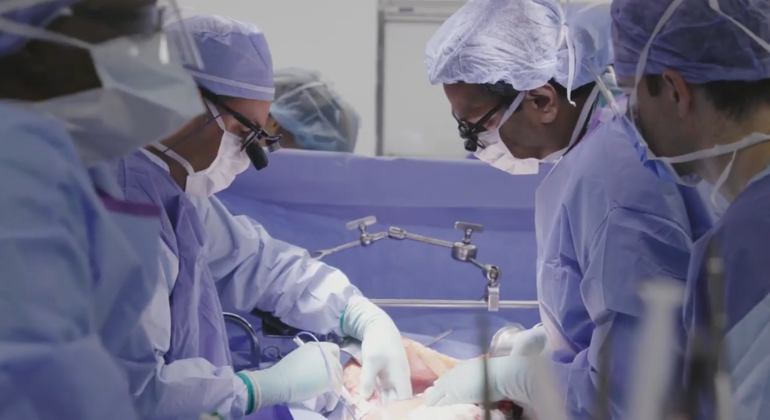
A team of Mount Sinai surgeons has performed the first heart-liver-kidney triple organ transplants in New York. They successfully completed two of these complex surgeries on patients from Westchester County, who have since returned home and are making full recoveries.
Heart-liver-kidney transplants are extremely rare—only 58 have been done across the country since the United Network for Organ Sharing, the government agency that oversees transplantation, started tracking cases in 1987. The two procedures at The Mount Sinai Hospital, which took place on January 10 and March 8, were among only four to date in the entire United States in 2025.
One of the Mount Sinai cases was the first heart-liver-kidney transplant in New York State, and took place in January of this year. That procedure gave the patient a second transplanted heart in addition to a liver and kidney transplant, one of only a handful of cases of its kind that have been performed in the country.
The extraordinarily high-risk and complex 22-hour operation was led by Anelechi Anyanwu, MD, Vice Chair of the Department of Cardiovascular Surgery for the Mount Sinai Health System, and Sander S. Florman, MD, the Charles Miller, MD Professor of Surgery and Director of the Recanati/Miller Transplantation Institute at Mount Sinai.
Drs. Anyanwu and Florman also led the second heart-liver-kidney transplant in March of this year.
“The coordination between our abdominal and thoracic medical and surgical teams was seamless—and the anesthesia expertise required to perform these transplants was critical,” says Dr. Florman. “An amazing tour de force for this patient!”
The patient, a 64-year-old man from Peekskill, New York, had previously undergone a heart transplant at The Mount Sinai Hospital in 2002 for complications of sarcoidosis, an autoimmune disease which can damage the heart muscle. After two healthy decades with the transplant, he developed chronic rejection of the transplanted heart. He also developed deteriorating kidney and liver function, a common complication of long-standing heart disease and anti-rejection medication. He was hospitalized in December 2024 with severe heart failure and rapidly declining kidney and liver function and needed three new organs to survive. His condition took a turn for the worse just after Christmas, and on December 30, he underwent emergency surgery to have artificial heart pumps (ventricular assist devices) implanted to keep him alive until a suitable donor was identified. Two weeks later, he had the successful triple organ transplant, and is now thriving with no complications.
“It is incredible to see how much better our patient feels and looks in a short period of time,” adds Noah Moss, MD, an advanced heart failure and transplant cardiologist at Mount Sinai who has cared for the patient for nearly a decade. “He describes that his activities of daily living are much easier to perform and he has returned to work where he volunteers for his community, and is already planning his next family vacation.”
The other triple-transplant case involved a 45-year old from Ossining, New York, who received a new heart, liver, and kidney as the result of a severe cardiomyopathy diagnosis. He had multiple complications during a hospitalization for an extreme episode of heart failure in 2024, which left him with end-stage kidney disease requiring dialysis and some scarring of his liver. He was admitted to the hospital in February 2025 with worsening heart failure and was listed for heart and kidney transplantation; at the time, his liver function was marginal but adequate. Because of worsening heart failure and cardiogenic shock—when the body organs are not receiving enough blood and oxygen to maintain their vital functions—he needed two emergency artificial heart pumps to keep his heart functioning and keep him alive until a donor was identified. By then, his liver function had deteriorated and he was dying of liver failure. He was emergently listed for a liver transplant and several days later, underwent the successful triple transplant and made a rapid turnaround. The procedure took place on March 18 and he went home less than a month later after making a full recovery.
These cases exemplify Mount Sinai’s success involving its organ transplant programs and complex multidisciplinary teams. They have a remarkable track record, performing 6 pancreas, 10 intestine, 25 lung, 51 heart, 178 liver, and 270 kidney transplants in 2024, with excellent outcomes.
About the Mount Sinai Health System
Mount Sinai Health System is one of the nation’s leading integrated academic health systems and one of the largest in the New York metropolitan area. Its comprehensive system includes seven hospitals, more than 400 outpatient practices, over 600 research and clinical laboratories, the Icahn School of Medicine at Mount Sinai, the Graduate School of Biomedical Sciences, and the Mount Sinai Phillips School of Nursing. Together, the Health System comprises approximately 48,000 employees, more than 9,000 physicians, and 8,600 nurses.
As a leading learning health system, Mount Sinai combines clinical expertise with scientific discovery to improve patient care while training the next generation of health care and biomedical leaders. The Health System provides care across every stage of life, from prenatal care through geriatrics, while advancing personalized medicine through artificial intelligence, data science, and biomedical research.
Mount Sinai is consistently recognized among the nation’s leading academic health systems for patient care, research, and education. The Mount Sinai Hospital is ranked No. 1 in New York by Newsweek and No. 5 on the magazine’s World’s Best Hospitals list. The Icahn School of Medicine at Mount Sinai ranks No. 11 among U.S. medical schools and No. 1 among freestanding medical schools for National Institutes of Health funding, reflecting the strength of its scientific enterprise and leadership in biomedical research.