
Mount Sinai Study Finds Wearable Devices Can Detect and Predict Inflammatory Bowel Disease Flare-Ups
Data collected by wearable technology can identify disease flare-ups up to seven weeks in advance
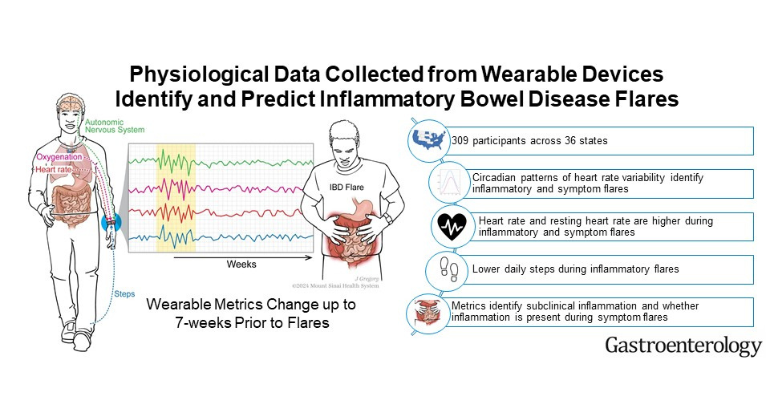
Credit: Courtesy of Gastroenterology.
Wearable devices can identify, differentiate, and predict flare-ups, or the worsening of symptoms and inflammation, in inflammatory bowel disease (IBD), Mount Sinai researchers have shown in a first-of-its-kind study.
The findings, published in the journal Gastroenterology on January 16, suggest that wearable technology can predict the subsequent development of flares in IBD, enabling continuous disease monitoring through widely available commercial devices.
“Current disease-monitoring methods rely on patients directly interacting with their doctors, either through office visits, blood or stool testing, or by undergoing a colonoscopy. These methods also only assess the disease at one point in time, and can often be invasive or inconvenient,” said first author Robert Hirten, MD, Clinical Director of the Hasso Plattner Institute for Digital Health; and Associate Professor of Medicine (Gastroenterology), and Artificial Intelligence and Human Health, at the Icahn School of Medicine at Mount Sinai. “Our study shows that commonly used wearable devices such as Apple Watches, Fitbits, and Oura Rings can be effective tools in monitoring chronic inflammatory diseases like IBD. This creates an opportunity to monitor the disease remotely outside the health care setting, in a continuous manner, and potentially in real time.”
IBD is a chronic condition that causes inflammation in the intestines and affects more than 2.4 million people in the United States. Mount Sinai researchers enrolled more than 300 participants with ulcerative colitis or Crohn’s disease, the two major types of IBD, from 36 states. The participants wore devices, answered daily symptom surveys, and provided blood and stool assessments of inflammation.
The researchers found that circadian patterns of heart rate variability (a marker of nervous system function), along with heart rate, oxygenation, and daily activity, all measured by the wearable devices, were significantly altered when inflammation or symptoms were present. Moreover, these physiological markers could detect inflammation even in the absence of symptoms and distinguish whether symptoms were driven by active inflammation in the intestines. Importantly, the researchers found that these metrics measured by wearables changed up to seven weeks before flares developed.
The researchers are applying similar approaches to other chronic inflammatory diseases, such as rheumatoid arthritis, and leveraging artificial intelligence to develop algorithms using wearable device data to predict flares on an individualized basis. “These findings open the door to leveraging wearable technology for health monitoring and disease management in innovative ways we haven’t previously considered,” Dr. Hirten said. “Our hope is that, in the future, this approach will significantly enhance the quality of life of our patients.”
About the Mount Sinai Health System
Mount Sinai Health System is one of the nation’s leading integrated academic health systems and one of the largest in the New York metropolitan area. Its comprehensive system includes seven hospitals, more than 400 outpatient practices, over 600 research and clinical laboratories, the Icahn School of Medicine at Mount Sinai, the Graduate School of Biomedical Sciences, and the Mount Sinai Phillips School of Nursing. Together, the Health System comprises approximately 48,000 employees, more than 9,000 physicians, and 8,600 nurses.
As a leading learning health system, Mount Sinai combines clinical expertise with scientific discovery to improve patient care while training the next generation of health care and biomedical leaders. The Health System provides care across every stage of life, from prenatal care through geriatrics, while advancing personalized medicine through artificial intelligence, data science, and biomedical research.
Mount Sinai is consistently recognized among the nation’s leading academic health systems for patient care, research, and education. The Mount Sinai Hospital is ranked No. 1 in New York by Newsweek® and No. 7 in the U.S. on the magazine’s World’s Best Hospitals 2026 list. The Icahn School of Medicine at Mount Sinai ranks No. 9 among U.S. medical schools and No. 1 among freestanding medical schools for National Institutes of Health grant funding, reflecting the strength of its scientific enterprise and leadership in biomedical research.