
Mount Sinai Obstetricians First in New York City to Use FDA-Cleared AI Tool That Enhances Fetal Screenings for Congenital Heart Defects
Recent study led by Mount Sinai West doctors found AI technology helped identify more than 97 percent of serious congenital heart defects in babies
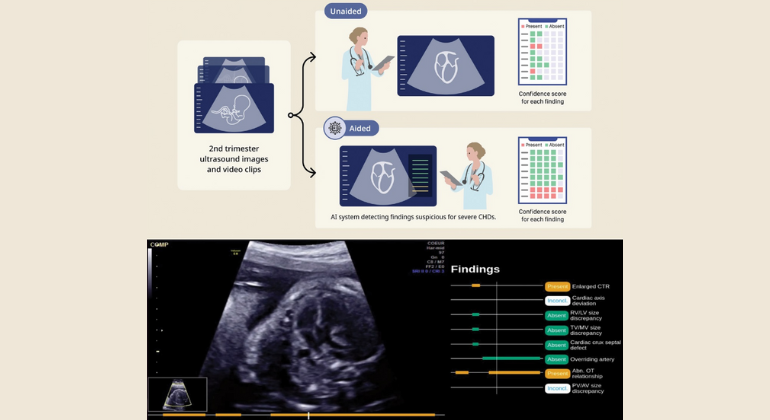
Photo credit: Figure 1AB. Courtesy of The Green Journal/Obstetrics & Gynecology
Doctors in the Raquel and Jaime Gilinski Department of Obstetrics, Gynecology and Reproductive Science at Mount Sinai have become the first in New York City to implement an artificial intelligence (AI) tool that enhances ultrasounds on a large scale—resulting in earlier detection and better care for babies and families.
Congenital heart defects, or conditions present at birth that affect the heart structure, are one of the most common birth abnormalities. About 1 in 500 newborns is classified as having a severe congenital heart defect that requires urgent medical or surgical intervention for survival, according to the National Institutes of Health.
Carnegie Imaging for Women, a modern OB/GYN imaging facility, is the first center in New York City to use a Food and Drug Administration-cleared AI software tool from medical company BrightHeart to make ultrasounds more accurate and efficient. The Mount Sinai-affiliated center has three locations in Manhattan.
In a recent Obstetrics & Gynecology study led by Mount Sinai West doctors, the researchers used the AI technology to improve their detection rates of ultrasound findings suspicious for major congenital heart defects to more than 97 percent, with an 18 percent reduction in reading time and 19 percent improvement in confidence score.
“AI assistance in prenatal diagnosis offers not only improved detection, but has the potential to offer significant improvement in workflow and efficiency benefits,” said corresponding author Jennifer Lam-Rachlin, MD, Assistant Clinical Professor of Obstetrics, Gynecology and Reproductive Science at the Icahn School of Medicine at Mount Sinai. “We, as clinicians, should embrace innovation and technology that is available, in order to maximize quality patient care. This technology allows for ‘leveling’ of the field of prenatal diagnosis to offer close to expert-level review of fetal ultrasounds, particularly in centers or geographical locations without fetal heart experts.”
The researchers examined a dataset of 200 deidentified fetal ultrasound examinations between 18 and 24 weeks of gestation from 11 medical centers across two countries, including 100 with at least one suspicious finding. The study aimed to evaluate the association between the use of AI-based software and reader performance in identifying second-trimester ultrasound examinations suspicious for severe congenital heart defects. Seven obstetrician-gynecologists and seven maternal-fetal medicine specialists (experts in high-risk pregnancies) reviewed each examination in randomized order, both with and without AI assistance, and assessed the presence or absence of each finding suspicious for congenital heart defects with confidence scores.
AI-assisted interpretation was associated with improved detection of lesions suspicious for severe congenital heart defects. The study demonstrated the ability of AI-based software to improve the detection of these suspicious findings via prenatal ultrasonography, as well as the overall confidence and time efficiency in interpreting these scans.
“Our study should prompt and encourage future research into AI-assisted software’s ability to improve detection rates, once integrated into clinical workflows, to reduce the variability and inequity of detection of congenital heart defects globally,” said co-author Andrei Rebarber, MD, Director of the Division of Maternal-Fetal Medicine at Mount Sinai West and Clinical Professor of Obstetrics, Gynecology and Reproductive Science at the Icahn School of Medicine at Mount Sinai. “The future for prenatal diagnostic imaging is bright when AI software is employed as an adjunct to physician interpretation.”
BrightHeart, developer of the AI-based software, funded the study. Researchers from the following institutions contributed to this study: the Division of Pediatric Cardiology at the Icahn School of Medicine at Mount Sinai; New York University School of Medicine; Maternal Fetal Medicine Associates in New York City; Pediatrics – Cardiology at Stanford University School of Medicine in Palo Alto, California; Palo Alto Medical Foundation, Sutter Health, in Palo Alto, California; the Fetal Diagnostic Center of Pasadena in Pasadena, California; Université Grenoble Alpes, Centre Hospitalier Universitaire-Grenoble Alpes (CHU Grenoble Alpes) in Grenoble, France; Medical Training Center in Rouen, France; Centre d’Echographie de l’Odéon in Paris; UE3C-Unité d’Explorations Cardiologiques-Cardiopathies Congénitales in Paris; Cardiologie Pédiatrique - Hôpital Necker-Enfants Maladies in Paris; Michigan Perinatal Associates, Corewell Health East, in Dearborn, Michigan; Wayne State University School of Medicine in Detroit; Fetal Echocardiography and Perinatal Research–Valley Health System in Paramus, New Jersey; Division of Maternal Fetal Medicine, Pennsylvania Hospital, University of Pennsylvania in Philadelphia; and Maternal Fetal Medicine, Perinatal Specialists of the Palm Beaches in West Palm Beach, Florida.
For more Mount Sinai artificial intelligence news, visit: https://icahn.mssm.edu/about/artificial-intelligence.
About the Mount Sinai Health System
Mount Sinai Health System is one of the nation’s leading integrated academic health systems and one of the largest in the New York metropolitan area. Its comprehensive system includes seven hospitals, more than 400 outpatient practices, over 600 research and clinical laboratories, the Icahn School of Medicine at Mount Sinai, the Graduate School of Biomedical Sciences, and the Mount Sinai Phillips School of Nursing. Together, the Health System comprises approximately 48,000 employees, more than 9,000 physicians, and 8,600 nurses.
As a leading learning health system, Mount Sinai combines clinical expertise with scientific discovery to improve patient care while training the next generation of health care and biomedical leaders. The Health System provides care across every stage of life, from prenatal care through geriatrics, while advancing personalized medicine through artificial intelligence, data science, and biomedical research.
Mount Sinai is consistently recognized among the nation’s leading academic health systems for patient care, research, and education. The Mount Sinai Hospital is ranked No. 1 in New York by Newsweek® and No. 7 in the U.S. on the magazine’s World’s Best Hospitals 2026 list. The Icahn School of Medicine at Mount Sinai ranks No. 9 among U.S. medical schools and No. 1 among freestanding medical schools for National Institutes of Health grant funding, reflecting the strength of its scientific enterprise and leadership in biomedical research.