
Monoclonal Antibody Can Reverse Effects of Bleeding and Complications Linked to Common Medication for Heart Attacks
Trial led by Mount Sinai researcher could save lives for patients in need of urgent surgery, invasive procedures, or experiencing major bleeding
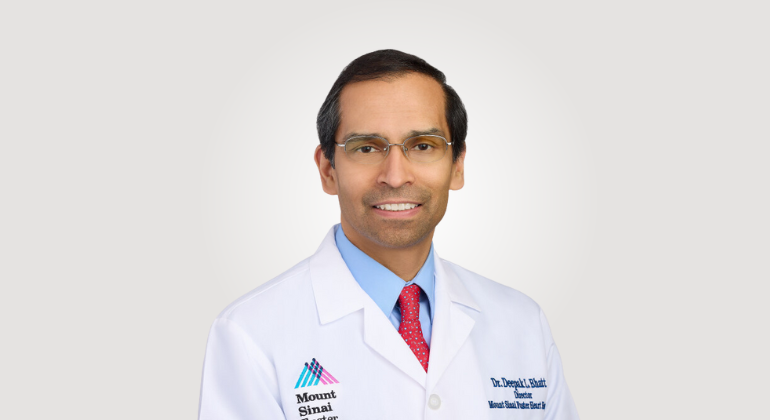
Deepak L. Bhatt, MD, MPH, MBA, FACC, FAHA, FESC, MSCAI, Director of Mount Sinai Fuster Heart Hospital and the Dr. Valentin Fuster Professor of Cardiovascular Medicine at the Icahn School of Medicine at Mount Sinai leads the “REVERSE-IT” trial.
An investigational monoclonal antibody called bentracimab can safely and effectively reverse potentially catastrophic bleeding complications linked to ticagrelor, a common drug used to treat patients with acute coronary syndromes, prior heart attack, stroke, and coronary artery disease.
Those are the findings from a multi-center international clinical trial analyzing bentracimab, the first experimental treatment of its kind. The “REVERSE-IT” trial results were presented Saturday, March 29, in a Late Breaking Clinical Trial Session at the American Academy of Cardiology Scientific Session (ACC.25) in Chicago.
“If approved by the Food and Drug Administration, bentracimab could be a new life-saving option for someone having life-threatening bleeding, such as a brain hemorrhage. The same could be true in patients who need urgent or emergency surgery following a heart attack, such as coronary artery bypass grafting. Use of this drug could also allow earlier surgery in patients taking ticagrelor, by reversing its effect and allowing the surgeon to operate earlier,” says study chair Deepak L. Bhatt, MD, MPH, MBA, FACC, FAHA, FESC, MSCAI, Director of Mount Sinai Fuster Heart Hospital and the Dr. Valentin Fuster Professor of Cardiovascular Medicine at the Icahn School of Medicine at Mount Sinai. “Right now, there is no effective way to reverse the antiplatelet effect of ticagrelor. If approved, bentracimab would be able to fill this clinical need.”
Ticagrelor is an effective, reversible oral platelet inhibitor for cardiac patients; like all antiplatelet agents, it can cause bleeding. Because of its specific molecular structure, researchers were able to develop bentracimab as a monoclonal antibody that reverses its effect when given intravenously to patients already taking ticagrelor. Bentracimab works by binding to ticagrelor and its active metabolite, effectively reversing the antiplatelet effects of ticagrelor and restoring platelet function.
In this phase 3 trial, researchers analyzed 226 ticagrelor patients dosed with bentracimab, of whom 212 met eligibility criteria and had an independent assessment of the degree of bleeding control. They included 141 surgery and 71 bleeding patients.
In all patients, platelet function was quickly and significantly restored within minutes. Effective bleeding control was achieved in 94.3 percent of the total eligible patients: 100 percent in the surgery group and 83 percent in the bleeding patients.
“This is the first antiplatelet reversal agent. If approved, in the right patients it could prevent or treat catastrophic bleeding events in patients receiving ticagrelor. The availability of a reversal agent might make ticagrelor the preferred antiplatelet agent, especially once it becomes available as a generic medication,” adds Dr. Bhatt.
SFJ Pharma funded this study. Dr. Bhatt is a paid consultant for this company.
Mount Sinai Is a World Leader in Cardiology and Heart Surgery
Mount Sinai Fuster Heart Hospital at The Mount Sinai Hospital ranks No. 4 nationally for cardiology, heart, and vascular surgery, according to U.S. News & World Report®. It also ranks No. 1 in New York and No. 6 globally according to Newsweek’s “The World’s Best Specialized Hospitals.”
It is part of Mount Sinai Health System, which is New York City's largest academic medical system, encompassing eight hospitals, a leading medical school, and a vast network of ambulatory practices throughout the greater New York region. We advance medicine and health through unrivaled education and translational research and discovery to deliver care that is the safest, highest-quality, most accessible and equitable, and the best value of any health system in the nation. The Health System includes approximately 9,000 primary and specialty care physicians; 11 free-standing joint-venture centers throughout the five boroughs of New York City, Westchester, Long Island, and Florida; and 45 multidisciplinary research, educational, and clinical institutes. Hospitals within the Health System are consistently ranked by Newsweek’s® “The World’s Best Smart Hospitals” and by U.S. News & World Report's® “Best Hospitals” and “Best Children’s Hospitals.” The Mount Sinai Hospital is on the U.S. News & World Report's® “Best Hospitals” Honor Roll for 2024-2025.
For more information, visit https://www.mountsinai.org or find Mount Sinai on Facebook, Twitter and YouTube.
About the Mount Sinai Health System
Mount Sinai Health System is one of the nation’s leading integrated academic health systems and one of the largest in the New York metropolitan area. Its comprehensive system includes seven hospitals, more than 400 outpatient practices, over 600 research and clinical laboratories, the Icahn School of Medicine at Mount Sinai, the Graduate School of Biomedical Sciences, and the Mount Sinai Phillips School of Nursing. Together, the Health System comprises approximately 48,000 employees, more than 9,000 physicians, and 8,600 nurses.
As a leading learning health system, Mount Sinai combines clinical expertise with scientific discovery to improve patient care while training the next generation of health care and biomedical leaders. The Health System provides care across every stage of life, from prenatal care through geriatrics, while advancing personalized medicine through artificial intelligence, data science, and biomedical research.
Mount Sinai is consistently recognized among the nation’s leading academic health systems for patient care, research, and education. The Mount Sinai Hospital is ranked No. 1 in New York by Newsweek and No. 5 on the magazine’s World’s Best Hospitals list. The Icahn School of Medicine at Mount Sinai ranks No. 11 among U.S. medical schools and No. 1 among freestanding medical schools for National Institutes of Health funding, reflecting the strength of its scientific enterprise and leadership in biomedical research.