
Valentin Fuster, MD, PhD, Received 2024 Distinguished Award From European Society for Clinical Investigation (ESCI)
President of Mount Sinai Fuster Heart Hospital given top honor for his scientific excellence and successful global education initiatives on cardiovascular disease
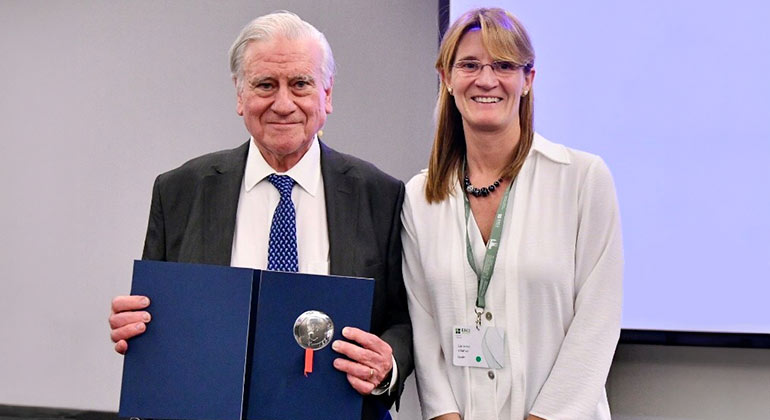
The European Society for Clinical Investigation (ESCI) is awarding Valentin Fuster, MD, PhD, President of Mount Sinai Fuster Heart Hospital and Physician-in-Chief of The Mount Sinai Hospital, its ESCI Distinguished Medal for 2024. He received this honor during the ESCI Annual Scientific Meeting in Barcelona, Spain, during a special ceremony on Friday, June 7.
The ESCI Medal is awarded yearly for outstanding achievements in clinical investigation and for the teaching of young scientists and medical specialists.
This prestigious recognition highlights Dr. Fuster’s significant contributions to the worldwide field of cardiology. Dr. Fuster’s work has been central to improving the health of patients with cardiovascular disease and he has designed, developed, and implemented early health education problems globally that have had positive impacts on society and promoted healthy habits in underserved communities at higher risk of heart disease. Additionally, Dr. Fuster has been instrumental in training and inspiring many physicians and scientists who have become cardiology leaders.
“I feel proud to represent Mount Sinai while accepting this award that highlights my scientific contributions by an organization that focuses on overall clinical research in additional to cardiovascular work,” says Dr. Fuster.
Dr. Fuster was named Director of the Cardiovascular Institute at Mount Sinai in 1994, became Director of Mount Sinai Heart at its establishment in 2006, and held that position until the end of 2022. He built what is now known as Mount Sinai Fuster Heart Hospital into one of the world’s leading centers for cardiovascular care, cardiac surgery, and advanced research. Dr. Fuster is also General Director of the Spanish National Center for Cardiovascular Research (CNIC).
Dr. Fuster helped develop a cardiovascular “polypill”—a single pill that includes three medications typically taken separately—that is effective in preventing secondary adverse cardiovascular events in people who have previously had a heart attack. Dr. Fuster and his team showed that the polypill reduces cardiovascular mortality by 33 percent in this population. This medication was recently included by the World Health Organization in its List of Essential Medicines and is pending Food and Drug Administration approval in the United States.
His research into the origin of cardiovascular events, which has contributed to improved treatment of heart attack patients, was recognized in 1996 by the Prince of Asturias Award for Technical and Scientific Research, the highest international award given by Dr. Fuster’s native Spain. In June 2011 he was awarded the Grand Prix Scientifique of the Institute of France for his translational research into atherothrombotic disease. Recently, he was named a Prince Mahidol Award Laureate in Thailand for his lifelong contribution to the field of medicine, and in 2022, the American College of Cardiology instituted the “Valentin Fuster Award in Science and Innovation,” which will be given to a single physician annually for the next 14 years. He also recently received a Lifetime Achievement Award from the World Heart Federation.
Dr. Fuster has also received the highest awards for research from the four leading cardiovascular organizations: the American Heart Association (Gold Medal and Research Achievement Award), the American College of Cardiology (Living Legend and Life Achievement Award), the European Society of Cardiology (Gold Medal), and the Interamerican Society of Cardiology (Research Achievement Award). In May 2014, King Juan Carlos I of Spain granted Dr. Fuster the title of Marquis for his "outstanding and unceasing research efforts and his educational outreach work."
About the Mount Sinai Health System
Mount Sinai Health System is one of the nation’s leading integrated academic health systems and one of the largest in the New York metropolitan area. Its comprehensive system includes seven hospitals, more than 400 outpatient practices, over 600 research and clinical laboratories, the Icahn School of Medicine at Mount Sinai, the Graduate School of Biomedical Sciences, and the Mount Sinai Phillips School of Nursing. Together, the Health System comprises approximately 48,000 employees, more than 9,000 physicians, and 8,600 nurses.
As a leading learning health system, Mount Sinai combines clinical expertise with scientific discovery to improve patient care while training the next generation of health care and biomedical leaders. The Health System provides care across every stage of life, from prenatal care through geriatrics, while advancing personalized medicine through artificial intelligence, data science, and biomedical research.
Mount Sinai is consistently recognized among the nation’s leading academic health systems for patient care, research, and education. The Mount Sinai Hospital is ranked No. 1 in New York by Newsweek and No. 5 on the magazine’s World’s Best Hospitals list. The Icahn School of Medicine at Mount Sinai ranks No. 11 among U.S. medical schools and No. 1 among freestanding medical schools for National Institutes of Health funding, reflecting the strength of its scientific enterprise and leadership in biomedical research.