Mount Sinai Secures Over $4 Million Grant From National Institutes of Health to Study Alopecia Areata and Atopic Dermatitis in People With Down Syndrome
First-of-its-kind clinical trial with specific JAK inhibition will investigate the best treatment for inflammatory skin conditions in these patients

The Icahn School of Medicine at Mount Sinai is embarking on biomedical research aiming to set new standard-of-care protocols for treating alopecia areata and atopic dermatitis in people with Down syndrome, or trisomy 21.
Emma Guttman-Yassky, MD, PhD, the Waldman Professor and Chair of Dermatology at Icahn Mount Sinai, together with Dusan Bogunovic, PhD, professor of pediatric immunology at Columbia University Vagelos College of Physicians and Surgeons, have been awarded more than $4 million for a five-year National Institutes of Health (NIH) R61/R33 grant to evaluate the long-term safety, efficacy, and mechanisms of medications known as JAK inhibitors in patients with Down syndrome. The medications have been approved by the Food and Drug Administration for treatment of atopic dermatitis and alopecia areata in adults and adolescents generally but have not been studied specifically in people with Down syndrome.
Down syndrome is the most common genetic cause of intellectual disability in the United States, affecting 1 in 700 newborns. In addition to cognitive symptoms, people with Down syndrome frequently experience an increase in inflammatory skin diseases, such as atopic dermatitis and alopecia areata. These individuals also represent a vulnerable population that is seldom included in clinical trials, leaving a void in care protocols aimed specifically at their needs.
“The Down syndrome population has unique medical challenges and considerations that necessitate evaluating the safety and effectiveness of treatments in studies that focus on this specific population,” said Dr. Guttman. “Given how common inflammatory skin diseases are in this population, particularly atopic dermatitis and alopecia areata, we want to ensure that safe and effective treatments are available, and that we understand the effects that they have on immune modulation in people with Down syndrome.”
An R61/R33 NIH grant is a combined mechanism that supports innovative ideas, taking them from the exploratory stage to practical applications with tangible benefits for patients. Ultimately, the goal of these projects is to improve health outcomes and quality of life.
This grant will facilitate a multidisciplinary effort of dermatologists, pediatricians, and internal medicine specialists as well as scientists, and intends to identify novel pathways in patients with Down syndrome, while also testing a novel targeted treatment approach. “We are hoping we will be able to better manage skin inflammation in patients with Down syndrome,” said Dr. Guttman.
Dr. Guttman and her team will begin a phase 2 clinical trial to test the long-term dosing regimens of JAK inhibition for a total of 60 weeks of treatment.
The aims of this trial include:
- To define the long-term safety profiles of abrocitinib and ritlecitinib in people with Down syndrome who have moderate-to-severe atopic dermatitis affecting more than or equal to 7 percent of the surface area of their body; or Down syndrome patients with alopecia areata affecting more than or equal to 25 percent of their scalp.
- To determine the long-term efficacy of abrocitinib and ritlecitinib for 60 weeks in controlling inflammatory skin diseases in adolescents and adults with Down syndrome.
- To evaluate Down syndrome-specific molecular mechanisms underlying inflammatory skin diseases and the response to selective JAK inhibition.
About the Mount Sinai Health System
Mount Sinai Health System is one of the nation’s leading integrated academic health systems and one of the largest in the New York metropolitan area. Its comprehensive system includes seven hospitals, more than 400 outpatient practices, over 600 research and clinical laboratories, the Icahn School of Medicine at Mount Sinai, the Graduate School of Biomedical Sciences, and the Mount Sinai Phillips School of Nursing. Together, the Health System comprises approximately 48,000 employees, more than 9,000 physicians, and 8,600 nurses.
As a leading learning health system, Mount Sinai combines clinical expertise with scientific discovery to improve patient care while training the next generation of health care and biomedical leaders. The Health System provides care across every stage of life, from prenatal care through geriatrics, while advancing personalized medicine through artificial intelligence, data science, and biomedical research.
Mount Sinai is consistently recognized among the nation’s leading academic health systems for patient care, research, and education. The Mount Sinai Hospital is ranked No. 1 in New York by Newsweek and No. 5 on the magazine’s World’s Best Hospitals list. The Icahn School of Medicine at Mount Sinai ranks No. 11 among U.S. medical schools and No. 1 among freestanding medical schools for National Institutes of Health funding, reflecting the strength of its scientific enterprise and leadership in biomedical research.
New Research Sheds Light on Why Eczema So Often Begins in Childhood
Feb 25, 2026 View All Press Releases
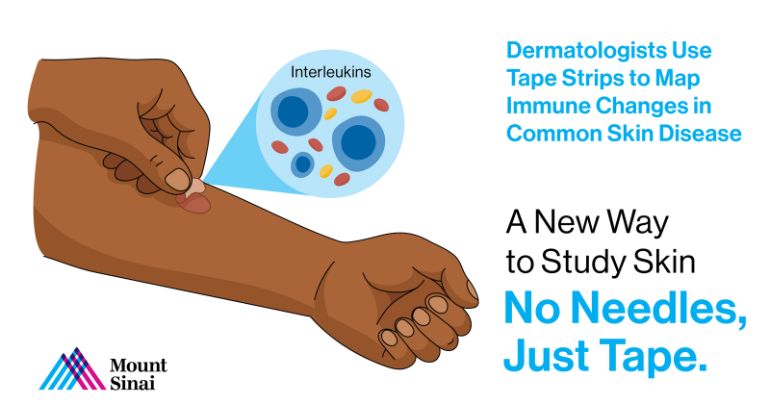
Mount Sinai Dermatologists Use Tape Strips to Map Immune Changes in Common Skin Disease
Jun 10, 2025 View All Press Releases