
Mount Sinai Researchers Enhance Screening Methods to Prevent Spread of Drug-Resistant Fungal Infections in Hospitals
Expanded protocols promote early detection in high-risk patients and prevent hospital outbreaks of Candida auris
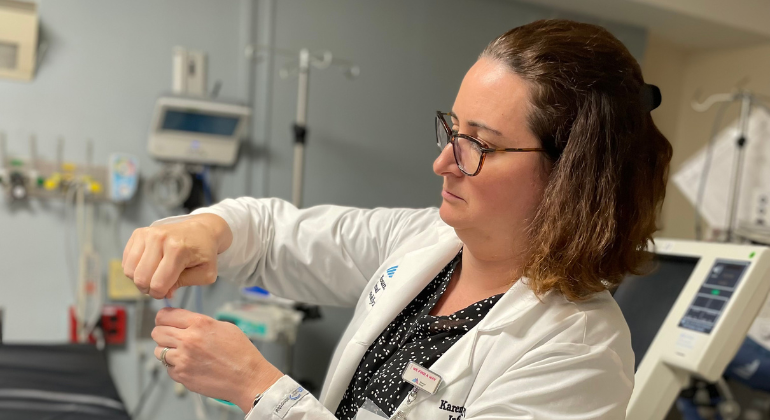
Study co-author Karen Brody, MSN, RN, GERO-BC, CIC, Assistant Director of Infection Prevention at Mount Sinai Brooklyn, swabs a hospital bed for ATP testing to ensure the surface is properly cleaned.
Mount Sinai researchers have enhanced hospital screening protocols for Candida auris, an often-drug-resistant fungal pathogen the Centers for Disease Control and Prevention considers an urgent global health threat. These new guidelines, published in an analysis in the American Journal of Infection Control on October 31, could promote early detection of the harmful fungus in high-risk patients and prevent hospital outbreaks.
C. auris, which emerged in New York City in 2016, is a fungus that can cause serious bloodstream, wound, and ear infections. It can affect the entire body and lead to severe complications, particularly in patients with weakened immune systems. The fungal pathogen can also spread easily in health care settings since it can survive on contaminated surfaces or medical devices for several weeks.
Experts at Mount Sinai have implemented expanded hospital admission screening protocols to identify patients with C. auris by screening all admitted patients who had lived in a nursing home within a month before admission, regardless of their specific risk factors. This enhanced screening was a shift from previous approaches that often vary across health care facilities and only screen people with more obvious risk factors, such as patients with a tracheostomy or those on a ventilator.
“Our findings demonstrate a significant advancement in infection prevention and patient safety, particularly within skilled nursing facility transfers,” said corresponding author Waleed Javaid, MD, MBA, MS, Professor of Medicine (Infectious Diseases) at the Icahn School of Medicine at Mount Sinai and Director of Infection Prevention and Control at Mount Sinai Downtown. “Response to Candida auris requires vigilance, rapid diagnosis, appropriate treatment, and stringent infection control protocols to limit its spread in health care facilities.”
In the retrospective review, the researchers screened all 591 patients for C. auris who were admitted to Mount Sinai Brooklyn from a nursing home from January 2022 to September 2023. They used these expanded screening protocols for one year and compared outcomes for that year to the nine-month period prior to the screening change. The experts found that 14 cases, or 2.4 percent, of the cohort tested positive for C. auris. Nine cases were considered high risk, while five cases were considered low risk at the time of screening. Ultimately, the new expanded screening identified eight cases that would have gone undiagnosed under the prior protocol. More cases were caught early, enabling the Mount Sinai team to quickly implement appropriate isolation, contact, and disinfection precautions to prevent further outbreaks.
“Our study supports the need for hospitals to adopt expanded screening protocols to enhance infection control practices,” said study co-author Scott Lorin, MD, MBA, President of Mount Sinai Brooklyn and Associate Professor of Medicine (Pulmonary, Critical Care and Sleep Medicine) at Icahn Mount Sinai. “Broader screening not only identifies cases early, but also allows for targeted precautions, reducing the risk of hospital-based outbreaks. The implementation of proactive protocols, based on community prevalence rates, can be a key tool in controlling the spread of this emerging global health threat.”
About the Mount Sinai Health System
Mount Sinai Health System is one of the nation’s leading integrated academic health systems and one of the largest in the New York metropolitan area. Its comprehensive system includes seven hospitals, more than 400 outpatient practices, over 600 research and clinical laboratories, the Icahn School of Medicine at Mount Sinai, the Graduate School of Biomedical Sciences, and the Mount Sinai Phillips School of Nursing. Together, the Health System comprises approximately 48,000 employees, more than 9,000 physicians, and 8,600 nurses.
As a leading learning health system, Mount Sinai combines clinical expertise with scientific discovery to improve patient care while training the next generation of health care and biomedical leaders. The Health System provides care across every stage of life, from prenatal care through geriatrics, while advancing personalized medicine through artificial intelligence, data science, and biomedical research.
Mount Sinai is consistently recognized among the nation’s leading academic health systems for patient care, research, and education. The Mount Sinai Hospital is ranked No. 1 in New York by Newsweek and No. 5 on the magazine’s World’s Best Hospitals list. The Icahn School of Medicine at Mount Sinai ranks No. 11 among U.S. medical schools and No. 1 among freestanding medical schools for National Institutes of Health funding, reflecting the strength of its scientific enterprise and leadership in biomedical research.