
Mount Sinai Receives $5 Million Gift for the Center for Ophthalmic Artificial Intelligence and Human Health
The John and Daria Barry Foundation will expand clinical and research programs on eye disease
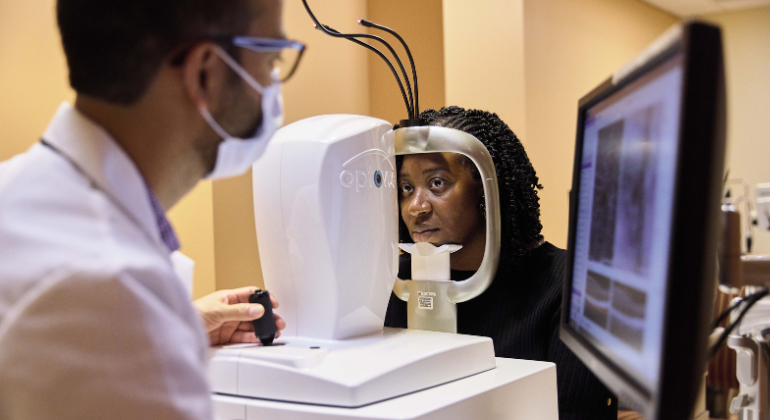
The Icahn School of Medicine has announced a $5 million gift from the John and Daria Barry Foundation for the Center for Ophthalmic Artificial Intelligence (AI) and Human Health. The Center, launched in 2023, will now carry the name “The Barry Family Center for Ophthalmic Artificial Intelligence and Human Health.” This gift will expand the Center’s clinical programs focused on equitable, primary care-based vision care and support research aimed at the early diagnosis of eye diseases and the creation of innovative risk assessments of systemic health conditions linked to eye disorders.
“We are extremely grateful to the Barry family for their generous and transformational gift to spur the growth and success of our innovative Center,” says James C. Tsai, MD, Delafield-Rodgers Professor and Chair of Ophthalmology at Icahn Mount Sinai and the Mount Sinai Health System, President of New York Eye and Ear Infirmary of Mount Sinai (NYEE), and inaugural Director of the Center. “We have made advances in raising the standard of vision care at Mount Sinai with new medical technologies that are expanding the boundaries of ophthalmic care for all of human health.”
“Glaucoma research is critically underfunded, despite the profound impact this disease has on millions worldwide, including my own family,” says Daria Barry. “By supporting Mount Sinai’s Center for Ophthalmic AI and Human Health, we aim to enable earlier diagnoses and more effective treatments while also ensuring that cutting-edge technology is accessible to all. We are proud to be part of this transformative initiative and confident it will push the boundaries of what’s possible in both ophthalmology and broader human health.”
The funds will be used to recruit a new Center director and a junior/mid-level AI scientist, support ongoing research initiatives, establish one of the first clinical ophthalmology fellowship programs in ophthalmic AI and digital health, and enhance the translation of research findings into clinical care and the educational curriculum for trainees.
In partnership with the Windreich Department of Artificial Intelligence and Human Health at Icahn Mount Sinai, the Center is advancing clinical innovation in AI-based diagnostic care in ophthalmology and population-based medical care.
Through this Center, Mount Sinai is incorporating AI into trainee and physician education, research, and the clinical setting for rapid diagnosis of eye diseases and conditions, including macular degeneration, diabetic retinopathy, glaucoma, hypertensive retinopathy, systemic conditions, and retinal tumors. Early detection and intervention can prevent vision loss and may also prevent heart attack and stroke, as NYEE researchers have identified deposits under retinal cells that may predict and/or be associated with an increased risk of cardiovascular and neurological conditions.
In addition, scientists and physicians at the Center are researching and implementing validated AI models across three initial areas: Mount Sinai’s tele-retina program, where primary care physicians use high-quality portable digital cameras to capture retinal images during annual patient exams; Mount Sinai’s ophthalmology tele-consult program, which provides timely diagnosis and triage of patients with eye emergencies by using sophisticated telemedicine platforms without relying on in-person consultations from ophthalmologists; and a program that expedites the diagnosis of patients who present with an acute eye stroke (central retinal artery occlusion) through advanced high-resolution imaging and collaborating with ophthalmologists, emergency medicine physicians, the stroke team, and interventional radiologists at several Mount Sinai emergency departments.
Researchers are analyzing data-embedded images from these programs and services by developing and using state-of-the-art AI algorithms and combining these findings with high-throughput genotyping data available at Icahn Mount Sinai. AI is helping to develop unique ocular biomarkers that can inform the pathophysiology of eye diseases, highlight health care disparities in eye disease, predict earlier onset of disease and progression, help to better monitor diseases and response to treatment, provide a framework for developing precision medicine strategies for these diseases, and streamline the performance of clinical trials.
About the Mount Sinai Health System
Mount Sinai Health System is one of the nation’s leading integrated academic health systems and one of the largest in the New York metropolitan area. Its comprehensive system includes seven hospitals, more than 400 outpatient practices, over 600 research and clinical laboratories, the Icahn School of Medicine at Mount Sinai, the Graduate School of Biomedical Sciences, and the Mount Sinai Phillips School of Nursing. Together, the Health System comprises approximately 48,000 employees, more than 9,000 physicians, and 8,600 nurses.
As a leading learning health system, Mount Sinai combines clinical expertise with scientific discovery to improve patient care while training the next generation of health care and biomedical leaders. The Health System provides care across every stage of life, from prenatal care through geriatrics, while advancing personalized medicine through artificial intelligence, data science, and biomedical research.
Mount Sinai is consistently recognized among the nation’s leading academic health systems for patient care, research, and education. The Mount Sinai Hospital is ranked No. 1 in New York by Newsweek and No. 5 on the magazine’s World’s Best Hospitals list. The Icahn School of Medicine at Mount Sinai ranks No. 11 among U.S. medical schools and No. 1 among freestanding medical schools for National Institutes of Health funding, reflecting the strength of its scientific enterprise and leadership in biomedical research.