
Mount Sinai Health System Researcher Receives $4 Million Grant From NIH to Study the Role of the Mammary Gland Secretome in Metabolic Health
Investigating a new frontier in understanding diseases like obesity and type 2 diabetes.
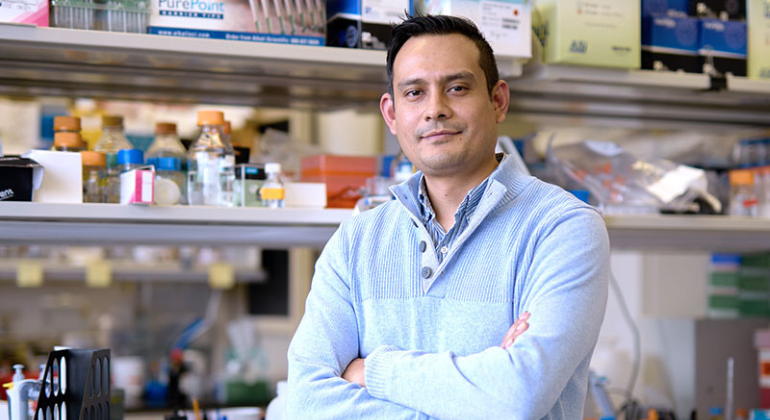
The National Institute of Diabetes and Digestive and Kidney Diseases (NIDDK) Catalyst Award program has awarded a $4 million, five-year grant to Prashant Rajbhandari, PhD, Assistant Professor of Medicine (Endocrinology, Diabetes and Bone Disease) at the Mount Sinai Diabetes, Obesity, and Metabolism Institute, to investigate a new frontier in understanding metabolic diseases like obesity and type 2 diabetes.
While much is known about how organs like the liver, fat tissue, and pancreas contribute to these conditions, Dr. Rajbhandari and his team are turning their focus to an overlooked player—the mammary gland. Their project is designated by the NIDDK as a High-Risk, High-Reward Research program.
“By using advanced technologies and machine learning that analyze single cells and proteins, the team and I hope to identify specific hormones produced by the mammary gland, which we call ‘mammokines,’” said Dr. Rajbhandari. “We believe mammokines could play a critical role in how the mammary gland communicates with different organs during breastfeeding and pregnancy and may influence obesity and diabetes in both mothers and offspring. Understanding these interactions might lead to new treatments or biomarkers for these diseases, particularly in women.”
The grant is part of the National Institutes of Health Director's Pioneer Award (DP1) mechanism. The DP1 mechanism was established to support an elite group of individual investigators who exhibit exceptional creativity and who are exploring bold and highly innovative research projects. The results of these projects have the potential to greatly impact areas relevant to the mission of NIDDK.
Dr. Rajbhandari’s study will explore how the mammary glands, particularly the cells lining the milk ducts, influence the body’s overall metabolic health. This research is inspired by the well-documented benefits of breastfeeding, which reduces the risk of diabetes and obesity for both mothers and their children. However, obesity can interfere with the normal function of the mammary gland, potentially impacting both maternal and child health.
This groundbreaking work could reveal how the mammary gland acts as an endocrine organ, potentially affecting the liver, pancreas, and fat tissue. The team will explore how these processes occur in both mice and humans, providing insights into the physiological impact of disrupted endocrine communication.
“This cutting-edge research represents a unique opportunity to make a critical impact on the fight against some of the most prevalent health issues of our time,” said Dr. Rajbhandari. “Obesity and diabetes affect millions worldwide, yet many of the mechanisms behind these diseases remain poorly understood. By investigating how mammokines affect organs like the liver and pancreas, this project could reveal entirely new pathways, potentially transforming the lives of countless lactating and non-lactating individuals.”
This innovative research aims to advance our understanding of metabolic health in women and may pave the way for new approaches to treating obesity and diabetes. The findings could also have implications for public health recommendations, especially regarding breastfeeding and maternal care.
About the Mount Sinai Health System
Mount Sinai Health System is one of the nation’s leading integrated academic health systems and one of the largest in the New York metropolitan area. Its comprehensive system includes seven hospitals, more than 400 outpatient practices, over 600 research and clinical laboratories, the Icahn School of Medicine at Mount Sinai, the Graduate School of Biomedical Sciences, and the Mount Sinai Phillips School of Nursing. Together, the Health System comprises approximately 48,000 employees, more than 9,000 physicians, and 8,600 nurses.
As a leading learning health system, Mount Sinai combines clinical expertise with scientific discovery to improve patient care while training the next generation of health care and biomedical leaders. The Health System provides care across every stage of life, from prenatal care through geriatrics, while advancing personalized medicine through artificial intelligence, data science, and biomedical research.
Mount Sinai is consistently recognized among the nation’s leading academic health systems for patient care, research, and education. The Mount Sinai Hospital is ranked No. 1 in New York by Newsweek and No. 5 on the magazine’s World’s Best Hospitals list. The Icahn School of Medicine at Mount Sinai ranks No. 11 among U.S. medical schools and No. 1 among freestanding medical schools for National Institutes of Health funding, reflecting the strength of its scientific enterprise and leadership in biomedical research.