
Mount Sinai Scientists Unravel How Psychedelic Drugs Interact with Serotonin Receptors to Potentially Produce Therapeutic Benefits
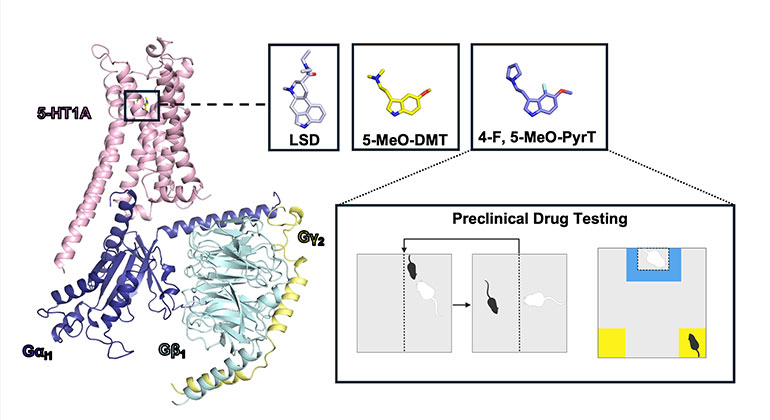
Researchers at the Icahn School of Medicine at Mount Sinai have shed valuable light on the complex mechanisms by which a class of psychedelic drugs binds to and activates serotonin receptors to produce potential therapeutic effects in patients with neuropsychiatric disorders such as depression and anxiety. In a study published May 8 in Nature, the team reported that certain psychedelic drugs interact with an underappreciated member of the serotonin receptor family in the brain known as 5-HT1A to produce therapeutic benefits in animal models.
“Psychedelics like LSD and psilocybin have entered clinical trials with promising early results, though we still don’t understand how they engage different molecular targets in the brain to trigger their therapeutic effects,” says first author Audrey Warren, a PhD candidate in the Graduate School of Biomedical Sciences at Icahn Mount Sinai “Our study highlights, for the first time, how serotonin receptors like 5-HT1A likely modulate the subjective effects of the psychedelic experience and also play a potentially pivotal role in their clinically observed therapeutic outcome.”
LSD and 5-MeO-DMT, a psychedelic found in the secretions of the Colorado River Toad, are known to mediate their hallucinogenic effects through the serotonin receptor 5-HT2A, though these drugs also activate 5-HT1A, a validated therapeutic target for treating depression and anxiety. Working closely with co-author Dalibor Sames, PhD, Professor in the Department of Chemistry at Columbia University, the team synthesized and tested 5-MeO-DMT derivatives in cell signaling assays and cryo-electron microscopy to identify the chemical components most likely to cause a drug to preferentially activate 5-HT1A over 5-HT2A. That exercise led to the discovery that a compound termed 4-F, 5-MeO-PyrT was the most 5-HT1A-selective compound in this series. Lyonna Parise, PhD, an instructor in the lab of Scott Russo, PhD, Director of the Center for Affective Neuroscience and the Brain and Body Research Center at Icahn Mount Sinai, then tested that lead compound in a mouse model of depression and showed that 4-F, 5-MeO-PyrT had antidepressant-like effects that are effectively mediated by 5-HT1A.
“We were able to fine-tune the 5-MeO-DMT/serotonin scaffold to obtain the maximum activity at the 5-HT1A interface and minimal activity at 5-HT2A,” explains senior author Daniel Wacker, PhD, Assistant Professor of Pharmacological Sciences and Neuroscience at Icahn Mount Sinai. “Our findings suggest that receptors other than 5-HT2A not only modulate behavioral effects stemming from psychedelics, but may substantially contribute to their therapeutic potential. In fact, we were pleasantly surprised by the strength of that contribution to 5-MeO-DMT, which is currently being tested in several clinical trials for depression. We believe our study will lead to a better understanding of the complex pharmacology of psychedelics that involve many receptor types.”
Indeed, researchers are hopeful based on their breakthrough findings that it may soon be possible to design novel psychedelic-derived medications that don’t possess the hallucinogenic properties of current drugs. Raising their expectations is the discovery that their lead compound – the most 5-HT1A-selective analog to 5-MeO-DMT – showed antidepressant effects without the 5-HT2A-related hallucinations.
Another near-term target for scientists is investigating the impact of 5-MeO-DMT in preclinical models of depression (given the research restrictions around psychedelic drugs, studies involving a 5-MeO-DMT derivative have been limited to animal models). “We’ve demonstrated that psychedelics have complex physiological effects that span many different receptor types,” emphasizes first author Warren, “and are now ready to build on that finding to develop improved therapeutics for a range of mental health disorders.”
Research reported in this press release was supported by the National Institute of General Medical Sciences; The National Institute of Mental Health; and the National Institute on Drug Abuse. The content is solely the responsibility of the authors and does not necessarily represent the official views of the National Institutes of Health.
About the Mount Sinai Health System
Mount Sinai Health System is one of the nation’s leading integrated academic health systems and one of the largest in the New York metropolitan area. Its comprehensive system includes seven hospitals, more than 400 outpatient practices, over 600 research and clinical laboratories, the Icahn School of Medicine at Mount Sinai, the Graduate School of Biomedical Sciences, and the Mount Sinai Phillips School of Nursing. Together, the Health System comprises approximately 48,000 employees, more than 9,000 physicians, and 8,600 nurses.
As a leading learning health system, Mount Sinai combines clinical expertise with scientific discovery to improve patient care while training the next generation of health care and biomedical leaders. The Health System provides care across every stage of life, from prenatal care through geriatrics, while advancing personalized medicine through artificial intelligence, data science, and biomedical research.
Mount Sinai is consistently recognized among the nation’s leading academic health systems for patient care, research, and education. The Mount Sinai Hospital is ranked No. 1 in New York by Newsweek and No. 5 on the magazine’s World’s Best Hospitals list. The Icahn School of Medicine at Mount Sinai ranks No. 11 among U.S. medical schools and No. 1 among freestanding medical schools for National Institutes of Health funding, reflecting the strength of its scientific enterprise and leadership in biomedical research.