Mount Sinai Researchers Uncover Early Signs in Gut Bacteria That Could Predict Peanut Allergy Development
Insights could impact approach to managing and preventing condition in children
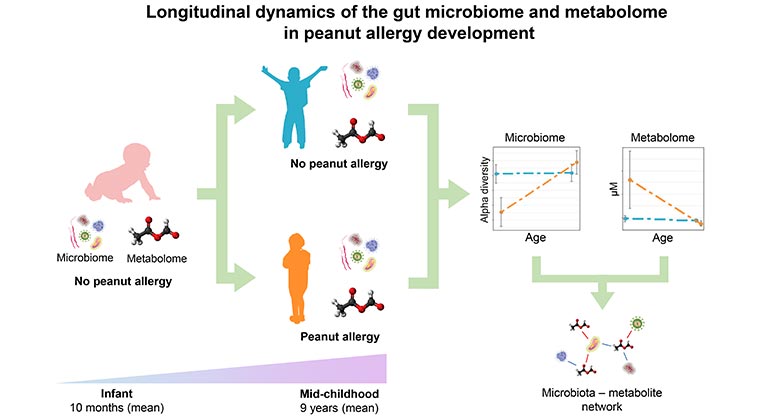
Graphical abstract: Babies who eventually develop peanut allergies have different gut bacteria patterns during childhood that produce different metabolites compared to children who don't develop the allergy.
A new study led by researchers at the Icahn School of Medicine at Mount Sinai has revealed key differences in gut bacteria and their metabolic byproducts in infants that may predict the development of peanut allergies by mid-childhood. The findings, published online August 22 in the Journal of Allergy and Clinical Immunology, could pave the way for new strategies to prevent or treat this increasingly common food allergy.
The multi-center longitudinal study monitored infants known to be at risk for allergies but who hadn't yet developed a peanut allergy. By analyzing fecal samples from infancy and later in childhood, the researchers were able to identify specific differences in gut bacteria and the metabolites they produce between children who did and did not develop a peanut allergy by around age 9.
Key findings of the study include:
- Infants who eventually developed peanut allergies had lower gut microbiome diversity during their early years.
- Specific classes of bacteria, including Clostridium and Bifidobacterium, and certain metabolites like butyrate and isovalerate were found in different patterns in children who developed peanut allergies.
- Metabolites associated with peanut allergy development were linked to the “histidine metabolism pathway” – a process in the body that breaks down and uses the protein building block histidine.
Senior author, Supinda Bunyavanich, MD, MPH, MPhil, the Mount Sinai Endowed Professor in Allergy and Systems Biology and Deputy Director of the Elliot and Roslyn Jaffe Food Allergy Institute, highlighted the significance of the study: "It's a major step forward to understand that specific patterns of gut bacteria and their metabolic products can be early indicators for the development of peanut allergies. This offers a unique perspective into potential preventive strategies that could have a profound impact on how we address peanut allergies in children."
However, Dr. Bunyavanich also cautioned against drawing premature conclusions: "While it's exciting to think our gut bacteria might influence our risk of developing allergies, it's crucial to note that altering a child's gut bacteria isn't yet an immediate solution. We need further research to truly harness these findings."
The study is one of the first of its kind to longitudinally track changes in gut bacteria and their byproducts from infancy to childhood, specifically in relation to peanut allergy development. The insights gleaned could lead to innovative approaches, such as probiotics or dietary interventions, to manage and prevent peanut allergies in children, improving countless lives.
The researchers acknowledge that while their findings present strong associations between the gut environment and peanut allergy development, it's not yet confirmed that these bacterial changes directly cause the allergy. Future studies with expanded sample sizes and clinical trials will be essential to strengthen these links.
This study was funded supported by the National Institutes of Health grants R01AI147028, U19AI066738, and U01AI066560. The study was also supported by grant numbers UL1 RR-025780 (National Jewish Health), UL1 TR-000067 (Mount Sinai), UL1 TR-000039 (University of Arkansas), UL1 TR-000083 (University of North Carolina), and UL1 TR-000424 (The Johns Hopkins University) from the National Center for Research Resources (NCRR), a component of the National Institutes of Health (NIH).
Study details: Chun Y, Grishin A, Rose R, et al. Longitudinal dynamics of the gut microbiome and metabolome in peanut allergy development. Journal of Allergy and Clinical Immunology. doi:10.1016/j.jaci.2023.08.012
About the Mount Sinai Health System
Mount Sinai Health System is one of the nation’s leading integrated academic health systems and one of the largest in the New York metropolitan area. Its comprehensive system includes seven hospitals, more than 400 outpatient practices, over 600 research and clinical laboratories, the Icahn School of Medicine at Mount Sinai, the Graduate School of Biomedical Sciences, and the Mount Sinai Phillips School of Nursing. Together, the Health System comprises approximately 48,000 employees, more than 9,000 physicians, and 8,600 nurses.
As a leading learning health system, Mount Sinai combines clinical expertise with scientific discovery to improve patient care while training the next generation of health care and biomedical leaders. The Health System provides care across every stage of life, from prenatal care through geriatrics, while advancing personalized medicine through artificial intelligence, data science, and biomedical research.
Mount Sinai is consistently recognized among the nation’s leading academic health systems for patient care, research, and education. The Mount Sinai Hospital is ranked No. 1 in New York by Newsweek and No. 5 on the magazine’s World’s Best Hospitals list. The Icahn School of Medicine at Mount Sinai ranks No. 11 among U.S. medical schools and No. 1 among freestanding medical schools for National Institutes of Health funding, reflecting the strength of its scientific enterprise and leadership in biomedical research.