
Ian Maze, PhD, Named 2022 Recipient of Jacob P. Waletzky Award by Society for Neuroscience
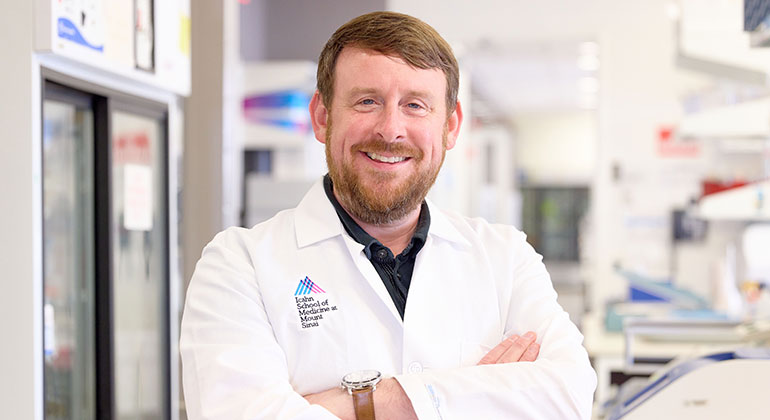
The Society for Neuroscience (SfN) has named Ian Maze, PhD, as the 2022 recipient of the Jacob P. Waletzky Award. The award, supported by the Waletzky Award Prize Fund and the Waletzky family, is granted to a young scientist whose independent research has led to significant conceptual and empirical contributions to the understanding of drug addiction.
Dr. Maze is a Professor of Neuroscience and Pharmacological Sciences, Director of the Center for Neural Epigenome Engineering, and Principal Investigator of the Laboratory for Mechanistic Neuroepigenetics and Disease at the Icahn School of Medicine at Mount Sinai.
Dr. Maze is a chromatin biologist and neuroscientist investigating the complex interplay between chromatin regulatory mechanisms and neural plasticity in the mammalian central nervous system. His multidisciplinary and integrative research involves the use of biochemical, biophysical, physiological, and behavioral analyses to explore the molecular underpinnings of neurodevelopmental and adult cognitive, psychiatric, and substance use disorders.
“Dr. Maze is an outstanding scientist who is not afraid to challenge conventional scientific theories in pursuit of novel pathways towards our understanding and treatment of drug addiction,” said Eric J. Nestler, MD, PhD, Dean for Academic Affairs, Nash Family Professor of Neuroscience, and Director of The Friedman Brain Institute at Icahn Mount Sinai, Chief Scientific Officer of the Mount Sinai Health System, and past president of the Society for Neuroscience. “Ian has already made significant contributions to The Friedman Brain Institute here at Mount Sinai and to the field of neuroscience, and he is just getting started. We are thrilled and profoundly grateful to SfN and the Waletzky family for their recognition of Dr. Maze’s early-career excellence and for the investment they’ve made to advance his exceptional, innovative research.”
Dr. Maze was one of the early pioneers of the addiction neuroepigenetics field, and his lab’s latest research has upended the long-held scientific dogma that the neurotransmitters dopamine and serotonin (which also contribute to drug addiction and depression) serve only as messengers within the central nervous system, allowing brain cells to communicate with each other. In addition to their roles as messengers, he has found, the chemicals are able to change the fundamental biology and behavior of brain cells by directly attaching to proteins.
Dr. Maze and his lab team extract proteins from brain cells in animal models and postmortem tissues and examine how they are chemically modified or changed. His team has identified thousands of proteins modified by dopamine and serotonin in the brain using mass spectrometry and other approaches, and they continue to search for new protein modifications and how they affect brain cells. Another avenue of research is exploring specific categories of drugs of abuse that may also function by directly or indirectly modifying proteins in our cells. In recent studies from 2020 and 2022 on cocaine and opioid dependence, published in Science and Neuropsychopharmacology respectively, Dr. Maze and team showed that by manipulating these types of marks in the brain’s reward circuitry in animal models they could reduce the tendency to relapse into addiction.
“It is truly a tremendous honor to receive this award and be able to follow in the footsteps of so many incredible researchers who have contributed so significantly to the addiction field. I would like to thank the Waletzky family, as well as the SfN, for their generous support of our work,” Dr. Maze said.
Among other accolades, Dr. Maze was named a Howard Hughes Medical Institute Investigator in 2021. He is a recipient of the 2022 McKnight Brain Disorder Award, the 2019 Dr. Harold and Golden Laport Basic Research Award, the 2019 Presidential Early Career Award for Scientists and Engineers, the 2016 Sloan Foundation Fellowship in Neuroscience, and the 2015 MQ: Transforming Mental Health Research Fellowship Award.
Dr. Maze received the award on Saturday, November 12 at the beginning of the Presidential Special Lecture during SfN Neuroscience 2022in San Diego.
About the Mount Sinai Health System
Mount Sinai Health System is one of the nation’s leading integrated academic health systems and one of the largest in the New York metropolitan area. Its comprehensive system includes seven hospitals, more than 400 outpatient practices, over 600 research and clinical laboratories, the Icahn School of Medicine at Mount Sinai, the Graduate School of Biomedical Sciences, and the Mount Sinai Phillips School of Nursing. Together, the Health System comprises approximately 48,000 employees, more than 9,000 physicians, and 8,600 nurses.
As a leading learning health system, Mount Sinai combines clinical expertise with scientific discovery to improve patient care while training the next generation of health care and biomedical leaders. The Health System provides care across every stage of life, from prenatal care through geriatrics, while advancing personalized medicine through artificial intelligence, data science, and biomedical research.
Mount Sinai is consistently recognized among the nation’s leading academic health systems for patient care, research, and education. The Mount Sinai Hospital is ranked No. 1 in New York by Newsweek and No. 5 on the magazine’s World’s Best Hospitals list. The Icahn School of Medicine at Mount Sinai ranks No. 11 among U.S. medical schools and No. 1 among freestanding medical schools for National Institutes of Health funding, reflecting the strength of its scientific enterprise and leadership in biomedical research.
Two Leading Mount Sinai Brain Scientists Elected to the National Academy of Sciences
May 05, 2022 View All Press Releases

Mount Sinai Neurobiologist Selected as a Howard Hughes Medical Institute Investigator
Sep 23, 2021 View All Press Releases