Mount Sinai Awarded Prestigious $4 Million Grant to Launch Skin Biology and Diseases Resource-based Center


The Icahn School of Medicine at Mount Sinai is establishing a Skin Biology and Diseases Resource-based Center (SBDRC), funded by a $4 million, five-year P30 grant from the National Institutes of Health and the National Institute of Arthritis and Musculoskeletal and Skin Diseases (NIAMS). The Mount Sinai SBDRC will serve as a hub for research in skin biology and skin diseases throughout the Mount Sinai Health System, New York City, and the entire tri-state region—one of only six SBDRCs nationwide supported by a NIAMS grant.
The Mount Sinai SBDRC will be directed by Elena Ezhkova, PhD, Professor of Cell, Developmental, and Regenerative Biology, and Dermatology, in the Black Family Stem Cell Institute at Icahn Mount Sinai. She is an internationally recognized leader in the study of skin epigenetics. Dr. Ezhkova’s most recent study, published in Developmental Cell, found that ultraviolet light exposure produces epigenetic changes in the epidermis to induce skin pigmentation.
“This new Center will continue our efforts at Mount Sinai to accelerate research in skin biology and diseases, and promote translation of that understanding to benefit our patients across the entire Health System,” said Dr. Ezhkova. “We will also ensure a vibrant future for skin biology and diseases research by aiding the early careers and development of outside investigators and physician-scientists through training and financial support.”
Sarah Millar, PhD, Director of the Black Family Stem Cell Institute and the Lillian and Henry M. Stratton Professor of Gene and Cell Medicine, and Emma Guttman, MD, PhD, the Waldman Professor of Dermatology, and System Chair of the Kimberly and Eric J. Waldman Department of Dermatology, at Icahn Mount Sinai, will serve as Associate Co-Directors of the Center.
The Center will use technical innovations, high-end infrastructure, and computing power available at Mount Sinai to advance and support skin research, and will embed experts in gene editing, genomics, and bioinformatics within skin research labs to break down interdisciplinary communication barriers. The SBDRC program will also provide in-person and virtual events, such as seminars and research-in-progress talks, to facilitate collaboration in cutaneous biology and diseases. The Center will promote research and innovation through three resource cores: Skin Disease Modeling; Skin Genomics, Transcriptomics, and Epigenetics; and Data Analysis and Integration.
“Research in skin biology is extremely strong at Mount Sinai and we have recently recruited additional highly talented faculty in this area,” said Dr. Millar, an expert in skin development, stem cells, and regeneration. “The SBDRC will provide a really important platform allowing us to synergize our research as well as increasing our interactions with new SBDRC members at other institutions.”
Dr. Guttman, a world-renowned expert in the molecular and cellular pathomechanisms of inflammatory skin diseases, said the grant will be a vital contribution to the future of dermatology research and help foster additional discoveries in skin diseases.
“The Skin Biology and Diseases Resource-based Center will be very important to foster additional dermatology research at Mount Sinai—both on model systems and at the human interface—and will assist our investigators and outside investigators with their skin-related research,” she said.
About the Mount Sinai Health System
Mount Sinai Health System is one of the nation’s leading integrated academic health systems and one of the largest in the New York metropolitan area. Its comprehensive system includes seven hospitals, more than 400 outpatient practices, over 600 research and clinical laboratories, the Icahn School of Medicine at Mount Sinai, the Graduate School of Biomedical Sciences, and the Mount Sinai Phillips School of Nursing. Together, the Health System comprises approximately 48,000 employees, more than 9,000 physicians, and 8,600 nurses.
As a leading learning health system, Mount Sinai combines clinical expertise with scientific discovery to improve patient care while training the next generation of health care and biomedical leaders. The Health System provides care across every stage of life, from prenatal care through geriatrics, while advancing personalized medicine through artificial intelligence, data science, and biomedical research.
Mount Sinai is consistently recognized among the nation’s leading academic health systems for patient care, research, and education. The Mount Sinai Hospital is ranked No. 1 in New York by Newsweek and No. 5 on the magazine’s World’s Best Hospitals list. The Icahn School of Medicine at Mount Sinai ranks No. 11 among U.S. medical schools and No. 1 among freestanding medical schools for National Institutes of Health funding, reflecting the strength of its scientific enterprise and leadership in biomedical research.
New Research Sheds Light on Why Eczema So Often Begins in Childhood
Feb 25, 2026 View All Press Releases
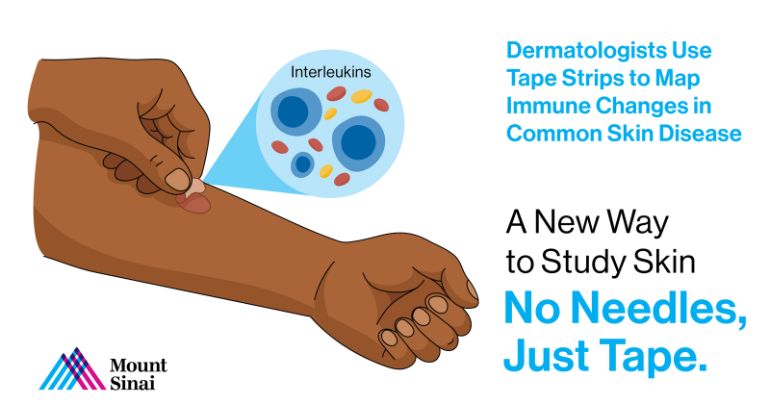
Mount Sinai Dermatologists Use Tape Strips to Map Immune Changes in Common Skin Disease
Jun 10, 2025 View All Press Releases