
Gold Nanoparticles Used in Photothermal Therapy Shown to be Safe and Effective Treatment for Prostate Cancer

Biocompatible gold nanoparticles designed to convert near-infrared light to heat have been shown to safely and effectively ablate low- to intermediate-grade tumors within the prostate, according to a study conducted at the Icahn School of Medicine and published in the journal Proceedings of the National Academy of Sciences. This treatment could offer patients a targeted therapy option that would preserve critical structures within the prostate, thus avoiding side effects associated with whole-gland treatment such as prostatectomies.
Prostate cancer is the second leading cause of cancer deaths in men in the United States¾11 percent of men will be diagnosed with the disease in their lifetime. Removal or other whole-gland treatment of the prostate carries risks of urinary incontinence and erectile dysfunction. However, technological advances have provided clinicians with options for focal therapies with fewer complications.
In this study, researchers tested the effectiveness of AuroLase® Therapy, a treatment from medical device company Nanospectra Biosciences that is based on technology invented at Rice University by engineer and chemist Naomi Halas, PhD, and Duke University bioengineer Jennifer West, PhD. The Principal Investigator and lead author, Ardeshir Rastinehad, DO, Associate Professor of Urology, and Radiology, at the Icahn School of Medicine at Mount Sinai, invented the technique used in the clinical trial to target and treat the prostate cancer cells using a custom-built MR US fusion guided platform in collaboration with Philips Healthcare. AuroLase® uses gold-silica nanoshells (GSN), particles Dr. Halas invented that are composed of a silica core and a gold shell with a diameter of 150 nanometers. AuroShells® are designed to absorb energy from near-infrared light and convert it to heat, resulting in selective hyperthermic cell death, without affecting adjacent non-tumorous tissue. The treatment was effectively demonstrated in previous cell studies and animal models. Following treatment, the particles are cleared through the liver, while some remain sequestered in the liver and spleen. There are no known side effects.
Sixteen men aged 58 to 79 with low- to intermediate-grade prostate cancer (Gleason score of 4+3) received GSN infusion. All were diagnosed and treated at The Mount Sinai Hospital using a targeted biopsy technique called magnetic resonance-ultrasound fusion imaging, which uses MRI technology to extract a tissue sample directly from the tumor. Patients underwent GSN infusion and high-precision laser ablation, and received an MRI of the prostate 48-72 hours after the procedure, MRI-targeted fusion biopsies at 3 and 12 months, and a standard biopsy at 12 months. Patients were discharged on the same day as the procedure after several hours of monitoring.
GSN-mediated focal laser ablation was successful in 87.5 percent of lesions treated at one year of follow-up. The goal of researchers was to find an eradication of cancer cells during biopsy.
“Gold-silica nanoshells infusion allows for a focused therapy that treats the cancer, while sparing the rest of the prostate, thus preserving a patient’s quality of life by reducing unwanted side effects, which could include erectile dysfunction and/or the leakage of urine,” said Dr. Rastinehad.
“Mount Sinai’s interventional urology program is research-driven and offers patients minimally invasive treatment therapies that improve quality of life,” said Ash Tewari, MBBS, MCh, Chair of the Department of Urology at the Mount Sinai Health System and the Kyung Hyun Kim, MD Professor of Urology at the Icahn School of Medicine at Mount Sinai. “Dr. Rastinehad’s gold nanoparticle research shows that patients are not only benefiting from this treatment, but also experiencing minimal side effects.”
Dr. Halas, Rice's Stanley C. Moore Professor of Electrical and Computer Engineering and director of Rice's Laboratory for Nanophotonics, invented gold nanoshells. Dr. Halas and Dr. West, the Fitzpatrick Family University Professor of Engineering at Duke University, co-invented the nanoshell-based treatment for photothermal ablation of cancer, which was licensed from Rice by Nanospectra Biosciences.
Researchers from Rice University, Duke University, the University of Michigan, and the University of Texas Health Science Center participated in this study. Funding support was provided by Nanospectra Biosciences. Dr. Rastinehad is a consultant for Nanospectra Biosciences.
About the Mount Sinai Health System
Mount Sinai Health System is one of the nation’s leading integrated academic health systems and one of the largest in the New York metropolitan area. Its comprehensive system includes seven hospitals, more than 400 outpatient practices, over 600 research and clinical laboratories, the Icahn School of Medicine at Mount Sinai, the Graduate School of Biomedical Sciences, and the Mount Sinai Phillips School of Nursing. Together, the Health System comprises approximately 48,000 employees, more than 9,000 physicians, and 8,600 nurses.
As a leading learning health system, Mount Sinai combines clinical expertise with scientific discovery to improve patient care while training the next generation of health care and biomedical leaders. The Health System provides care across every stage of life, from prenatal care through geriatrics, while advancing personalized medicine through artificial intelligence, data science, and biomedical research.
Mount Sinai is consistently recognized among the nation’s leading academic health systems for patient care, research, and education. The Mount Sinai Hospital is ranked No. 1 in New York by Newsweek and No. 5 on the magazine’s World’s Best Hospitals list. The Icahn School of Medicine at Mount Sinai ranks No. 11 among U.S. medical schools and No. 1 among freestanding medical schools for National Institutes of Health funding, reflecting the strength of its scientific enterprise and leadership in biomedical research.
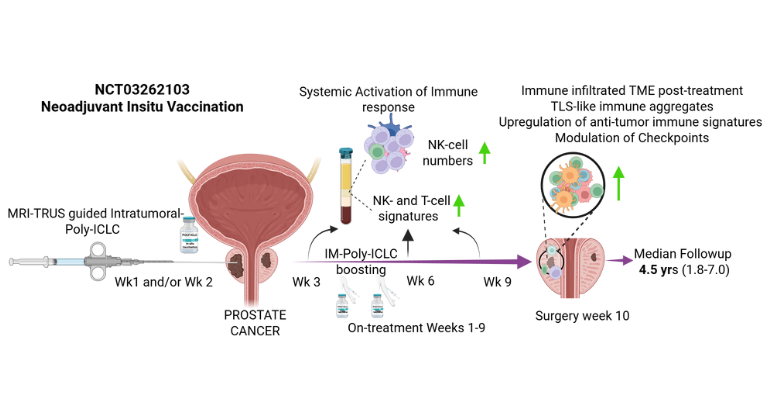
Early Clinical Trial Tests Immune-Boosting Therapy Before Prostate Cancer Surgery
Oct 30, 2025 View All Press Releases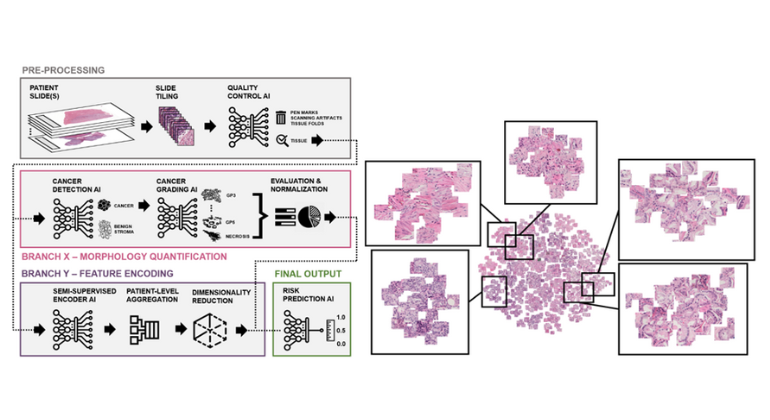
New AI Tool by Mount Sinai Researchers Could Reshape Prostate Cancer Care
Sep 23, 2024 View All Press Releases

Mount Sinai Receives $4 Million Gift to Support Prostate Health and Urology Department
Oct 28, 2020 View All Press ReleasesMount Sinai Receives $1 Million Grant for Prostate Cancer Research
Dec 05, 2019 View All Press Releases