
Presence of Pelvic Inflammation in Prostate Cancer Patients May Drive Cancer Recurrence or Cancer Spread, Mount Sinai Study Finds

Journal: Cancers
Paper Title: “Association between Incidental Pelvic Inflammation and Aggressive Prostate Cancer”
First and Corresponding Author: Dimple Chakravarty, PhD, Assistant Professor of Urology, Icahn School of Medicine at Mount Sinai
Senior Author: Ashutosh Tewari, MD, Chair of Urology, Mount Sinai Health System
Background on the Condition: Inflammation is a known driver of carcinogenesis which is the initiation of cancer formation. A Mount Sinai research team observed that prostate cancer patients with pelvic inflammation had poor outcomes. This is the first study to look at the link between pelvic inflammation and prostate cancer biology and outcomes.
What the Paper is About: This study reports a significant association of pelvic inflammation with advanced prostate cancer in a large cohort of men undergoing robot-assisted laparoscopic prostatectomy (RALP) for localized prostate cancer. Prostate cancer patients with pelvic inflammation had elevated expression of inflammation-associated genes and cancer-driving pathways in their tumors. Increased systemic inflammation with activation of the IL6-STAT pathway was seen in prostate cancer patients with pelvic inflammation. The presence of pelvic inflammation in prostate cancer patients suggests aggressive disease with a potential to develop biochemical recurrence and metastasis. This study is highly relevant as it allows us to closely follow prostate cancer patients with pelvic inflammation for metastasis. It also suggests that inhibiting the STAT-IL6 pathway would benefit these patients.
Bottom Line: Pelvic inflammation was associated with adverse pathology and higher biochemical recurrence rates in prostate cancer patients. Prostate cancer patients with pelvic inflammation had elevated expression of inflammation-associated genes and cancer-driving pathways in their tumors that drive reoccurrence or metastasis.
Why the Research is Important: Tumor inflammation promotes prostate cancer carcinogenesis. However, the implications of pelvic inflammation and its effect on prostate cancer have never been studied. In this study, researchers retrospectively investigated the association of pelvic inflammation with PCa aggressiveness and its impact on oncological outcomes in a large cohort of men undergoing RALP for localized PCa. Overall, pelvic inflammation was a significant predictor of AP in both univariate and multivariate analyses.
Quotes: “We have observed that prostate cancer patients with adhesions or scar tissues had a higher likelihood of aggressive disease. With further in-depth analysis, we discovered that pelvic inflammation is a driver of aggressive prostate phenotype. Until now, chronic inflammation within the prostate was considered a significant contributor to prostate cancer progression. However, our studies, for the first time, demonstrate that inflammation away from the prostate could be equally important. Therefore, managing inflammation in high-risk prostate cancer patients is critical and could be achieved by diet and other intervention strategies,” says Dr. Ash Tewari.
“This study fundamentally contributes to the growing literature demonstrating inflammation’s negative impact on cancer progression. The role of pelvic inflammation in prostate cancer progression has never been studied, and our study in a large cohort of patients provides mechanistic insights that could explain how pelvic inflammation contributes to prostate cancer progression and biochemical recurrence. We are pursuing multi-institutional collaborations to validate our findings in other cohorts. Our long-term objective is to develop blood or urine-based biomarker to monitor inflammation status in our prostate cancer patients,” adds Dr. Dimple Chakravarty, the lead author.
About the Mount Sinai Health System
Mount Sinai Health System is one of the nation’s leading integrated academic health systems and one of the largest in the New York metropolitan area. Its comprehensive system includes seven hospitals, more than 400 outpatient practices, over 600 research and clinical laboratories, the Icahn School of Medicine at Mount Sinai, the Graduate School of Biomedical Sciences, and the Mount Sinai Phillips School of Nursing. Together, the Health System comprises approximately 48,000 employees, more than 9,000 physicians, and 8,600 nurses.
As a leading learning health system, Mount Sinai combines clinical expertise with scientific discovery to improve patient care while training the next generation of health care and biomedical leaders. The Health System provides care across every stage of life, from prenatal care through geriatrics, while advancing personalized medicine through artificial intelligence, data science, and biomedical research.
Mount Sinai is consistently recognized among the nation’s leading academic health systems for patient care, research, and education. The Mount Sinai Hospital is ranked No. 1 in New York by Newsweek and No. 5 on the magazine’s World’s Best Hospitals list. The Icahn School of Medicine at Mount Sinai ranks No. 11 among U.S. medical schools and No. 1 among freestanding medical schools for National Institutes of Health funding, reflecting the strength of its scientific enterprise and leadership in biomedical research.
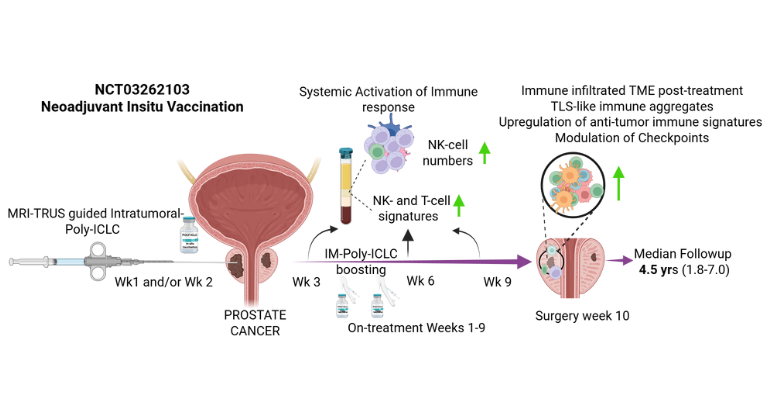
Early Clinical Trial Tests Immune-Boosting Therapy Before Prostate Cancer Surgery
Oct 30, 2025 View All Press Releases

New AI Tool by Mount Sinai Researchers Could Reshape Prostate Cancer Care
Sep 23, 2024 View All Press Releases
Mount Sinai Health System Launches Mobile Prostate Cancer Screening Unit in New York City
Apr 01, 2022 View All Press ReleasesMount Sinai and Man Cave Health Launch Sports-Themed Resource Center
Jan 02, 2019 View All Press Releases